
Why the 2026 Oscars Finally Rewarded ‘Systemic Friction’ and ‘Cultural Outsourcing’
Why the 2026 Oscars Finally Rewarded ‘Systemic Friction’ and ‘Cultural Outsourcing’: Morphokinetics™ Narrative Pacing
Minute-by-minute audience retention risk vs. narrative tension. Identifies structural sag points and retention thresholds.
Why the 2026 Oscars Finally Rewarded ‘Systemic Friction’ and ‘Cultural Outsourcing’
We usually look to the Oscars for pure escapism, a celebration of glittering movie stars and larger-than-life heroes saving the day. But if you look closely at the slate of winners from the 98th Academy Awards, the “invincible hero” was completely shut out.
Instead, the Academy handed its highest honours to stories about people being crushed by the very systems they trusted.
Look at Paul Thomas Anderson’s One Battle After Another, which swept the night with Best Picture, Best Director, and Best Adapted Screenplay. It isn’t a traditional underdog story; it’s a gruelling, 161-minute saga about betrayal and the exhausting search for justice within a compromised system. Similarly, Ryan Coogler taking home Best Original Screenplay (and Michael B. Jordan winning Best Actor) for Sinners proves that our definition of “horror” has evolved. The scariest monsters are no longer supernatural; they are societal and administrative.
The Insight: The Era of “Administrative Survivors”
The Academy’s voting block is reflecting a global psychological shift. We are suffering from Systemic Friction. Audiences no longer inherently believe that one hero can fix a broken world, and the Oscars just validated that anxiety. We are rewarding characters who don’t necessarily “win,” but simply manage to survive the bureaucratic rot around them.
Furthermore, the historic Best Original Song win for “Golden” from K-pop Demon Hunters perfectly encapsulates our theory of Cultural Outsourcing. When the local reality feels too heavy, we export our joy and escapism to polished, global utopias like South Korea.
What This Means For You
The era of the “Aspirational Saviour” is officially on pause. When you watch this year’s Best Picture winner, pay attention to the exhaustion of the protagonist. In 2026, the ultimate heroic act isn’t saving the world — it’s just keeping your own identity intact against a system designed to erase it.
Below are five deep dives into the real reasons these films took home the gold. Grab your coffee, and let’s look beneath the gold plating.
✍️ Supplement 1: The ‘Systemic Friction’ Masterclass
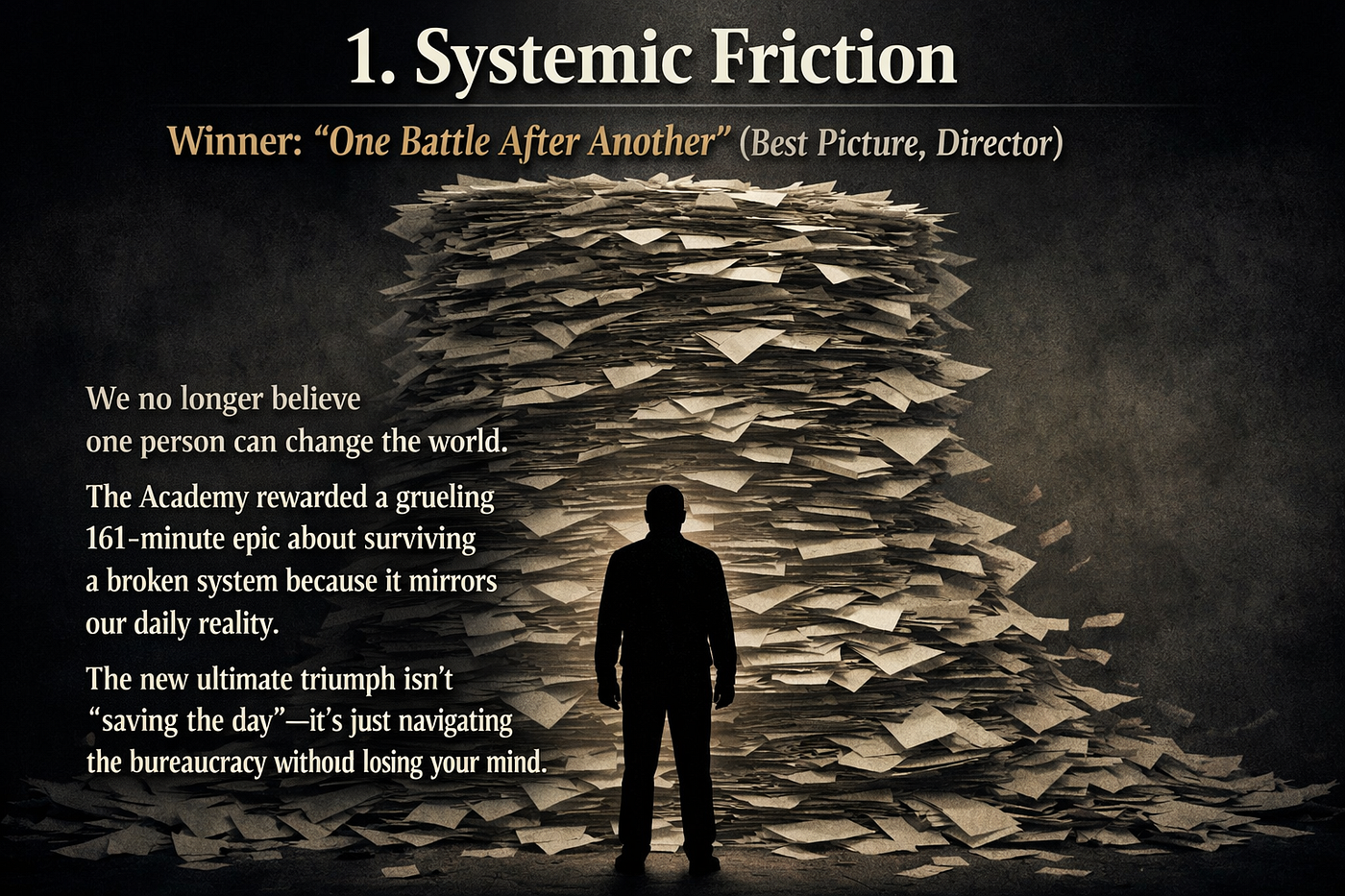
The Death of the Hero’s Journey: Why ‘One Battle After Another’ Won Best Picture
The Excerpt:
Paul Thomas Anderson’s 161-minute epic didn’t win Best Picture because it offered hope; it won because it validated our collective exhaustion. By entirely abandoning the traditional “Hero’s Journey,” the film proved that in 2026, simply surviving a broken system is the ultimate cinematic triumph.
The Deep Decode:
For decades, Hollywood conditioned us to believe in the “Aspirational Saviour.” If you fight hard enough, you defeat the villain, fix the system, and win the day. One Battle After Another brutally dismantles this myth. Following a group of left-wing ex-revolutionaries navigating a labyrinth of betrayal and bureaucratic dead-ends, the film’s pacing is intentionally gruelling. It mimics the Systemic Friction we all feel in our daily lives — the endless emails, the unyielding algorithms, the institutions that refuse to work.
Sean Penn’s Oscar-winning supporting performance isn’t built on explosive monologues; it’s built on the quiet, hollowed-out stare of a man who realises the game was rigged from the start.
The Grey Verdict:
This is the new blueprint for prestige cinema. We are no longer a society that believes one person can change the world. We are a society that just wants to make it through the week with our sanity intact. The Academy didn’t reward a movie; they rewarded a mirror.
✍️ Supplement 2: The Rise of ‘Institutional Noir’
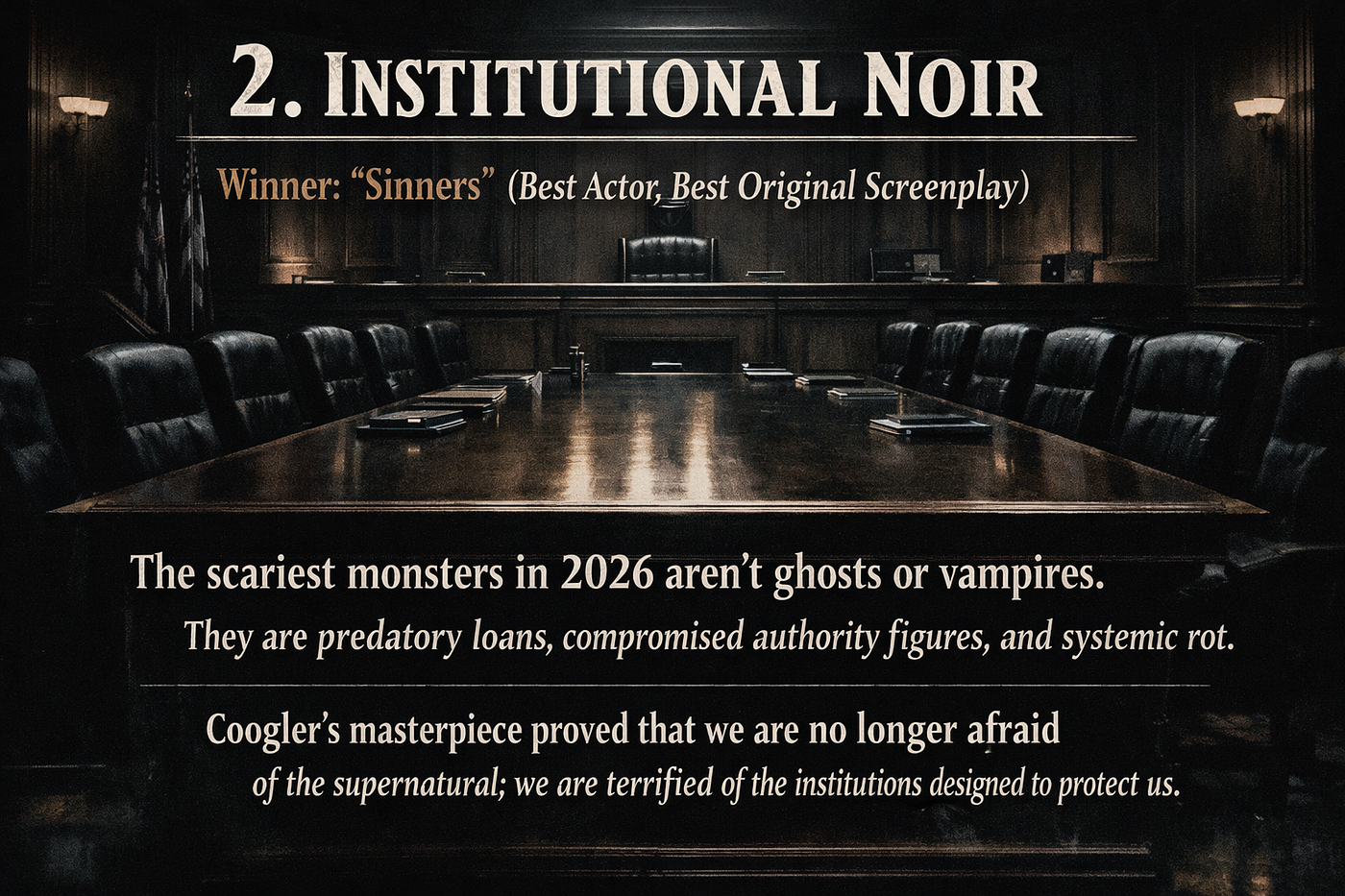
Redefining the Monster: Why Ryan Coogler’s ‘Sinners’ is a Masterpiece of Modern Terror
The Excerpt:
By securing Best Original Screenplay and Best Actor for Michael B. Jordan, Sinners officially retired the supernatural jump-scare. Coogler’s terrifying vision proves that vampires and ghosts are no longer scary — societal rot, historical guilt, and institutional predation are the true modern monsters.
The Deep Decode:
What scares the 2026 audience? It isn’t a creature hiding under the bed; it’s a predatory loan, an unverified allegation, or a deeply compromised local authority. Coogler brilliantly hijacked the vampire genre to create a masterpiece of Institutional Noir.
Michael B. Jordan’s devastating, Oscar-winning performance works because he isn’t fighting an otherworldly evil; he is fighting the inherited trauma and systemic decay of his own environment. The horror in Sinners is administrative and societal. The “bloodsuckers” are the institutions designed to drain the life out of marginalised communities, making the terror feel suffocatingly real.
The Grey Verdict:
Sinners won because it recognised a fundamental shift in audience psychology: you can outrun a monster, but you cannot outrun a broken system.
✍️ Supplement 3: ‘The Fragility of Permanence’
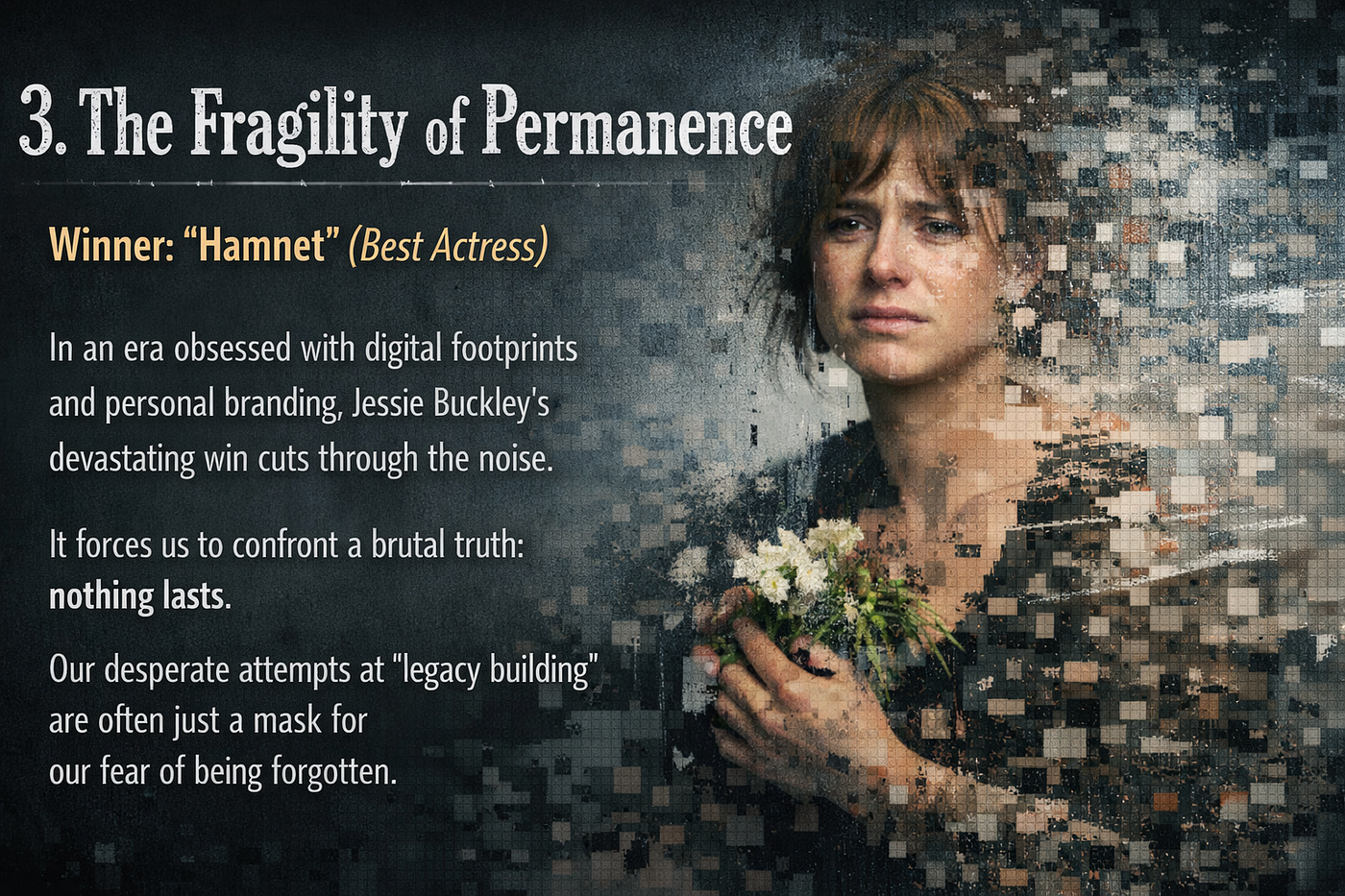
The Illusion of Legacy: Decoding Jessie Buckley’s Best Actress Win in ‘Hamnet’
The Excerpt:
Jessie Buckley’s harrowing victory for Hamnet taps into our deepest unspoken anxiety: the realisation that nothing lasts. In an era obsessed with digital footprints and brand building, this film forces us to confront the terrifying fragility of memory, family, and legacy.
The Deep Decode:
We live in an era of obsessive documentation. We record every meal, every milestone, and every thought, desperate to achieve a sense of permanence. Hamnet cuts through this modern delusion like a scalpel. By focusing on the grief of losing a child — and the subsequent creation of Shakespeare’s most famous play — the film asks a brutal question: Does art actually immortalise the people we love, or does it just commodify our grief?
Buckley’s performance is a masterclass in raw, unvarnished loss. She doesn’t give us the clean, Hollywood version of mourning. She gives us the messy, terrifying reality that the people we love can vanish, and no amount of “legacy-building” can bring them back.
The Grey Verdict:
The Academy rewarded Hamnet because it acts as a necessary anchor in our hyper-digital world, reminding us that permanence is a myth, and our desperate attempts to “leave a mark” are often just a mask for our fear of being forgotten.
✍️ Supplement 4: The ‘Cultural Outsourcing’ Phenomenon
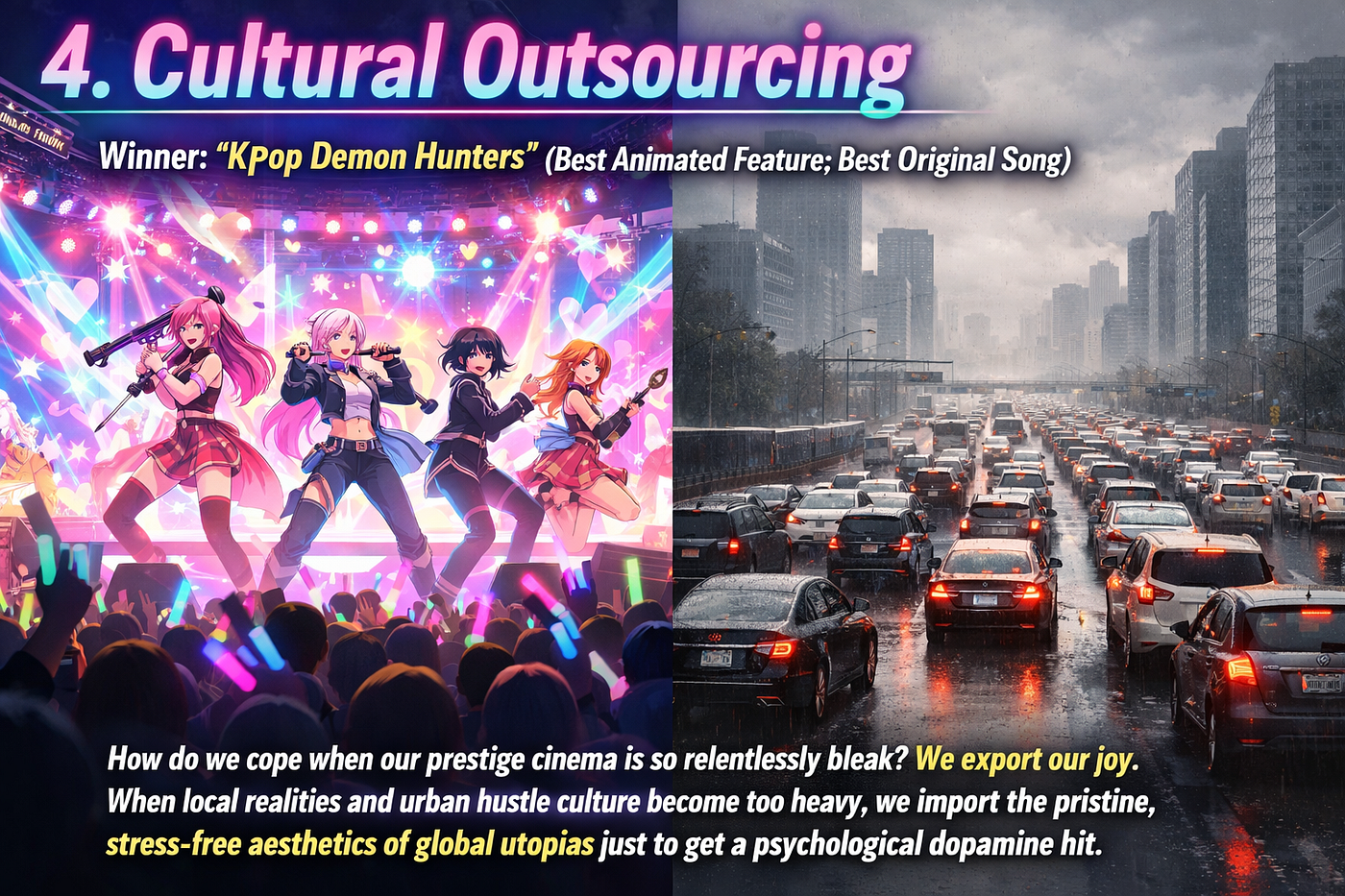
Exporting Our Joy: Why ‘KPop Demon Hunters’ Was the Most Important Win of the Night
The Excerpt: Earning historic wins for Best Animated Feature and Best Original Song, KPop Demon Hunters isn’t just a colourful distraction; it is the ultimate proof of “Cultural Outsourcing.” When our local realities become too heavy, we project our need for heroism and joy onto hyper-polished global utopias.
The Deep Decode:
If One Battle After Another and Sinners represent our systemic exhaustion, KPop Demon Hunters represent our coping mechanism. Why did a neon-drenched, high-BPM animated fantasy resonate so deeply with Academy voters and global audiences alike?
Because we are exhausted by local grit. The urban Gen-Z and Millennial audience is experiencing severe burnout. We no longer look to our own backyards for escapism. Instead, we engage in Cultural Outsourcing — we import the pristine aesthetic, flawless choreography, and emotional order of South Korean pop culture to soothe our own chaotic anxieties. The Oscar-winning track “Golden” is the anthem of a generation desperate for a stress-free reality.
The Grey Verdict:
This win solidifies that “Algorithm-Bait” isn’t inherently soulless if it gives an exhausted audience exactly the psychological dopamine hit they need to survive the week.
✍️ Supplement 5: ‘Tech Anxiety’ Disguised as Gothic Horror
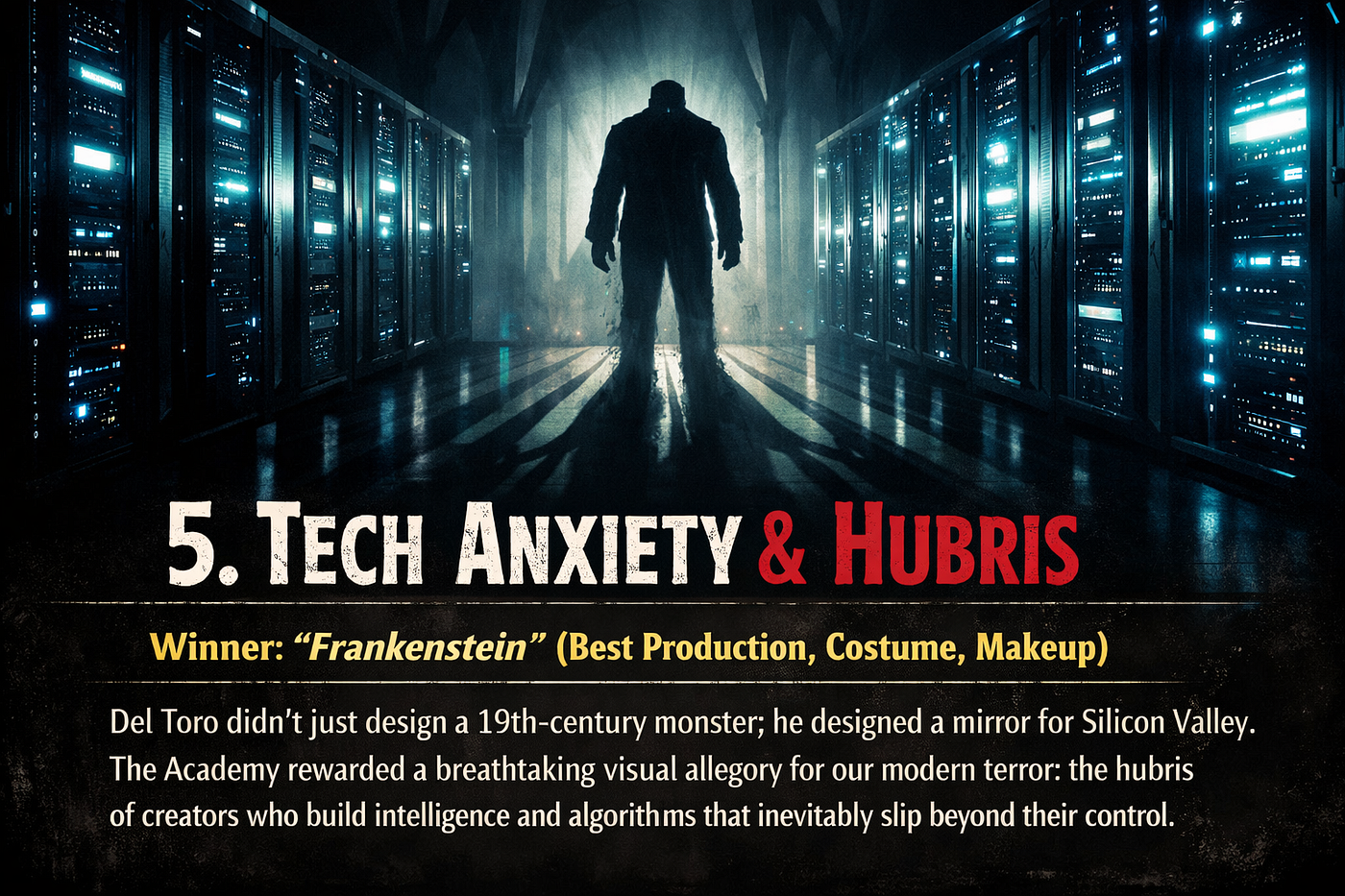
The Hubris of Creation: How Guillermo del Toro’s ‘Frankenstein’ Mirrors 2026
The Excerpt:
Sweeping the design categories (Production, Costume, Makeup), Guillermo del Toro’s Frankenstein was rewarded for making our deepest modern fears beautiful. It isn’t a film about a 19th-century monster; it’s a flawless cinematic allegory for our current terror regarding Artificial Intelligence and the loss of human agency.
The Deep Decode:
Del Toro didn’t win because he designed a scary monster; he won because he designed a mirror. In 2026, the global conversation is dominated by the fear of the “Algorithm” — systems and intelligence we built that have now slipped beyond our control.
By grounding Mary Shelley’s classic in breathtaking, tactile, practical effects and Gothic grandeur, del Toro tapped directly into our Tech Anxiety. The tragedy of the creature isn’t that it’s ugly; it’s that it was brought into a world without a moral framework by a creator blinded by ambition. Sound familiar? Every visual choice rewarded by the Academy serves as a warning about Silicon Valley hubris.
The Grey Verdict:
Frankenstein proves that the best way to make the audience swallow a bitter pill about their own technological doom is to wrap it in unparalleled, Oscar-winning aesthetics.
What did the 2026 Oscars reveal about our cultural psyche? That heroism now means surviving systemic chaos, not conquering it. Thanks for reading. Share your take on these wins! Stay tuned for more film insights. 🎬✨
[[LENS_NARRATIVE:
🎬 Today’s Morning Brief: March 17, 2026 (The Oscar Edition)
- Trending Now
One Battle After Another: The undisputed champion of the 98th Academy Awards, taking Best Picture and Best Director. The ultimate high-IQ exploration of the “Erosion of Agency.”
Sinners: Ryan Coogler (Original Screenplay) and Michael B. Jordan (Best Actor) take home gold. A masterclass in “Systemic Horror” where societal rot is the true villain.
Frankenstein: Guillermo del Toro pulls off the rare “Design Trifecta” (Production, Costume, Makeup). A brilliant look at the “Hubris of Creation” that mirrors our modern tech anxieties.
- Critical View
Hamnet: Jessie Buckley’s Best Actress win is sparking deep conversations. A devastating look at grief that perfectly captures 2026’s obsession with the “Fragility of Permanence.”
KPop Demon Hunters: Winning Best Original Song for “Golden,” the historic K-Pop victory is being debated. Is it a triumph of global cinema, or the ultimate proof of “Cultural Outsourcing”?
- The Social Spark
The Death of the Invincible Hero: Why did the Academy completely reject traditional “Saviours” this year in favour of exhausted survivors fighting broken systems?
The “March 19” Reality Check: With the Oscars in the rearview mirror, the Indian box office braces for the massive IMAX clash between ‘Dhurandhar 2’ and ‘Toxic’. Will spectacle reclaim the narrative from prestige cinema?]]
Related Greybrainer Reads
GREYBRAINER
AI-Powered Cinematic Intelligence