The Shift to “Intimate Stakes”: Why Entertainment Is Rejecting the Spectacle: Morphokinetics™ Narrative Pacing
Minute-by-minute audience retention risk vs. narrative tension. Identifies structural sag points and retention thresholds.
The Shift to “Intimate Stakes”: Why Entertainment Is Rejecting the Spectacle
The End of an Era
The entertainment landscape has undergone a fundamental recalibration. As of January 2026, a clear pattern has emerged: audiences are abandoning the CGI-heavy, world-ending fatigue that defined the previous decade. Instead, they are gravitating toward what we call “Intimate Stakes”, narratives that prioritise personal conflict, human competence, and moral complexity over apocalyptic scale.
For content strategists and media analysts, this represents more than a cyclical trend. It signals a deeper psychological shift in audience preferences, one that demands a new approach to content criticism and narrative evaluation. This is the moment to move beyond surface-level reviews into Narrative Synthesis, a framework that connects content trends to broader cultural and psychological movements.
Part 1: The Mass Appeal Wave
The Unexpected Renaissance of A Knight of the Seven Kingdoms (JioHotstar)
Premiered January 19, 2026, this spinoff series has achieved what many believed impossible: it has successfully “renovated” the Game of Thrones franchise by systematically removing the elements that defined its predecessors — trauma, moral ambiguity on an extreme scale, and dragon-centric spectacle.
The Grey Verdict: This show is a cultural bellwether. Its success proves that the “World-Ending Stakes” era is definitively over. Audiences are no longer seeking the adrenaline rush of civilizational collapse. Instead, they crave narratives centred on honour, loyalty, and personal stories — the stuff of classical adventure storytelling, stripped of gothic despair.
The implication for content creators is significant: scale is no longer a proxy for stakes. A siege can matter less than a betrayal between brothers.
Tehran Season 3 (Apple TV+): When Reality Outpaces Fiction
Released January 9, Apple TV+’s geopolitical thriller Tehran Season 3 introduces Hugh Laurie as a nuclear inspector and delivers what should be a conventional espionage narrative. Instead, the series has become something far more unsettling: a Mossad-centred drama whose plot mirrors real-world 2025–2026 nuclear tensions so closely that it transcends entertainment.
The Grey Verdict: Tehran occupies a controversial grey zone — the boundary between fiction and dramatised reality. Viewers report an uncanny sensation: the show feels less like a thriller and more like a live news broadcast dressed as drama. This raises an ethical question for content creation: At what point does narrative tension collapse into mere anxiety amplification?
The success of Tehran suggests audiences are comfortable with this dissolution of boundaries, but the critical conversation centres on whether this represents artistic maturity or a troubling conflation of entertainment and information.
Tere Ishk Mein (Netflix): The Redemption Arc as Political Statement
Released January 23 and directed by Aanand L. Rai (known for Raanjhanaa), this romantic drama starring Dhanush has claimed the top position among the month’s releases in its category.
The Grey Verdict: Tere Ishk Mein positions itself as a “spiritual successor” to Raanjhanaa, but with a critical update: it attempts to bridge the gap between toxic obsession and cross-generational redemption. Where Raanjhanaa romanticised obsessive love, Tere Ishk Mein appears to interrogate it, asking whether obsession can be transformed into genuine commitment through time and self-awareness.
This narrative choice reflects a broader cultural shift in how Indian cinema approaches male desire and agency. The success of this framework, examining rather than endorsing toxic dynamics, suggests audiences are ready for more psychologically nuanced romantic narratives.
Part 2: The Critical Conversation
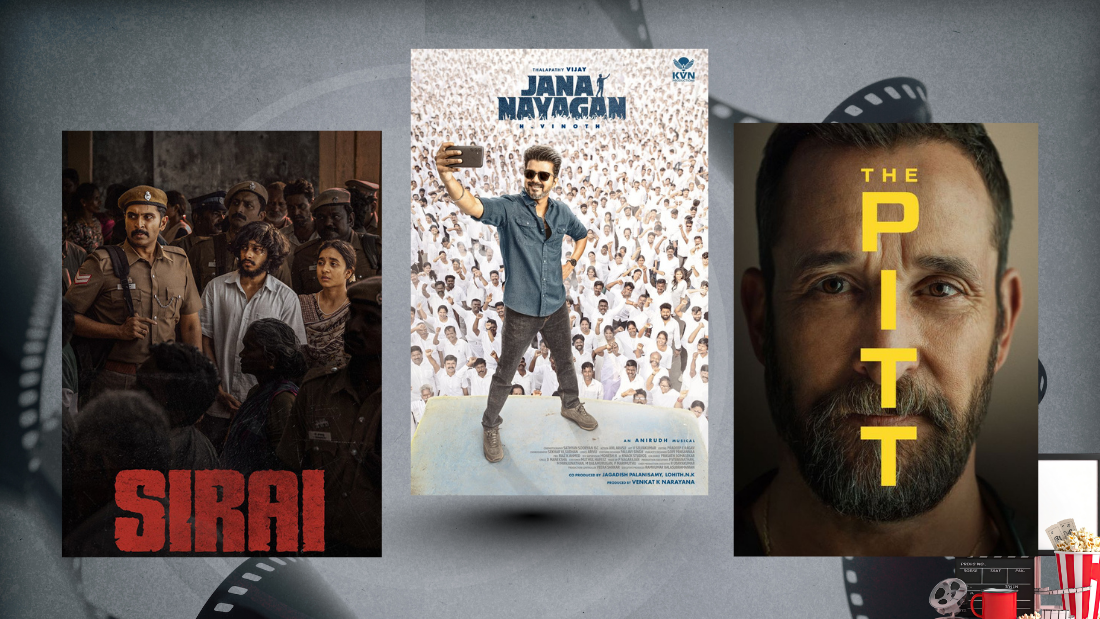
The Pitt Season 2 (JioHotstar): Competence as Drama
Released January 8, this medical drama starring Noah Wyle has established itself as the new critical benchmark for what we might call “Competence Porn” — narratives where the central tension derives not from romantic will-they-won’t-they dynamics, but from professional mastery and procedural excellence.
The Grey Verdict: The Pitt deliberately inverts the Grey’s Anatomy formula. Where Grey’s Anatomy balanced medicine with personal melodrama, The Pitt prioritises Process over Romance. Critics have hailed it for its “grubby authenticity”, the refusal to glamorise hospital environments or sanitise the burnout epidemic facing medical professionals.
For content strategists in the healthcare sector, this is a critical insight: audiences are increasingly drawn to narratives that depict real competence without narrative sugar-coating. The appeal lies in watching professionals navigate genuine complexity, not in imagining romance blooming amid chaos.
Sirai (ZEE5): The Legal System Under Scrutiny
This legal drama, featuring actor Vikram Prabhu, has generated significant critical attention, though for divided reasons.
The Grey Verdict: Sirai has been praised for its “tight narrative” construction, efficient storytelling without excess. However, it has also been scrutinised for its depiction of systemic prejudice within the Indian legal system. The show appears to take on the structural inequities of Indian jurisprudence, a choice that positions it as more than entertainment, as social commentary.
The critical conversation around Sirai reveals an audience appetite for drama that doesn’t shy away from institutional critique, yet simultaneously demands that such critique be narratively earned, not polemical.
Part 3: The Broader Cultural Debates
Censorship and Creative Freedom: The Jana Nayagan Battleground
Thalapathy Vijay’s final film has become the focal point of a much larger industry conflict. The ongoing legal battle between the film and India’s Central Board of Film Certification (CBFC) has transcended questions about specific content to become a battleground for Creative Freedom vs. Political Sensitivity.
In an election-heavy 2026, with political tensions high, the Jana Nayagan controversy reflects a fundamental tension: What role should entertainment play in political discourse? Should filmmakers self-regulate to avoid controversy, or does such restraint constitute a form of creative censorship?
This debate matters for all content creators, not just filmmakers. It signals that audiences and regulators are increasingly aware of entertainment’s capacity to shape political narrative.
The “Small Scale” Fantasy Shift: Are We Tired of Dragons?
With the success of A Knight of the Seven Kingdoms, a significant fan and critical conversation has emerged: Are audiences finally exhausted by “Dragons and Gore”?
The evidence is compelling. A Knight of the Seven Kingdoms succeeds not by promising larger-than-life spectacle, but by delivering a “buddy adventure” narrative — two flawed knights on a quest, their relationship the central drama rather than a subplot.
This shift suggests a fundamental pivot: from spectacle-driven narratives to human-centric ones. Fantasy doesn’t require apocalyptic stakes. Adventure doesn’t require world-ending consequences. The most resonant stories, audiences are discovering, are about people navigating moral complexity within confined spaces.
The New Entertainment Aesthetic
January 2026 marks a decisive shift in entertainment culture. The era of CGI-heavy spectacle, of world-ending stakes, of trauma as narrative depth, is concluding. In its place emerges something more restrained, more psychological, more human.
This doesn’t mean grand narratives have disappeared. It means they must be earned. It means intimacy, competence, and moral complexity are the new currency of entertainment value.
For content strategists, this is clarifying. The next wave of successful content won’t be defined by production budgets or franchise IP. It will be defined by psychological authenticity by the degree to which audiences believe the characters are genuinely skilled, genuinely conflicted, and genuinely human.
The question isn’t whether entertainment will continue to evolve. It will. The question is whether content creators will recognise this moment as a permanent shift in audience consciousness, or as a temporary corrective before the next cycle of spectacle returns.
Everything we’ve seen in January 2026 suggests the former is true.
[[LENS_NARRATIVE:
🎬 GreyBrain Lens: Jan 24, 2026
- Trending Now
A Knight of the Seven Kingdoms (JioHotstar): Westeros goes analogue. A small-scale “Hedge Knight” story that trades dragons for honour and character depth.
Tere Ishk Mein (Netflix): Dhanush & Aanand L. Rai reunite for an intense romantic drama that is currently the top trending film on digital.
Tehran Season 3 (Apple TV+): Hugh Laurie enters the Mossad nuclear plot. A geopolitical thriller so close to reality it feels like a documentary.
- Critical View
The Pitt Season 2 (JioHotstar): The “Anti-Grey’s Anatomy.” A masterclass in medical realism and “competence porn” that refuses to romanticise burnout.
Sirai (ZEE5): Vikram Prabhu’s legal thriller is being hailed for its “tight narrative” and critique of systemic prejudice.
- The Social Spark
Censorship & Jana Nayagan: The Supreme Court battle for Vijay’s final film sparks a national debate on “Free Speech vs. Political Transition.”
Scale Fatigue: Is the audience finally tired of “World-Ending” plots? The success of ‘Small Fantasy’ suggests a pivot to human-centric stories.]]
Related Greybrainer Reads
GREYBRAINER
AI-Powered Cinematic Intelligence