Masala to Noir: Why Indian OTT Just Got Serious: Morphokinetics™ Narrative Pacing
Minute-by-minute audience retention risk vs. narrative tension. Identifies structural sag points and retention thresholds.
Masala to Noir: Why Indian OTT Just Got Serious
The Indian entertainment landscape has reached a critical inflexion point. As January progresses, early commercial cinema is giving way to narratives centred on institutional critique, psychological depth, and lived experience within systems, what might be termed “Competence Noir.” This week’s releases reveal where audiences now invest their attention.
The Digital Titans: What’s Commanding Attention
Tere Ishk Mein (Netflix, January 23) arrives as the week’s digital heavyweight. Directed by Aanand L. Rai and starring Dhanush and Kriti Sanon in their first pairing, the film generated ₹161.96 crore globally. Crucially, it repositions love narratives away from fairytale romance toward psychological complexity, exploring how emotional dependency can mutate into possessiveness. This signals audience readiness for nuance — stories that refuse easy emotional resolution.
A Knight of the Seven Kingdoms (JioHotstar, weekly) takes the opposite approach: stripping away spectacle entirely. Episode 2 premiered January 26, continuing the series’ implicit critique of “CGI fatigue.” By removing dragons and epic battles that defined Game of Thrones, it focuses on character-driven storytelling centred on Ser Duncan the Tall, a hedge knight navigating personal moral dilemmas. HBO CEO Casey Bloys has stated that franchise quality, not quantity, prevents creative fatigue. This series embodies that thesis, with Season 2 already confirmed for 2027.
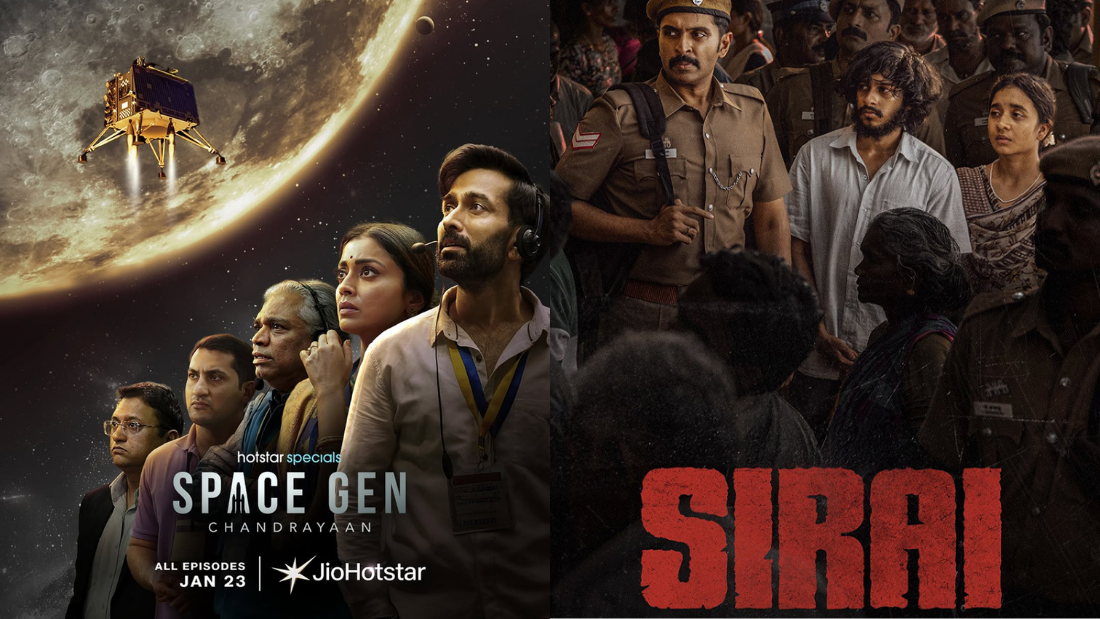
Space Gen: Chandrayaan (JioHotstar, January 23), produced by The Viral Fever, reframes patriotism itself. Dramatising India’s lunar exploration journey from Chandrayaan-2’s 2019 failure to Chandrayaan-3’s successful landing, the series triggered what industry observers call “scientific patriotism.” Rather than military heroism or political drama, ISRO scientists’ collective competence becomes the patriotic narrative — a meaningful shift in how national pride stories are constructed on Indian platforms.
Critical Reception vs. Commercial Appeal
Sirai (ZEE5, January 23), a Tamil crime drama starring Vikram Prabhu, exemplifies “systemic critique” cinema. Following a police escort mission, the film’s real engine is institutional corruption and how bureaucratic systems fail individuals. This grounded approach contrasts sharply with Mastiii 4 (ZEE5, January 23), which maintains its franchise’s commitment to adult comedic excess through “Love Visa” plotting. While Mastiii 4 draws “guilty pleasure” viewership, critics note it relies on regressive tropes. The juxtaposition reveals OTT audience maturation: some seek entertainment through exaggeration, while vocal critics now privilege substance over spectacle.
The Pitt Season 2 (JioHotstar) reinforces this pattern. Covering one hospital shift in real-time across 15 episodes, the medical drama has become a critical darling precisely because it refuses to dramatise medical burnout — it documents it authentically. Rather than resolving personal trauma, the show renders visible the institutional horror of healthcare system failure, resonating with audiences seeking authenticity over resolution.
The Narrative Wars: Institutional Power vs. Personal Agency
Two concurrent conversations reveal deeper anxieties about power and representation.
The Jana Nayagan Censorship Battle dominates institutional discourse. Thalapathy Vijay’s final film faced a complex legal standoff between filmmakers and the Central Board of Film Certification over content certification. The Madras High Court’s January 27 verdict on the CBFC’s appeal transcends a single release — it becomes precedent for how institutional authority will regulate future content. The Supreme Court’s involvement signals judicial recognition that creative freedom battles have broader implications for Indian cinema.
The “Silver Economy” Shift operates more subtly but equally significantly. Angammal (SunNXT, January 9), starring Geetha Kailasam — traditionally cast in supporting mother roles — positions her as the protagonist making autonomous choices. Adapting Perumal Murugan’s story, the film examines a middle-aged widow asserting independence. Her quiet resistance to social conformity becomes an assertion of self-respect. The film won Best Film at the New York Indian Film Festival and Best Actress recognition for Kailasam at the Indian Film Festival of Melbourne.
This matters commercially: OTT platforms have historically overlooked seniors as protagonists rather than ancillary figures. Angammal suggests a viable market — narratives where ageing adults make consequential autonomous decisions. This reframing carries direct relevance for healthcare and wellness platforms seeking to serve ageing populations with dignity and agency.
The Macro Shift: From Spectacle to Systems
The broader transition from early January’s commercial bombast to late January’s institutional critique reflects audience maturation. Early month content dominated through scale and spectacle. Late-month conversation shifted toward authenticity, system interrogation, and character depth.
Franchise Fatigue as Creative Strategy: A Knight of the Seven Kingdoms exists because audiences are tired of Game of Thrones’ epic scope. By stripping away dragons and major battles, HBO refused formula replication, a counterintuitive yet audience-responsive approach. Quality guidance prevents saturation; tentpole quotas produce fatigue.
Patriotism’s Evolution: Traditional Indian cinema weaponised patriotism through military narratives. Space Gen: Chandrayaan demonstrates a shift toward institutional competence as a patriotic virtue. Scientists’ resilience through failure and ultimate technological success becomes the patriotic story, normalising different expressions of national pride rooted in professional excellence.
Systemic Critique as Commercial Content: Sirai, The Pitt Season 2, and Jana Nayagan regulatory battles reveal audience appetite for institutional interrogation. These narratives don’t celebrate systems; they render visible how systems fail individuals. This represents a departure from earlier OTT content celebrating individual triumph despite institutional failure.
Strategic Implications
For professionals navigating Indian entertainment, several patterns emerge:
Authenticity outperforms exaggeration — whether depicting medical burnout or police corruption, grounded storytelling resonates with audiences.
Demographic representation drives commerce — Angammal demonstrates viable market demand for senior-centric narratives with agency.
Institutional critique engages affluent audiences — subscription-paying viewers increasingly seek content interrogating systems rather than celebrates individual heroism.
Spectacle fatigue is quantifiable — A Knight of the Seven Kingdoms’ renewal over dragon-centric alternatives suggests audiences hunger for narrative depth over visual scale.
Indian OTT platforms have shifted from competing on spectacle and volume to competing on authenticity and depth. This transition extends beyond entertainment, signalling how institutional narratives — in healthcare, policy, and technology — will be depicted across platforms where your work operates.
[[LENS_NARRATIVE:
🎬 Today’s Morning Brief: Jan 26, 2026
- Trending Now
Tere Ishk Mein (Netflix): Dhanush and Kriti Sanon’s romantic tragedy is the #1 digital premiere. It’s a “Varanasi Noir” that trades typical Bollywood romance for messy, obsessive, and high-consequence storytelling.
A Knight of the Seven Kingdoms (JioCinema): Westeros has returned, but it’s “Analog Fantasy” now. No dragons, just a hedge knight and his squire. It’s trending for its wit and human-scale stakes.
Mark (JioHotstar): Kiccha Sudeep’s high-octane “Aggressive Cop” drama is pulling massive numbers from the heartland, proving the “One-Man-Army” trope still has legs when executed with grit.
- Critical View
Sirai (ZEE5): A Vikram Prabhu legal thriller inspired by true events. Critics are calling it a “Tight Narrative” that exposes systemic rot, standing out for its realism in a week of loud action.
Kalamkaval (SonyLIV): Mammootty’s “anti-thriller” remains the critical benchmark of 2026, lauded for its atmospheric silence and refusal to manipulate the audience with jump scares.
- The Social Spark
Censorship & Jana Nayagan: The legal battle over Thalapathy Vijay’s final film reaches a climax at the Madras High Court tomorrow (Jan 27). It’s a battle for “Creative Freedom vs. Political Sensitivity” as a superstar transitions into statecraft.
The “Small Scale” Fantasy Shift: With A Knight of the Seven Kingdoms, a debate is peaking: Are we finally tired of “Dragons and CGI wars”? The success of this intimate “buddy adventure” suggests a massive pivot toward character-driven narratives.]]
Related Greybrainer Reads
GREYBRAINER
AI-Powered Cinematic Intelligence