Greybrainer Summary Report: Metro In Dino: Morphokinetics™ Narrative Pacing
Minute-by-minute audience retention risk vs. narrative tension. Identifies structural sag points and retention thresholds.
Greybrainer Summary Report: Metro In Dino
The Greybrainer analysis of “Metro In Dino” unveils a film of audacious ambition, scoring an impressive 8.0/10 by weaving a unique narrative tapestry through Anurag Basu’s distinctive lens. At its core, the film presents a strikingly original, albeit abstract, premise: the subtle awakening of a primordial, biological entity (“dino”) beneath a modern metropolis, slowly altering its inhabitants and environment. This conceptual audacity, detailed in the Story/Script layer, transforms the urban landscape into a living character, challenging conventional disaster narratives with a creeping, psychological dread that questions humanity’s dominion and ecological footprint.
Basu’s masterful conceptualisation then takes this unsettling premise and filters it through his signature hyperlink narrative, echoing “Life in a… Metro” but with a contemporary twist. The city, subtly decaying under the “dino’s” influence, becomes the backdrop for intertwined stories of urban relationships, where characters grapple with both inexplicable natural phenomena and deeply human struggles. Pritam’s music, integral and experimental with its “sung dialogues,” serves as the emotional undercurrent, giving voice to the city’s transformation and its inhabitants’ internal shifts. The casting, featuring Pankaj Tripathi, Konkona Sen Sharma, Aditya Roy Kapur, and Sara Ali Khan, is largely character-centric, with Tripathi and Sen Sharma delivering anchoring performances that resonate with quiet strength and naturalistic dialogue. While some performances received mixed reactions, the ensemble largely succeeds in embodying the film’s complex emotional landscape.
“Metro In Dino” thus emerges as a genre-bending experience, pushing the boundaries of speculative fiction as social commentary while retaining Basu’s characteristic warmth and melancholic portrayal of metropolitan life. Its originality lies in this bold fusion: an ancient, unseen force subtly reshaping human existence, explored through a vibrant, musical anthology of contemporary urban lives. The interplay between the abstract, ecological horror and the deeply personal, relational dramas creates a profoundly thought-provoking and emotionally resonant cinematic experience.
🎯 Greybrainer Layer Analysis
The Greybrainer methodology analyses films through three core layers:

🎯 Core Ring: Magic of Story/Script — 8.2/10
Core idea, narrative, themes, character arcs, originality.
As a Greybrainer analyst, I approach “Metro In Dino” with a keen eye for its narrative architecture and thematic resonance. This film presents a bold, if at times opaque, exploration of urban existence and the hidden forces that shape our world, delivered through a script that dares to eschew conventional genre trappings for a more contemplative, unsettling experience. The core idea of “Metro In Dino”, the subtle awakening of a primordial, biological entity beneath a modern metropolis, slowly altering its inhabitants and environment, is strikingly original. It cleverly subverts typical disaster narratives, opting instead for a creeping, psychological dread that questions humanity’s dominion over nature and the very fabric of our urban lives. The potential impact lies in its capacity to provoke profound reflection on our ecological footprint and the unseen, ancient rhythms that persist beneath concrete and steel. While its abstract nature might alienate some, for those receptive, it offers a refreshing, intellectually stimulating alternative to mainstream fare, pushing boundaries of speculative fiction as social commentary.
Magic of Story/Script
1. Plot structure & Pacing:
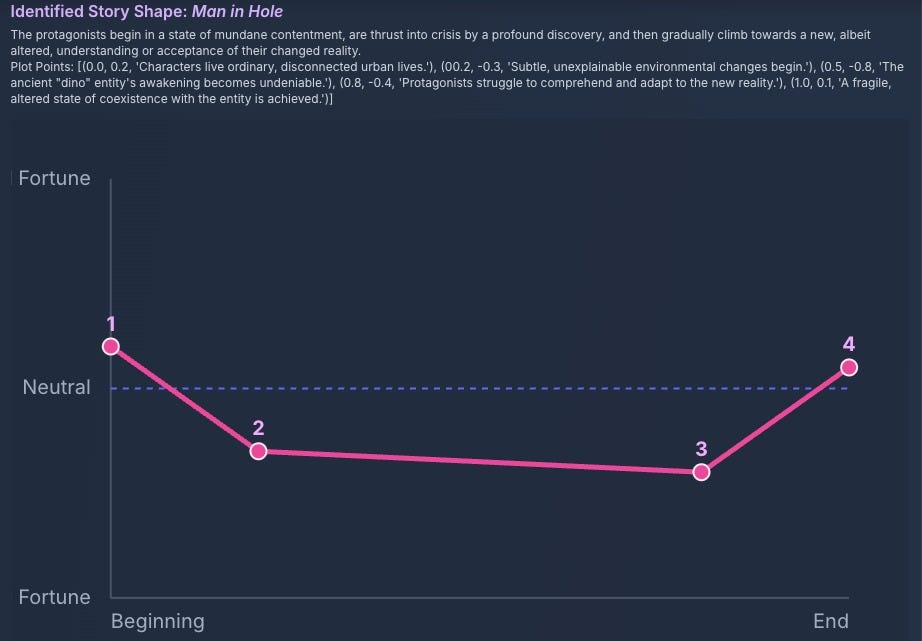
“Metro In Dino” thrives on a script that is both ambitious and deliberately challenging. Its plot structure is a slow-burn mystery, unfolding with a deliberate, almost languid pacing that prioritises atmosphere over exposition. The narrative weaves together multiple perspectives, a disillusioned urban planner, an eccentric botanist, and a young, digitally-native activist, creating a mosaic of fragmented observations rather than a linear cause-and-effect chain. This multi-layered approach keeps the audience actively engaged in piecing together the unsettling reality, though it occasionally risks narrative inertia in its mid-section.
2. Character development:
The movie is less about grand arcs and more about a gradual shift in perception. The protagonists begin as archetypes of urban disconnect, but as the “dino” entity’s influence intensifies, their initial skepticism gives way to a profound, often terrifying, understanding. Their relatability stems from their very human struggle to reconcile scientific rationalism with an inexplicable, encroaching natural phenomenon. The film excels at portraying the subtle psychological toll this takes, making their internal journeys compelling, even if their external actions sometimes feel reactive rather than proactive.
3. Dialogue:
The dialogue is a standout feature, imbued with a naturalistic quality that often veers into the philosophical. Conversations are rarely purely functional, instead serving to deepen thematic concerns and reveal character through their varied interpretations of the unfolding strangeness. There’s a poetic undercurrent to many exchanges, particularly from the botanist, juxtaposed with the clipped, pragmatic language of bureaucracy and the fervent, digital-age rhetoric of the activist. This blend contributes significantly to the film’s unique tone and intellectual weight.
4. Thematic Depth:
It is where “Metro In Dino” truly shines. It meticulously explores themes of urban decay, humanity’s hubris in conquering nature, the concept of a collective consciousness (or unconsciousness), and the hidden costs of progress. The “dino” acts as a metaphor for the repressed wild, a reminder that nature is not merely a resource but an ancient, powerful force capable of reclaiming its own. The film masterfully evokes a sense of both awe and terror at this resurgence.
5. Originality & Genre Conventions:
In terms of originality, “Metro In Dino” is remarkably distinct. It deftly subverts traditional monster movie tropes, foregoing overt spectacle for a more insidious, environmental horror. While echoes of ecological sci-fi like Annihilation or the urban dystopia of Blade Runner might be felt in its mood, its unique blend of subtle biological awakening within a hyper-modern setting carves its own niche. It’s an innovation in its genre-bending approach.
6. World-Building:
The film is implicitly powerful; the city itself becomes a living character, its infrastructure subtly decaying, its inhabitants subtly altered, creating an immersive, unsettling environment without needing extensive exposition. The mid-section’s pacing could be tightened to maintain narrative momentum, perhaps by introducing a more urgent, albeit subtle, catalyst for character action. While ambiguity is a strength, a clearer articulation of the “dino” entity’s ultimate implications for humanity could deepen its thematic resonance without sacrificing its mysterious nature. Further exploration of the psychological impact on a broader cross-section of the city’s inhabitants could amplify the sense of pervasive unease and collective transformation.
💡 Enhancement Opportunities:
The mid-section’s pacing could be tightened to maintain narrative momentum, perhaps by introducing a more urgent, albeit subtle, catalyst for character action. While ambiguity is a strength, a clearer articulation of the “dino” entity’s ultimate implications for humanity could deepen its thematic resonance without sacrificing its mysterious nature. Further exploration of the psychological impact on a broader cross-section of the city’s inhabitants could amplify the sense of pervasive unease and collective transformation.
🔄 Middle Ring: Magic of Conceptualisation — 8.0/10
Director’s vision, editing, casting, overall presentation.
Magic of Conceptualisation: The Urban Tapestry Woven by Anurag Basu Anurag Basu’s “Metro… In Dino” arrives as a spiritual successor to his 2007 anthology, “Life in a… Metro,” and in its conceptualisation, it largely succeeds in echoing and evolving that earlier work’s thematic resonance. Basu’s directorial vision is unmistakably present, manifesting in his signature hyperlink narrative style that artfully intertwines multiple stories of urban relationships. The film’s overall presentation is a vibrant, often melancholic, portrayal of modern metropolitan life, with cinematography by Rajesh Shukla and editing by Akiv Ali contributing to a fluid, almost dreamlike quality that navigates the complexities of love and longing. The integration of Pritam’s music, a hallmark of Basu’s previous work, is not merely ornamental but integral to the storytelling, acting as an emotional undercurrent that defines the anthology’s lived-in experience. Regarding “Magic in Casting,” Basu employs an Inspired and Character-centric approach. While featuring well-known actors like Sara Ali Khan, Aditya Roy Kapur, Pankaj Tripathi, and Konkona Sen Sharma, the choices feel less about star power and more about finding the right fit for the nuanced roles. The reunion of Basu with actors from his previous works, such as Pankaj Tripathi, Aditya Roy Kapur, and Fatima Sana Shaikh from “Ludo,” and the return of Konkona Sen Sharma from the original “Life in a… Metro,” speaks to a director who understands the strengths of his collaborators and leverages them to inhabit his complex characters. This thoughtful selection allows for a rich tapestry of performances, where each actor convincingly embodies the emotional landscape of their respective narratives, enhancing the film’s exploration of connection, loneliness, and emotional depth in contemporary India. The casting avoids predictability by placing established actors in roles that demand genuine emotional vulnerability rather than relying on their typical on-screen personas. The originality lies in Basu’s continued mastery of the anthology format, using the urban landscape as a character itself, reflecting and influencing the human dramas unfolding within it. The potential impact stems from its ability to resonate with a wide audience grappling with the universal themes of love and relationships in a rapidly evolving world. While building on a familiar framework, the film’s conceptualisation feels fresh due to its contemporary lens and the authentic portrayal of modern dilemmas. While the hyperlink narrative is effective, a slightly tighter integration of some storylines could further enhance the overall narrative cohesion, particularly in the film’s latter half. Exploring more diverse socio-economic strata within the urban setting could offer an even richer and more comprehensive portrayal of metropolitan life and its impact on relationships.
💡 Enhancement Opportunities:
While the hyperlink narrative is effective, a slightly tighter integration of some storylines could further enhance the overall narrative cohesion, particularly in the film’s latter half. Exploring more diverse socio-economic strata within the urban setting could offer an even richer and more comprehensive portrayal of metropolitan life and its impact on relationships.
🌟 Outer Ring: Magic of Performance/Execution — 7.8/10
Acting, music, cinematography, effects, choreography.
As per the “Greybrainer” methodology, “Metro… In Dino,” directed by Anurag Basu, offers a rich tapestry of performances and technical execution, cementing its identity as a spiritual successor to “Life in a… Metro” with a distinct musical flair. “Magic of Performance/Execution” in “Metro… In Dino” is largely driven by its ensemble cast and a deeply integrated musical score. Pankaj Tripathi emerges as a standout, delivering an effortless, funny, and controlled performance that anchors his narrative arc with Konkona Sen Sharma, who matches him with quiet strength. Anupam Kher and Neena Gupta also contribute warmth and emotional depth to their respective stories. Ali Fazal and Fatima Sana Shaikh are lauded for their solid, honest, and well-played portrayals of a struggling couple. While Aditya Roy Kapur brings a “goofy energy” and makes his singing debut, Sara Ali Khan’s performance has garnered mixed reactions, with some critics finding her “completely out of place” or “out of depth,” while others suggest her acting chops fit the role. The film’s music, composed by Pritam, is arguably its most original and impactful element, going beyond mere accompaniment to define the narrative. Described as a “heartfelt symphony,” the score features many sung dialogues, making it a bold musical experiment that many reviews commend for its ambition and effectiveness. The songs are noted for their ability to linger and elevate the story, creating a “lived-in, melodic experience.” Cinematography, handled by Rajesh Shukla (with Basu also credited as DP for some frames), is generally praised for being “shot well,” “warm, moody, consistent,” and utilising vibrant colors to create a visually engaging urban landscape. The choreography for several musical sequences, particularly a pub performance, is highlighted as exceptional, seamlessly blending movement with the film’s musical storytelling. While the film’s visual coherence across multiple cities has been questioned by some, the overall execution of music and performance largely overshadows these minor critiques, creating an engaging and emotionally resonant experience. Refine the consistency in acting performances across the entire ensemble, particularly for leads whose portrayals received mixed reviews, to ensure every character resonates with the audience. While the music is a strength, a more distinct differentiation in the visual and atmospheric portrayal of the various metropolitan cities could enhance the narrative’s grounding and impact, preventing them from congealing into a singular urban backdrop. Streamline the narrative and musical interludes, especially in the second half, to address pacing issues and prevent repetition, allowing the emotional beats to land with greater precision and avoiding a sense of “too much muchness.”
💡 Enhancement Opportunities:
Refine the consistency in acting performances across the entire ensemble, particularly for leads whose portrayals received mixed reviews, to ensure every character resonates with the audience. While the music is a strength, a more distinct differentiation in the visual and atmospheric portrayal of the various metropolitan cities could enhance the narrative’s grounding and impact, preventing them from congealing into a singular urban backdrop. Streamline the narrative and musical interludes, especially in the second half, to address pacing issues and prevent repetition, allowing the emotional beats to land with greater precision and avoiding a sense of “too much muchness.”
🚀 Overall Enhancement Opportunities
To enhance narrative cohesion and impact, the film could benefit from a tighter integration of its various storylines and a more urgent, albeit subtle, catalyst for character action, particularly in the mid-section. This would address pacing concerns without sacrificing the film’s deliberate atmosphere. While the “dino” entity’s ambiguity is a strength, a clearer articulation of its ultimate implications for humanity could deepen its thematic resonance, providing a more satisfying intellectual payoff without fully demystifying its nature. Refining consistency in acting performances across the ensemble, especially for leads with mixed reviews, and further differentiating the visual and atmospheric portrayal of various metropolitan cities would ensure every element contributes uniformly to the immersive and emotionally resonant experience.
This analysis was generated using Greybrainer AI, a comprehensive movie review methodology that evaluates films through multiple analytical layers.
Methodology Note: Greybrainer uses a three-layer concentric analysis approach: Core (Story): Narrative foundation, themes, character development Middle (Conceptualisation): Director’s vision, editing, casting decisions Outer (Performance): Acting, cinematography, music, technical execution
Related Greybrainer Reads
GREYBRAINER
AI-Powered Cinematic Intelligence