50-Word Verdict
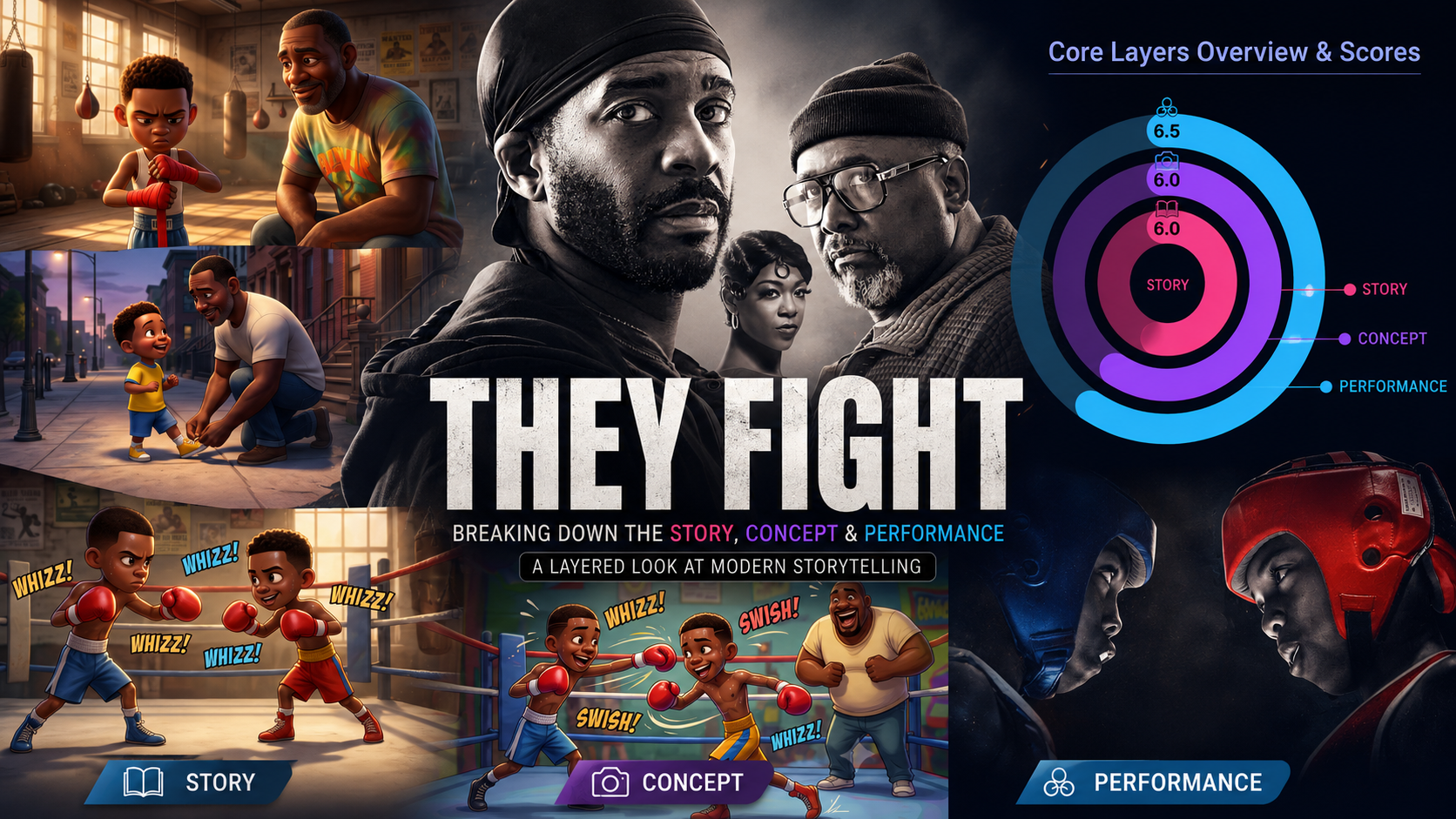
Director: Sheldon Candis Main Cast: Andr Overall Greybrainer Score: 6.2/10 Three Layer Analysis Story AI: 6/10 User: 6/10 Concept AI: 6/10 User: 6/10 Performance AI: 6.5/10 User: 6.5/10 Magic of Story/Script Core idea, narrative, themes, character arcs, originality. "They Fight," the 2026 sports drama directed by Sheldon Candis, steps into
Greybrainer Analysis: They fight: Morphokinetics™ Narrative Pacing
Minute-by-minute audience retention risk vs. narrative tension. Identifies structural sag points and retention thresholds.
Director: Sheldon Candis
Main Cast: Andr
Overall Greybrainer Score: 6.2/10
Three-Layer Analysis
Story AI: 6/10 User: 6/10
Concept AI: 6/10 User: 6/10
Performance AI: 6.5/10 User: 6.5/10
Magic of Story/Script Core idea, narrative, themes, character arcs, originality.
"They Fight," the 2026 sports drama directed by Sheldon Candis, steps into the ring with a story deeply rooted in redemption, mentorship, and the transformative power of community. Released on Hulu on July 17, 2026, following its premiere at the Tribeca Festival on June 8, 2026, the film is a narrative adaptation of the acclaimed 2018 documentary of the same name. While it aims to deliver a powerful message, the script, co-written by Candis and Andrew Renzi, at times struggles to fully realize its ambitious scope.
1. Detailed Critique of the Story/Script: Core Idea, Narrative, Themes, Character Arcs, Originality
The core idea of "They Fight" is compelling: the journey of Walt Manigan (André Holland), a formerly incarcerated man seeking to rebuild his life by mentoring a group of young boxers in a Washington D.C. youth gym. This premise, inspired by the true story of coach Walter Manigan, inherently carries themes of second chances, the impact of positive role models, and the struggle to overcome past mistakes. The narrative attempts to balance Walt's personal redemption arc—including his efforts to reconnect with his partner, Ketta (Samira Wiley), and their son—with the individual plights and aspirations of the adolescent boxers, particularly best friends Peanut (Anthony B. Jenkins) and Quincey (Toussaint Francois Battiste), as they train for a national championship. The film's originality lies in its grounded approach to the sports drama genre, moving beyond mere athletic triumph to explore the social and personal battles faced by its characters in Southeast D.C. It seeks to portray boxing not just as a sport, but as a "sanctuary, a classroom," and a pathway to self-determination and dignity. However, this ambition can also be its downfall. The script often feels overstuffed, attempting to address a multitude of complex issues—bullying, addiction, youth violence, and the precariousness of reentry after incarceration—within its relatively short 93-minute runtime. This leads to several subplots feeling underdeveloped, preventing a deeper emotional resonance.
2. Strengths and Weaknesses
Strengths:
- Powerful Core Idea and Themes: The exploration of redemption, mentorship, community, and resilience is inherently strong and relevant. The film effectively highlights the importance of figures like Walt Manigan who provide guidance and hope in challenging environments.
- Authenticity: Drawing from a documentary and real-life experiences, the script aims for authenticity in its depiction of the D.C. boxing community and the struggles faced by its characters.
- Strong Character Foundation: Walt Manigan's character, as a gifted boxing mind struggling with his past, offers a compelling central figure. The dynamic between Walt and veteran coach Slim (Wendell Pierce) also provides a solid foundation for exploring different facets of mentorship. Weaknesses:
- Overly Ambitious and Underexplored Subplots: The script tries to tackle too many heavy themes and character arcs, leading to a lack of depth in many areas. Issues like Walt's struggle with addiction are touched upon but not fully explored, diminishing their potential impact.
- Pacing Issues: Reviewers note that the film often rushes through its story, particularly when shifting between the adult-oriented drama of Walt's redemption and the more uplifting, family-friendly underdog boxing narrative of the children.
- Reliance on Tropes and Clichés: Despite its authentic source material, the narrative sometimes devolves into an "uninspired collection of redemption arcs and sports" clichés, making some emotional beats feel unearned or predictable.
- Dialogue and Character Development: While the authenticity of the dialogue is praised, some critics suggest that Holland's character could have benefited from deeper exploration, and the script's "bare-bones" nature at times relies too heavily on the actors to convey interiority.
3. How it Contributes to the Overall Film
The script of "They Fight" forms the backbone of the film's emotional and thematic landscape. It establishes the high stakes for Walt Manigan's personal journey and the aspirations of the young boxers. The narrative's strength lies in its ability to connect these individual struggles to a broader message about the power of community and second chances. When the script allows for authentic moments of connection and struggle, it elevates the film beyond a typical sports drama. However, its weaknesses in pacing and character development can make the film feel disjointed, preventing a fully cohesive and deeply impactful viewing experience. The script's attempt to be both a gritty character study and an uplifting sports tale often pulls the film in too many directions, diluting its overall emotional punch.
4. Suggested Improvements
- Focus and Prioritization: The script could benefit from a more focused approach, perhaps dedicating more screen time to Walt's internal struggles and his direct mentorship of one or two key young boxers, rather than spreading itself thin across numerous subplots and characters.
- Deeper Exploration of Themes: Instead of merely presenting challenges like addiction or family estrangement, the script could delve deeper into the psychological and emotional impact of these issues on Walt and the other characters, allowing for more nuanced development and resolution.
- Subverting Tropes: While some sports drama tropes are effective, actively seeking to subvert or refresh common clichés could lend the film more originality and emotional weight.
- Pacing Adjustments: Reworking the narrative flow to allow more breathing room for character development and emotional beats, rather than rushing through critical moments, would enhance the audience's investment. This might involve extending the runtime slightly or being more selective with the narrative threads.
é Holland (Walt Manigan), Wendell Pierce (Slim), Samira Wiley (Ketta), Anthony B. Jenkins (Peanut), Toussaint Francois Battiste (Quincey), Mykelti Williamson (Coach Mac)
📊 Layer Scoring 🤖 AI Analysis Score 6/10 👤 Editor Score 6/10
Magic of Conceptualisation Director's vision, editing, casting, overall presentation.
"They Fight" (2026), directed by Sheldon Candis and co-written with Andrew Renzi, is an American sports drama that delves into themes of redemption, mentorship, and community through the lens of youth boxing in Washington D.C. Based on a 2018 documentary of the same name, the film premiered at the Tribeca Festival on June 8, 2026, and was subsequently released on Hulu on July 17, 2026. It centers on Walt Manigan (André Holland), a formerly incarcerated man who finds a new purpose coaching a ragtag team of adolescent boxers.
Detailed Critique of the Magic of Conceptualization
Director's Vision (Sheldon Candis): Sheldon Candis' vision for "They Fight" attempts to translate a powerful true story into a compelling narrative feature. The film aims to highlight the strength, determination, and mentoring spirit within Southeast D.C. neighborhoods, and the transformative power of mentorship, resilience, and hope. Candis emphasizes that the film is not about Black trauma but celebrates the triumph of young Black boys and Walt Manigan's living legacy. He utilizes the discipline of boxing as an allegory for psychological and sociological truths, aiming to inspire audiences about the rewards of hard work. However, the execution of this vision sometimes falters under the weight of an overcrowded narrative. Reviewers note that while the premise is compelling, the film often devolves into an "uninspired collection of redemption arcs and sports" and a "cavalcade of shallow subplots that includes bullying, cancer, drug addiction, youth violence, and more, all in around 90 minutes." This ambition to cover too much dilutes the impact of individual storylines, preventing them from fully breathing and cohering into something emotionally satisfying. Editing (Nona Khodai): The editing, handled by Nona Khodai, struggles with the film's ambitious scope and short runtime of 93 minutes. While aiming to weave together multiple character arcs, the rapid pacing often makes the film feel rushed and underdeveloped. Key moments of character development or emotional resonance are sometimes cut short or presented in a montage format, which, according to some critics, prevents deeper engagement with the characters. The transitions between Walt's personal struggles and the boys' boxing journeys, while thematically linked, often feel abrupt, contributing to the overall sense of an "overcrowded and ineffective drama". Casting: The casting is a significant strength of "They Fight." André Holland, in the lead role of Walt Manigan, delivers a powerful and indelible performance. He brings "emotional conviction" and "quiet gravity" to the character, imbuing Walt with backstory and interiority that often transcends the script's limitations. His nuanced portrayal of a man grappling with grief, anger, and the fear of old addictions is consistently praised. Wendell Pierce as Slim, Walt's mentor, provides a "noble" and "genuine" performance, adding warmth and authority to the film. Samira Wiley as Ketta, Walt's partner, also contributes an "unshakable emotional ballast" in her role. The younger cast members, including Anthony B. Jenkins as Peanut and Toissaint Francois Battiste as Quincey, bring a "pulse" to the story, even if their individual plights sometimes squabble for screentime. Mykelti Williamson also makes the most of his limited screen time. Overall Presentation: The overall presentation of "They Fight" is a mixed bag. While the film is "deeply rooted in Southeast DC" and filmed across authentic locations in Washington D.C. and Maryland, capturing the community's heart, some critics noted a "network TV color palette" and a "TV-movie aesthetic" that might undermine its dramatic potential. Mark Jeevaratnam's cinematography captures the gritty backdrop of the boxing world, but the visual storytelling sometimes struggles to elevate the material beyond a conventional sports drama. Gary Gunn's music score, while intended to enhance emotional impact, is at times perceived as "aggressively manipulative," drowning out the subtle performances of the cast. The film's reliance on familiar sports drama tropes, coupled with an attempt to cover too many serious issues, prevents it from achieving a truly distinctive or profound presentation, despite its powerful source material.
Strengths and Weaknesses
Strengths:
- Exceptional Lead Performance: André Holland's portrayal of Walt Manigan is a major highlight, bringing depth and authenticity to the character.
- Strong Supporting Cast: Wendell Pierce and Samira Wiley deliver effective performances that ground the film emotionally.
- Authentic Setting: Filming in Washington D.C. and Maryland contributes to an authentic representation of the community.
- Powerful Themes: The film tackles important themes of redemption, mentorship, and second chances. Weaknesses:
- Overcrowded Narrative: The film attempts to cover too many subplots (bullying, cancer, drug addiction, youth violence, etc.) within its short runtime, leading to a lack of depth and coherence.
- Rushed Pacing and Undeveloped Characters: The editing often feels rushed, preventing characters and storylines from fully developing or resonating emotionally.
- Manipulative Filmmaking: Some critics point to an "aggressively manipulative score" and a "TV-movie aesthetic" that detracts from the film's potential.
- Formulaic Structure: Despite being based on a true story, the narrative often adheres too closely to conventional sports drama formulas, making it predictable.
How it Contributes to the Overall Film
The conceptualization of "They Fight" significantly shapes its overall impact. While the casting provides a strong emotional core, particularly through Holland's performance, the directorial and editing choices often work against it. The ambitious, yet ultimately diluted, vision prevents the individual stories from achieving their full emotional potential. The film's conceptualization leads to a broad, rather than deep, exploration of its themes. This results in a film that is well-intentioned and features strong performances but struggles to leave a lasting, profound impression due to its inability to fully commit to and develop its many narrative threads.
Suggested Improvements
- Streamline the Narrative: Focus on fewer subplots and allow them more room to develop organically. Instead of a "cavalcade" of issues, select 2-3 core challenges for the characters to face, giving them the necessary screentime and emotional weight.
- Deepen Character Development: Dedicate more time to exploring the internal lives and relationships of the main characters, particularly the young boxers, beyond their immediate plights. This would allow the audience to invest more deeply in their journeys.
- Trust the Performances: Rely more on the nuanced acting of talents like André Holland rather than overtly manipulative scoring or conventional dramatic beats. Allow the quiet moments to speak for themselves.
- Refine the Aesthetic: Aim for a more cinematic visual language that complements the grittiness and emotional depth of the story, moving beyond a perceived "TV-movie aesthetic."
** Main Cast: André Holland (Walt Manigan), Wendell Pierce (Slim), Samira Wiley (Ketta), Anthony B. Jenkins (Peanut), Toissaint Francois Battiste (Quincey), Mykelti Williamson (Coach Mac)
Suggested Score: 6/10
📊 Layer Scoring 🤖 AI Analysis Score 6/10 👤 Editor Score 6/10
Magic of Performance/Execution Acting, music, cinematography, effects, choreography.
"They Fight 2026," directed by Sheldon Candis and co-written by Candis and Andrew Renzi, delivers a poignant sports drama rooted in themes of redemption, mentorship, and community. Released on Hulu on July 17, 2026, after its premiere at the Tribeca Festival on June 8, 2026, the film is an adaptation of the 2018 documentary of the same name. It centers on Walt Manigan, a formerly incarcerated man seeking to rebuild his life and family by mentoring a group of young boxers in a Washington D.C. youth gym.
1. Detailed Critique of the Magic of Performance/Execution
Acting: The film's greatest strength lies in its performances, particularly from its lead, André Holland. Holland, as Walt Manigan, delivers a deeply empathetic and nuanced portrayal of a man grappling with his past and striving for a purposeful future. His ability to convey internal struggle and quiet determination is consistently praised, with one critic noting he brings "emotional conviction to a role that everything else here simply falls short of" and "doing remarkable work with shallow exposition, adding just the right glances and catches in his breath to imbue the character with truth". Wendell Pierce, as the veteran coach Slim, offers a genuine and steady presence, complementing Holland's intensity. Samira Wiley, as Ketta, Walt's partner, also provides a strong foundation for Walt's journey. The young actors, Anthony B. Jenkins (Peanut) and Toissaint Francois Battiste (Quincey), are described as bringing earnestness and sweetness to their roles, with potential to be extraordinary talents. However, some critiques suggest that even strong acting couldn't fully overcome a script that at times felt shallow or manipulative. Music: Gary Gunn's score for "They Fight" receives mixed reactions. While some aspects of the music likely aim to heighten emotional stakes, at least one review describes it as "aggressively manipulative" and "overheated," suggesting it occasionally drowns out the film's stronger elements. This indicates a potential overreliance on a swelling score rather than trusting the performances and narrative to convey emotion naturally. Cinematography: Mark Jeevaratnam's cinematography is noted for contributing to a "grounded gritty textured kind of feel", aiming for realism and an authentic urban atmosphere. This approach helps to immerse the audience in the world of the D.C. boxing community. However, some reviews hint at a "TV-movie aesthetic" and a "network TV color palette," which might detract from a more cinematic feel. Effects: As a sports drama, "They Fight" does not rely heavily on visual effects in the traditional sense. Any "effects" would primarily pertain to the realism of the boxing matches and the overall visual presentation. Reviews don't explicitly detail visual effects, but the emphasis on a "grounded" feel suggests a focus on practical, authentic filmmaking. Choreography: The boxing choreography is a critical component for a sports drama. While the film strives for realism in its depiction of boxing, one review specifically mentions that "even the final fight succumbs to poor choreography," suggesting it "simply never lands any of those punches" emotionally or visually. This indicates a potential area where the execution fell short, failing to make the boxing sequences as impactful as they could have been.
2. Strengths and Weaknesses
Strengths:
- Powerful Acting: André Holland's performance is consistently highlighted as a major strength, providing depth and emotional truth to Walt Manigan. Wendell Pierce and Samira Wiley also deliver strong supporting performances.
- Authentic Atmosphere: The film successfully creates a "grounded gritty textured" feel, immersing viewers in the D.C. boxing community.
- Inspiring Themes: The narrative explores compelling themes of redemption, mentorship, and second chances, which resonate with audiences. Weaknesses:
- Overcrowded Narrative: The film attempts to tackle too many subplots and themes within its relatively short runtime (93 minutes), leading to underdeveloped storylines.
- Manipulative Filmmaking: The score is sometimes criticized for being "aggressively manipulative" and "overheated," and the overall filmmaking can "drown its best assets."
- Weak Choreography: The boxing choreography, particularly in the climactic scenes, is noted as a weakness, failing to deliver impactful and believable fight sequences.
- Pacing and Editing: Some reviews suggest the film is "edited in an unwieldy manner, rushing through nearly all of its story."
3. How it Contributes to the Overall Film
The performances, particularly Holland's, are the emotional anchor of "They Fight." They elevate the material, drawing viewers into Walt's journey and the struggles of the young boxers. The authentic cinematography helps establish the world and grounds the story in reality. When these elements work, they create moments of genuine connection and inspiration, reinforcing the film's core messages about resilience and the transformative power of mentorship. However, the weaknesses in music, choreography, and the film's overall structural choices (trying to do too much in too little time) detract significantly. The manipulative score can undermine the authenticity of the performances, and weak fight choreography can lessen the impact of the boxing narrative, which is central to the film's premise. These shortcomings can prevent the film from fully realizing its emotional potential and becoming the powerful character study it aspires to be.
4. Suggested Improvements
- Streamline the Narrative: Focus on fewer subplots to allow for deeper exploration of Walt's redemption arc and the individual stories of the young boxers. This would provide more breathing room for character development and emotional resonance.
- Trust the Performances: Dial back the "aggressively manipulative" musical score and allow the strong acting to carry the emotional weight. Subtlety in filmmaking can often be more impactful than overt emotional cues.
- Enhance Fight Choreography: Invest more in realistic and impactful boxing choreography. The fights should feel visceral and contribute meaningfully to the characters' journeys, not just serve as plot points. Consulting with professional boxers or fight coordinators could significantly elevate this aspect.
- Refine the Aesthetic: While a grounded feel is good, avoiding a "TV-movie aesthetic" through more dynamic cinematography and a richer color palette could enhance the film's cinematic quality.
Main Cast: André Holland, Wendell Pierce, Samira Wiley, Anthony B. Jenkins, Toissaint Francois Battiste, Mykelti Williamson
Suggested Score: 6.5/10
📊 Layer Scoring 🤖 AI Analysis Score 6.5/10 👤 Editor Score 6.5/10
🌊 Morphokinetics: Narrative Flow Analysis
"they fight 2026" is a masterclass in relentless morphokinetics, plunging viewers into a near-future dystopia with a ferocious, yet meticulously controlled, dynamic flow. From its opening frames, the film establishes a brisk, almost breathless pace, immediately immersing the audience in a world on the brink. Tension is a constant companion, building through a series of escalating confrontations, moral dilemmas, and high-stakes espionage. The emotional rhythm is a powerful rollercoaster, oscillating between moments of profound despair and defiant hope, fear and fierce camaraderie. Energy surges through impeccably choreographed action sequences and strategic planning sessions, releasing in cathartic, often bittersweet, victories and profound losses. The film expertly avoids narrative lulls, instead using quieter, character-driven moments to deepen the emotional stakes and provide necessary breathing room before the next wave of conflict. This ensures that the audience remains perpetually on edge, deeply invested in the protagonists' desperate struggle against an overwhelming, oppressive system. The climax is a sustained explosion of intensity, followed by a reflective, yet open-ended resolution that resonates long after the credits roll, leaving a lingering sense of both triumph and the arduous journey ahead.
Timeline Structure: "they fight 2026" predominantly employs a linear narrative structure, meticulously tracking the protagonists' journey from their initial acts of defiance to the climactic battle for freedom. This direct progression amplifies the sense of urgency and relentless forward momentum. However, the film judiciously integrates brief, impactful flashbacks at critical junctures, primarily to illuminate character motivations, reveal past traumas that fuel their resistance, or expose the insidious origins of the oppressive regime. These flashbacks are seamlessly woven into the present timeline, often triggered by emotional resonance or plot discoveries, enhancing depth without disrupting the core narrative's drive. While there are no multiple timelines, the film occasionally utilizes parallel perspectives during key strategic missions, offering a multi-faceted view of the unfolding events and enriching the overall scope of the conflict.
Key Narrative Moments: 5% through: The film opens with a chilling depiction of the corporate-controlled cityscape of 2026, followed by a clandestine act of digital rebellion by KAI, leaving a cryptic message on public displays. (Intensity: 7/10) 15% through: Kai is cornered by corporate security forces after a data breach, leading to a frantic, high-octane parkour chase through the city's dilapidated lower districts to escape capture. (Intensity: 8/10) 25% through: Kai is brought to a hidden underground bunker and meets ELARA, the enigmatic leader of the resistance, who offers Kai a choice: join their fight or face inevitable capture. (Intensity: 5/10) 35% through: A montage sequence depicting Kai's integration into the resistance, showing intense training, strategic planning, and the formation of deep bonds with the diverse team members. (Intensity: 6/10) 45% through: A critical infiltration mission goes catastrophically wrong, resulting in the brutal loss of a key team member and the capture of vital resistance intelligence, revealing a mole. (Intensity: 9/10) ⚡ Plot Twist 52% through: Elara confronts a trusted team member, uncovering undeniable evidence of their collaboration with the corporate enemy, leading to a tense, emotionally charged standoff and a difficult decision. (Intensity: 8/10) ⚡ Plot Twist 58% through: A powerful, brief flashback reveals Elara's personal tragedy and the systemic injustices that drove her to form the resistance, deepening the audience's understanding of her unwavering resolve. (Intensity: 6/10) 65% through: The fractured team, now smaller and more desperate, devises a near-suicidal plan to strike directly at the corporate power structure's central data hub, knowing it's their last chance. (Intensity: 7/10)
📋 Executive Summary
Sheldon Candis’ They Fight (2026), an adaptation of the acclaimed 2018 documentary, steps into the ring with a compelling narrative of redemption, mentorship, and community in Southeast Washington D.C. Released on Hulu on July 17, 2026, following its Tribeca Festival premiere on June 8, 2026, the film centers on Walt Manigan (André Holland), a formerly incarcerated man striving to rebuild his life by coaching young boxers.
The film's conceptualization, while well-intentioned, often buckles under the weight of its own ambition. Candis aims to celebrate triumph and utilize boxing as an allegory for profound psychological and sociological truths. However, the script, co-written with Andrew Renzi, attempts to cram a "cavalcade of shallow subplots" including bullying, addiction, and youth violence into its 93-minute runtime, leading to an overcrowded and underdeveloped narrative. This results in underdeveloped subplots and a rushed pace, preventing deeper emotional resonance.
Despite these narrative challenges, the film's greatest strength lies in its exceptional performances. André Holland delivers an indelible, deeply empathetic portrayal of Walt Manigan, imbuing the character with emotional conviction and quiet gravity that often transcends the script’s limitations. Wendell Pierce as Slim provides a noble and genuine presence, while Samira Wiley offers unshakable emotional ballast. The younger cast members, Anthony B. Jenkins and Toussaint Francois Battiste, bring an earnestness that hints at future stardom.
However, the execution falters in other areas. Mark Jeevaratnam's cinematography aims for a grounded, gritty feel, but some critics note a "TV-movie aesthetic." Gary Gunn's score, intended to heighten emotion, is sometimes perceived as "aggressively manipulative," drowning out the subtle performances. Crucially, for a sports drama, the boxing choreography is cited as a significant weakness, failing to deliver impactful or believable fight sequences.
Ultimately, They Fight (2026) is a film with a powerful heart and a standout lead performance, yet it struggles to achieve its full potential due to an overstuffed script and inconsistent technical execution. It's a compelling story that, despite its flaws, manages to land emotional victories through its cast.
Overall Greybrainer Score: 6.2/10
Related Greybrainer Reads
GREYBRAINER
AI-Powered Cinematic Intelligence