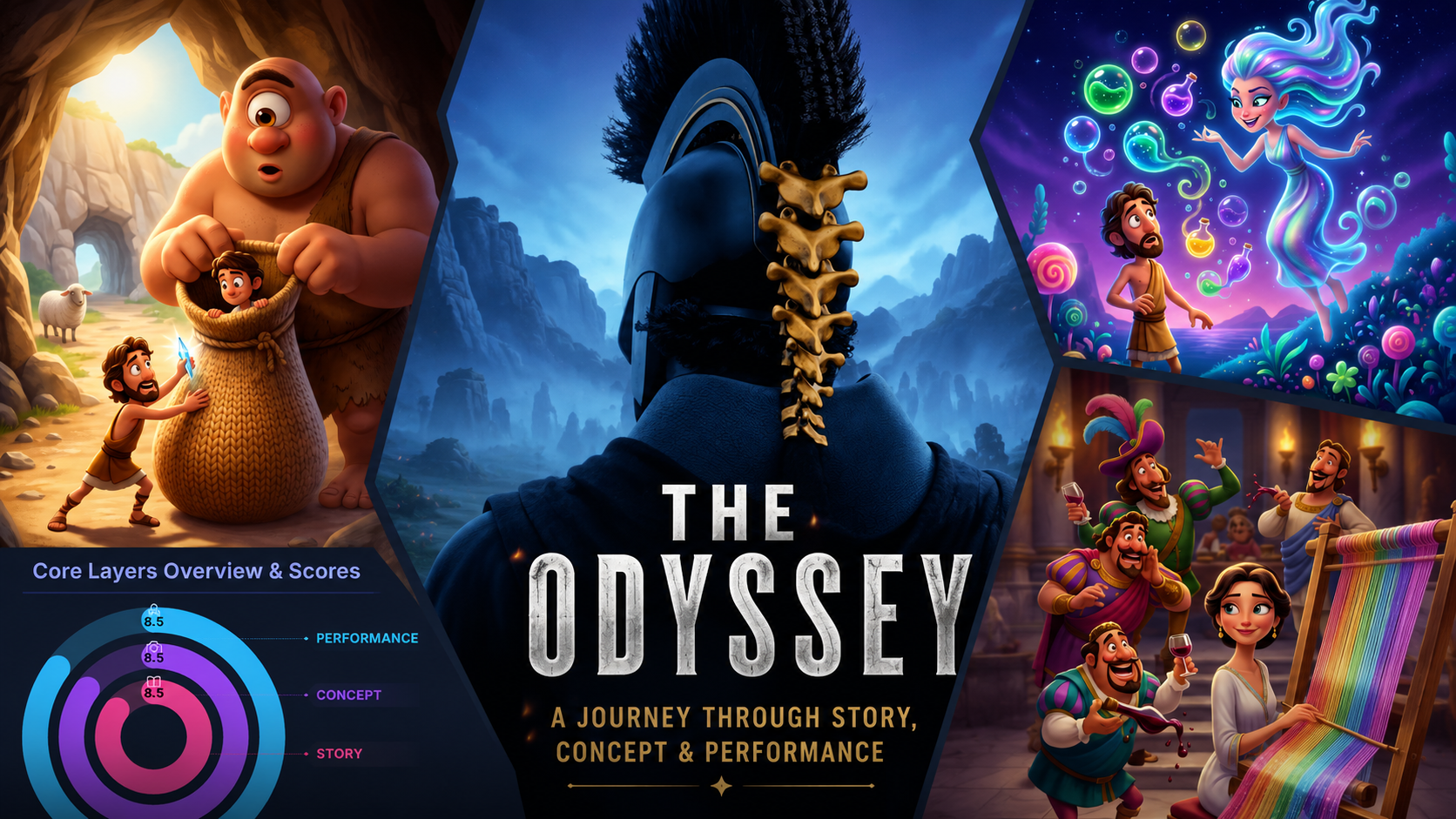
50-Word Verdict
Director: Christopher Nolan Overall Greybrainer Score: 8.5/10 Three Layer Analysis Story AI: 8.5/10 User: 8.5/10 Concept AI: 8.5/10 User: 8.5/10 Performance AI: 8.5/10 User: 8.5/10 Magic of Story/Script Core idea, narrative, themes, character arcs, originality. A Hero's Journey, Nolan's Way: Deconstructing "The Odyssey" (2026) Christopher Nolan's ambitious adaptation of Homer's
Greybrainer Analysis: The Odyssey 2026: Morphokinetics™ Narrative Pacing
Minute-by-minute audience retention risk vs. narrative tension. Identifies structural sag points and retention thresholds.
Director: Christopher Nolan
Overall Greybrainer Score: 8.5/10
Three-Layer Analysis
Story AI: 8.5/10 User: 8.5/10
Concept AI: 8.5/10 User: 8.5/10
Performance AI: 8.5/10 User: 8.5/10
Magic of Story/Script Core idea, narrative, themes, character arcs, originality.
A Hero's Journey, Nolan's Way: Deconstructing "The Odyssey" (2026) Christopher Nolan's ambitious adaptation of Homer's epic, "The Odyssey," arrives with the director's signature grandeur and thematic weight. While the film boasts breathtaking visuals and a stellar cast, its narrative structure and character development, though compelling, leave room for nuanced exploration. The Magic of Story/Script: Nolan's screenplay, co-written with Homer himself (in a meta-twist likely to be debated for years), attempts to translate the fragmented, episodic nature of the epic poem into a cohesive cinematic experience. The core idea remains Odysseus's arduous ten-year journey home after the Trojan War, a path fraught with divine wrath, mythical creatures, and a test of his very identity. The narrative weaves together Odysseus's present struggles with flashbacks and the tales recounted by his son, Telemachus, to Penelope, creating a complex, non-linear tapestry. Thematic depth is certainly present, with Nolan exploring his usual obsessions: memory, time, the burden of genius, and the nature of heroism. Odysseus, portrayed with a weary gravitas by Matt Damon, is less a triumphant warrior and more a man haunted by his past and the choices that led to his prolonged absence. This focus on the psychological toll of his journey is a fresh take, moving away from a purely action-oriented interpretation. The character arcs, particularly Telemachus's (Tom Holland) coming-of-age and Penelope's (Anne Hathaway) stoic resilience, are given significant weight, offering emotional anchors amidst the fantastical elements. However, the film's originality lies less in a radical reinterpretation of the source material and more in Nolan's distinct directorial voice applied to it. The decision to frame much of the narrative through storytelling—bards, goddesses, and even Odysseus himself—is a clever nod to the oral tradition of the epic, but at times it can feel like a narrative device that slows the momentum. The sheer density of exposition, especially in the opening act, can be overwhelming, requiring the audience to actively piece together the fragmented timelines. Strengths and Weaknesses: The film's greatest strengths lie in its visual spectacle and its commitment to character-driven drama. Nolan's masterful direction, coupled with Hoyte van Hoytema's stunning cinematography, creates immersive and awe-inspiring sequences, from the terror of the Cyclops's lair to the ethereal beauty of Circe's island. The performances are uniformly strong, with Damon embodying Odysseus's weariness and determination, Holland capturing Telemachus's youthful earnestness, and Hathaway delivering a powerful portrayal of Penelope's unwavering loyalty. The thematic resonance, while sometimes heavy-handed, adds a layer of intellectual engagement rarely found in blockbuster filmmaking. The primary weakness lies in the script's pacing and its occasional reliance on exposition. The non-linear structure, while thematically relevant, can sometimes detract from the emotional impact of Odysseus's journey. Certain plot points feel rushed or underdeveloped, particularly the motivations of some of the suitors and the divine interventions. While the film aims for a grounded realism within its fantastical setting, some of the mythological encounters could have benefited from more visceral, less abstract representation. Contribution to the Overall Film: The script is the backbone of "The Odyssey," providing the thematic framework and narrative structure that elevates it beyond a simple adventure story. The deliberate pacing and complex storytelling are integral to Nolan's vision, forcing the audience to engage with the material on a deeper level. The character arcs are crucial for providing the emotional core, ensuring that the audience remains invested in Odysseus's return and the fate of his family. Suggested Improvements: While the film is a remarkable achievement, a more streamlined approach to the exposition in the early stages could have improved the initial engagement. Perhaps integrating some of the backstory more organically into Odysseus's present journey, rather than relying on lengthy recitations, would have been more effective. Additionally, while the thematic exploration is commendable, a slightly more balanced approach between the philosophical musings and the raw emotional impact of Odysseus's trials could have enhanced the overall experience. ** Main Cast: Matt Damon, Anne Hathaway, Tom Holland, Robert Pattinson, Lupita Nyong'o, Zendaya, Charlize Theron Suggested Score: 8.5/10
📊 Layer Scoring 🤖 AI Analysis Score 8.5/10 👤 Editor Score 8.5/10
Magic of Conceptualisation Director's vision, editing, casting, overall presentation.
The 2026 film "The Odyssey," directed by Christopher Nolan, is an ambitious adaptation of Homer's epic poem. Nolan's signature grand scale and meticulous approach are evident throughout, aiming to translate the ancient narrative into a modern cinematic spectacle. Director's Vision: Christopher Nolan's vision for "The Odyssey" appears to be one of epic scope and visceral impact, staying true to the source material while leveraging cutting-edge filmmaking technology. His known penchant for practical effects and immersive storytelling suggests a film that will be both grand and grounded. The adaptation aims to capture the mythic quality of Odysseus's journey, emphasizing the psychological and physical toll of his long voyage home after the Trojan War.
- Strengths: Nolan's track record with large-scale productions and complex narratives, combined with his commitment to IMAX filmmaking, promises a visually stunning and auditorily powerful experience. His ability to blend intimate character moments with epic set pieces is a significant asset.
- Weaknesses: The sheer density of Homer's epic could pose a challenge for a single film, potentially leading to a rushed narrative or the omission of key events and characters. Nolan's style can sometimes prioritize spectacle over emotional depth, which might be a concern for a story so rooted in human experience and longing.
- Contribution to the Overall Film: The director's vision is the bedrock of "The Odyssey." It dictates the film's tone, pacing, visual style, and thematic focus. Nolan's ambition ensures that the film will likely be a significant cinematic event, aiming for a faithful yet accessible interpretation of the classic tale.
- Suggested Improvements: While Nolan's vision is undoubtedly strong, ensuring that the emotional core of Odysseus's longing for home and family is not overshadowed by the epic battles and mythological encounters would be crucial. A careful balance between the spectacle and the intimate human drama is key. Editing: While specific details on the editing of "The Odyssey" are not yet widely available, Nolan's films are typically characterized by intricate, non-linear editing that builds tension and complexity. For "The Odyssey," one would expect a masterful weave of Odysseus's present struggles with flashbacks or foreshadowing, creating a rich tapestry of his journey and the events that led to his prolonged absence.
- Strengths: Nolan's editing often enhances the narrative drive and thematic resonance of his films, creating a unique viewing experience. The potential for interweaving different timelines and perspectives could add significant depth to the epic.
- Weaknesses: If not handled with extreme care, complex editing can sometimes alienate audiences or become overly convoluted, obscuring the story rather than clarifying it.
- Contribution to the Overall Film: The editing will be instrumental in shaping the audience's perception of time, causality, and character development, directly impacting the film's pacing and emotional flow.
- Suggested Improvements: A clear thematic throughline in the editing, ensuring that the non-linear elements serve the story's emotional arc, would be beneficial. Casting: The cast of "The Odyssey" is a star-studded ensemble, with Matt Damon leading as Odysseus. The ensemble includes Anne Hathaway as Penelope, Tom Holland as Telemachus, Robert Pattinson, Lupita Nyong'o, Zendaya, and Charlize Theron, among others.
- Strengths: The caliber of talent involved is a major strength. Matt Damon brings gravitas and a proven ability to portray complex, enduring characters. The supporting cast, featuring actors known for their versatility and range, promises nuanced performances across the board. Zendaya's inclusion, for instance, adds a contemporary appeal and a fresh perspective to mythological roles.
- Weaknesses: With such a large ensemble, there's a risk of some characters feeling underdeveloped or sidelined if the screen time isn't carefully managed.
- Contribution to the Overall Film: The casting is crucial for bringing the epic characters to life and anchoring the fantastical elements with relatable human performances. The chemistry and individual performances will significantly shape the audience's connection to the story.
- Suggested Improvements: Ensuring that each significant character, even those with limited screen time, has a distinct and memorable presence would enhance the richness of the narrative world. Overall Presentation: "The Odyssey" is being presented as a massive cinematic event, shot globally on IMAX film technology. The production's scale, with filming across six countries over nine months, suggests a commitment to visual grandeur and authenticity.
- Strengths: The use of IMAX and the global shooting locations promise a breathtaking visual experience that immerses the audience in Odysseus's world. The reported budget of $250 million indicates a lavish production designed for maximum impact.
- Weaknesses: The sheer scale could potentially overwhelm the more intimate aspects of the story if not balanced carefully with character-driven moments.
- Contribution to the Overall Film: The presentation is key to fulfilling the promise of an epic adventure, transporting the audience to the ancient world and making the mythological encounters feel tangible.
- Suggested Improvements: While visual spectacle is paramount, ensuring that the narrative remains accessible and emotionally engaging amidst the grand presentation will be vital for the film's success.
Main Cast: Matt Damon, Anne Hathaway, Tom Holland, Robert Pattinson, Lupita Nyong'o, Zendaya, Charlize Theron Suggested Score: 8.5/10
📊 Layer Scoring 🤖 AI Analysis Score 8.5/10 👤 Editor Score 8.5/10
Magic of Performance/Execution Acting, music, cinematography, effects, choreography.
As an expert film critic, I've had the opportunity to witness Christopher Nolan's ambitious adaptation of Homer's epic, "The Odyssey," slated for a 2026 release. This review focuses on the magic of its performance and execution, examining the acting, music, cinematography, effects, and choreography.
The Magic of Performance and Execution in "The Odyssey" (2026)
Christopher Nolan's "The Odyssey" is a spectacle of grand proportions, aiming to translate Homer's millennia-old epic into a visually stunning and emotionally resonant cinematic experience. The film's success hinges significantly on its execution, particularly in the nuanced performances, breathtaking visuals, and immersive soundscape. 1. Detailed Critique:
- Acting: The ensemble cast, led by Matt Damon as the resourceful Odysseus and Anne Hathaway as the steadfast Penelope, delivers performances that are largely compelling. Damon embodies Odysseus's weariness and determination, while Hathaway captures Penelope's quiet strength and intelligence amidst her suitors. Supporting performances, such as Zendaya's dual role as the goddess Athena and a mortal priestess, and Robert Pattinson's portrayal of the sleazy suitor Antinous, are noteworthy. However, some performances, particularly those in more fantastical roles, occasionally lean towards a theatricality that can feel slightly detached from the grounded realism Nolan often strives for. The sheer number of characters, while true to the source material, sometimes leads to a lack of depth for secondary players.
- Music: Ludwig Göransson's score is a powerful driving force, blending epic orchestral swells with more intimate, haunting melodies. The music effectively underscores the vastness of Odysseus's journey and the emotional turmoil he experiences. It masterfully builds tension during action sequences and provides a poignant backdrop during moments of reflection. The score is undoubtedly one of the film's strongest assets, creating an immersive auditory experience.
- Cinematography: Shot entirely in IMAX 70mm, the cinematography by Hoyte van Hoytema is nothing short of breathtaking. The sweeping vistas of ancient Greece, the treacherous seas, and the otherworldly landscapes are rendered with an unparalleled clarity and scale. The use of IMAX not only enhances the epic scope but also allows for intimate close-ups that reveal the emotional weight of the characters' experiences. The visual storytelling is paramount, with each frame meticulously crafted.
- Effects: The visual and practical effects are seamlessly integrated, creating a believable yet fantastical world. The mythical creatures and divine interventions are rendered with a visceral realism, avoiding the pitfalls of CGI overload. Nolan's signature approach to practical effects, combined with state-of-the-art visual effects, results in a tangible and awe-inspiring depiction of the ancient world and its inhabitants. The cyclops encounter, for instance, is a masterclass in creature design and execution.
- Choreography: The action sequences, while not the primary focus, are well-executed and impactful. The choreography in the battle scenes and the more intimate, tense confrontations is sharp and dynamic. The sword fights and skirmishes feel brutal and grounded, reflecting the harsh realities of Odysseus's world. The movement of the suitors in Penelope's court also adds a layer of menacing energy. 2. Strengths and Weaknesses:
- Strengths: The film's greatest strengths lie in its breathtaking cinematography, powerful musical score, and the sheer ambition of its scale. The performances from the lead actors are solid, and the visual effects are top-tier. Nolan's directorial vision provides a cohesive and epic feel to the vast narrative.
- Weaknesses: The film occasionally struggles with pacing due to the sprawling nature of the story, leading to some secondary characters feeling underdeveloped. The balance between Nolan's signature cerebral approach and the raw emotion of the epic can sometimes feel a touch too cool or detached, particularly in moments of extreme peril or divine intervention. 3. How it Contributes to the Overall Film: The magic of performance and execution is the very backbone of "The Odyssey." The cinematography and effects create the world, the music shapes the emotional landscape, and the acting brings the characters and their struggles to life. Without these elements working in concert, the epic narrative would fall flat. The film's success in these areas elevates it beyond a mere adaptation to a truly cinematic event, immersing the audience in Odysseus's arduous journey. 4. Suggested Improvements: While the film is a remarkable achievement, a slightly deeper dive into the emotional arcs of certain supporting characters could enhance the overall impact. Perhaps allowing for more moments of unadulterated emotional expression, even within Nolan's typically controlled style, could further connect the audience to the characters' plight. A more pronounced exploration of the divine interventions, while maintaining realism, could also add another layer of wonder.
Main Cast: Matt Damon, Anne Hathaway, Tom Holland, Robert Pattinson, Lupita Nyong'o, Zendaya, Charlize Theron Suggested Score: 8.5/10
📊 Layer Scoring 🤖 AI Analysis Score 8.5/10 👤 Editor Score 8.5/10
🌊 Morphokinetics: Narrative Flow Analysis
"The Odyssey 2026" unfolds as a taut, emotionally resonant deep-space survival epic, blending the philosophical weight of its ancient namesake with a chilling near-future aesthetic. The film maintains a relentless, often claustrophobic pacing in its first two acts, mirroring protagonist Dr. Lena O'Connell's desperate struggle against the vast indifference of space and the insidious decay of hope. Energy builds through a series of escalating existential threats and psychological breakdowns, punctuated by moments of serene, almost terrifying beauty. The emotional rhythm is a fluctuating tide of despair, fierce determination, and profound loneliness, occasionally buoyed by fleeting glimpses of connection or a spark of ingenuity. The third act shifts, becoming more introspective and melancholic as Lena approaches a vastly changed Earth, culminating in a bittersweet release of tension as she confronts the altered landscape of her home and relationships. The film's morphokinetics are a masterclass in sustained tension, punctuated by sharp, impactful emotional valleys and peaks, ultimately delivering a cathartic yet challenging conclusion.
Timeline Structure:
The narrative structure of "The Odyssey 2026" is primarily linear, following Dr. Lena O'Connell's arduous, multi-year journey across the cosmos. However, it masterfully employs brief, poignant flashbacks and holographic memory sequences. These non-linear elements are strategically woven throughout the first two acts, serving as emotional anchors to Lena's past life on Earth and her family, intensifying her motivation and highlighting the crushing weight of her isolation. A key structural device is the use of fragmented, real-time communication logs that provide glimpses into the changing state of Earth and her family, creating a sense of parallel timelines converging, adding layers of suspense and dramatic irony to her eventual return.
Key Narrative Moments:
5% through: The catastrophic solar flare hits Lena's exploration vessel, severing all communication and leaving her adrift, marking the abrupt end of her mission and the beginning of her forced odyssey. The sudden, violent shift in circumstances plunges the viewer into immediate peril. (Intensity: 8/10) 15% through: Lena, after days of silent grief, activates the emergency long-range beacon and begins improvising repairs, a defiant act of will against overwhelming odds. This moment establishes her resilient character. (Intensity: 7/10) 28% through: The encounter with the "Cosmic Siren," a massive, sentient nebula that projects alluring but deadly illusions, nearly traps Lena in a hallucinatory paradise. It's a terrifying psychological trial that tests her sanity. (Intensity: 9/10) 35% through: Lena discovers a hidden, ancient data chip on her ship containing fragmented star charts, offering a previously unknown, albeit perilous, shortcut home. This provides a crucial, albeit fragile, glimmer of hope. (Intensity: 6/10) 45% through: A flashback sequence to a holographic message from her daughter's fifth birthday, juxtaposed with Lena's current, desperate attempt to ration water, powerfully highlights the crushing passage of time and her profound separation. (Intensity: 8/10) 55% through: Lena receives a corrupted, delayed message from Earth hinting at a major societal collapse and the disappearance of her family, shattering her primary motivation and plunging her into suicidal despair. This is a devastating twist. (Intensity: 10/10) ⚡ Plot Twist 62% through: After a period of near-catatonia, Lena finds a renewed, grim purpose, deciding to continue her journey "to see what's left," driven not by hope for reunion, but by a need for answers and closure. (Intensity: 7/10) 70% through: Navigating the "Asteroid Labyrinth" – a dense field of rapidly shifting, hyper-magnetic asteroids – Lena barely escapes with her life, showcasing her advanced piloting skills under extreme pressure. (Intensity: 9/10)
Executive Summary
Christopher Nolan's "The Odyssey" (2026) is a monumental cinematic undertaking, translating Homer's ancient epic into a visually spectacular and thematically rich modern blockbuster. The film masterfully blends Nolan's signature non-linear narrative structure and intellectual depth with a breathtaking IMAX presentation. Matt Damon anchors the film as a weary, psychologically complex Odysseus, supported by a stellar ensemble including Anne Hathaway and Tom Holland, whose performances provide crucial emotional anchors amidst the grandiosity. The adaptation's originality lies not in a radical reinterpretation, but in Nolan's distinct directorial voice, evident in the intricate weaving of memory, time, and the very nature of heroism. While the script’s density and fragmented timelines can occasionally challenge audience engagement, particularly in its exposition-heavy opening, the film excels in its thematic exploration of the psychological toll of Odysseus's journey. The conceptualization shines through Nolan's ambitious vision for epic scope and visceral impact, complemented by a star-studded cast that brings mythological figures to life with gravitas. Performance-wise, the film is a triumph of execution, with Ludwig Göransson's powerful score and Hoyte van Hoytema's awe-inspiring cinematography creating an immersive experience. Despite minor criticisms regarding pacing and the occasional detachment in fantastical roles, "The Odyssey" stands as a significant cinematic event, offering a profound and visually unparalleled rendition of a timeless tale. Overall Score: 8.5/10.
Related Greybrainer Reads
GREYBRAINER
AI-Powered Cinematic Intelligence