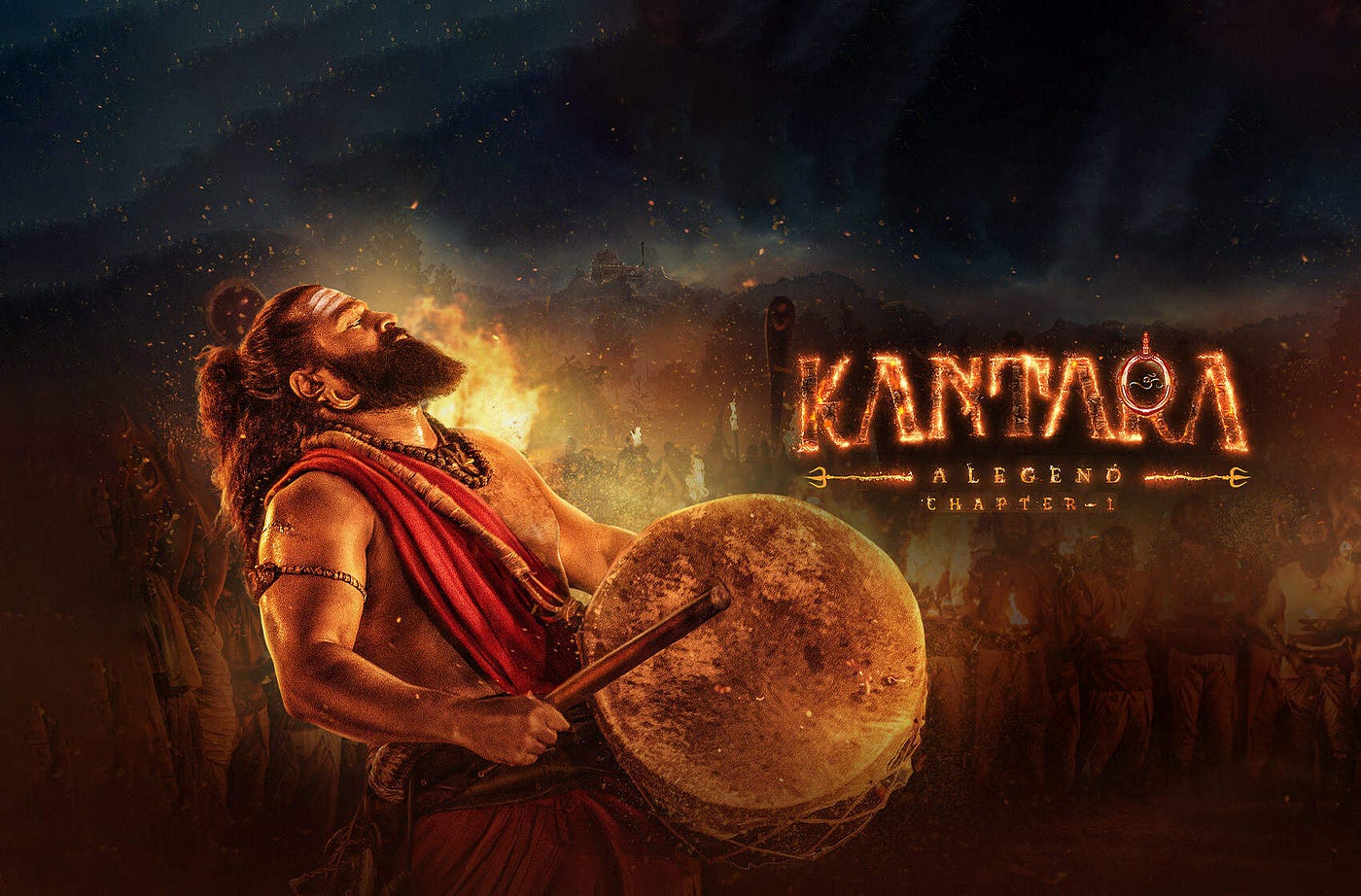
GreyBrainer Summary Report: Kantara A Legend: Chapter 1: Morphokinetics™ Narrative Pacing
Minute-by-minute audience retention risk vs. narrative tension. Identifies structural sag points and retention thresholds.
GreyBrainer Summary Report: Kantara A Legend: Chapter 1
Rishab Shetty’s “Kantara A Legend: Chapter 1” emerges as a formidable origin story, earning a GreyBrainer overall score of 8.8/10. This cinematic endeavor masterfully synthesizes indigenous folklore, socio-political commentary, and visceral action, setting a new benchmark for culturally rooted storytelling.
The story/script is a masterclass in narrative architecture, skillfully weaving Tulu culture into a universally resonant tale of land rights and spiritual awakening. It’s a slow-burning character study of Shiva, evolving from a hedonistic individual to a divine protector, culminating in an operatic climax that feels profoundly earned. The authentic dialogue and deep thematic exploration of man-nature balance, tradition versus modernity, and holy justice elevate the narrative beyond mere spectacle. While the initial exposition could be tighter, the script’s originality in blending folk horror, mythological drama, and socio-political commentary, anchored by exceptional world-building, is truly commendable.
Conceptualisation, driven by Shetty’s visionary direction, strategically crafts a prequel that delves deeper into the Daiva tradition. This is a “cinematic spectacle,” meticulously detailed in set design and ritual portrayal, ensuring a “deep visual and emotional experience.” The casting is inspired and character-centric, with Shetty himself delivering a performance that is inherently connected as Berme. The thoughtful inclusion of Jayaram, Rukmini Vasanth, and Gulshan Devaiah ensures an authentic embodiment of intricate mythological figures, grounding the fantastical in believable human emotion. The film’s audacious scale and unwavering commitment to indigenous folklore make its conceptualisation a significant industry challenge to conventional paradigms.
The performance/execution is largely breathtaking. Rishab Shetty delivers an “electrifying” and “once-in-a-lifetime” portrayal, commanding the screen with spiritual fervor and physical intensity. Rukmini Vasanth offers a career-best performance, adding crucial emotional depth, while Gulshan Devaiah and Jayaram leave indelible marks. B. Ajaneesh Loknath’s “thumping” score, replete with tribal chants, powerfully drives the narrative, though occasionally overpowering dialogue. Arvind S. Kashyap’s “spectacular” cinematography transforms landscapes into atmospheric entities, blending epic scope with human dimension. While the choreography is “stunning,” particularly the ritual dances, some CGI elements, like the Brahmarakshasa, could benefit from refinement to maintain consistent visual immersion.
“Kantara A Legend: Chapter 1” is a powerful testament to indigenous storytelling, where a deeply spiritual script is brought to life by visionary conceptualisation and electrifying execution. It leverages its specific cultural lens to achieve universal resonance, solidifying its place as a formidable and impactful cinematic experience.
Visual Layer Overview & Scores:
(Innermost Ring) Story: 8.8/10
(Middle Ring) Concept: 9.0/10
(Outermost Ring) Performance: 8.5/10

Detailed Layer Analysis, Ratings & Suggestions:
Magic of Story/Script (Score: 8.8/10)
(Core idea, narrative, themes, character arcs, originality)
As an expert critic employing the “GreyBrainer” methodology, I analyse “Kantara A Legend: Chapter 1” through the rigorous lens of its “Magic of Story/Script,” dissecting its narrative architecture, thematic resonance, and unique cultural integration. Directed by and starring Rishab Shetty, this cinematic offering distinguishes itself through a potent blend of folklore, social commentary, and visceral action, all anchored by a script that dares to delve deep into the spiritual bedrock of its setting, immersing the audience in a unique cultural experience.
Script: The script of “Kantara A Legend: Chapter 1” is a masterclass in weaving cultural specificity into a universally resonant narrative. Its plot structure & pacing initially unfold as a slow-burning character study, establishing the protagonist Shiva’s hedonistic, aimless existence against the backdrop of an ancient village grappling with land rights and tradition. The pacing intelligently escalates, gradually introducing the insidious threat of the landlord and the rigid authority of the forest department, before exploding into a breathtaking, almost operatic climax. This gradual build-up ensures that the eventual supernatural revelations and Shiva’s transformation feel earned rather than abrupt.
Character development: The character development is central to the story’s power. Shiva undergoes a profound arc, evolving from a reckless, indifferent individual into a reluctant protector, and then fully embraces his role as a protector of his community and its deities. His journey is fraught with internal conflict and external pressures, making his eventual divine possession a cathartic and impactful culmination of his spiritual awakening. The antagonist, the local landlord, is portrayed with chilling subtlety, his calculated malevolence a stark contrast to Shiva’s raw, untamed energy. Even the forest officer, Murali, receives a nuanced portrayal, his initial antagonism giving way to a grudging respect and eventual understanding, adding layers to the human conflict.
Dialogue: The dialogue is authentically rooted in the local Tulu dialect, contributing significantly to the film’s immersive world-building. It is often terse and impactful, particularly in the exchanges between Shiva and Murali, highlighting their ideological clashes. Crucially, the ritualistic chants and pronouncements associated with the Daiva Kola performances are not mere spectacle but integral narrative devices, carrying immense thematic depth.
Thematic Depth: The film delves into profound themes, stimulating intellectual engagement. It explores the delicate balance between man and nature, the clash between ancient traditions and modern bureaucracy, the spiritual connection to land, and the nature of divine justice. It questions skepticism versus belief, and the price of progress when it disregards cultural heritage.
Originality & Genre Conventions: The script masterfully blends folk horror, mythological drama, and socio-political commentary on land rights. Its originality stems from the authentic integration of Daiva Kola rituals and local Tulu culture, subverting conventional hero narratives by embedding the protagonist’s transformation within a profound spiritual awakening. While drawing on universal archetypes, its specific cultural lens and raw energy feel genuinely innovative, sparking intrigue in the audience. The world-building is exceptional, achieved not only through dialogue and plot but also through a deep respect for the cultural practices and spiritual beliefs depicted, making the fictional village feel incredibly real and lived-in.
Overall, the script of “Kantara A Legend: Chapter 1” is a testament to the power of indigenous storytelling, delivering a narrative that is both culturally specific and universally compelling. Its ability to marry a grounded human conflict with spectacular supernatural elements, all while maintaining thematic coherence and character integrity, is truly commendable.
Potential Enhancements:
-
A slightly tighter exposition in the initial act could further sharpen the narrative focus before the core conflicts fully emerge, accelerating audience engagement.
-
While effective, some supporting character motivations could be explored with a marginally greater depth to enrich the ensemble’s contribution to Shiva’s journey.
Magic of Conceptualisation (Score: 9.0/10)
(Director’s vision, editing, casting, overall presentation)
Magic of Conceptualisation: A Dive into Mythic Origins
Rishab Shetty’s “Kantara A Legend: Chapter 1” emerges as a profoundly conceptualised cinematic endeavor, building upon the rich tapestry of its predecessor by delving into the ancient roots of the Daiva tradition. Shetty’s directorial vision is unequivocally the driving force, manifesting a cohesive and immersive world that seamlessly blends regional folklore, spirituality, and visceral action within an epic period mythological drama. The decision to craft a prequel is a strategic masterstroke, allowing for a deeper, more intricate exploration of the man-nature conflict and ancestral lore, thereby enriching the established “Kantara” universe.
The overall presentation is a “visual treat” and a “cinematic spectacle”, reflecting a meticulous attention to detail in set design, cinematography, and the portrayal of ancient rituals. This grand scale, supported by a substantial budget, translates into a “deep visual and emotional experience” for the audience. The editing is instrumental in crafting a narrative rhythm that builds tension towards a “spine-chilling pre-climax and thunderous climax”, indicative of a well-orchestrated narrative flow that captivates and enthralls.
Regarding casting, the approach is decidedly character-centric, leaning towards inspired choices. Rishab Shetty, as both writer-director and lead actor, exemplifies this, embodying the fierce Naga Sadhu with an inherent understanding and personal connection to the role. This self-casting is not a vanity project but a testament to his deep immersion in the narrative’s cultural and spiritual core. The inclusion of talents like Jayaram, Rukmini Vasanth, and Gulshan Devaiah further underscores a commitment to actors who can authentically inhabit these intricate mythological figures, rather than relying on pure star power. This thoughtful selection elevates the performances and grounds the fantastical elements in believable human emotion.
The originality of this conceptualisation lies in its unwavering commitment to indigenous folklore, a commitment that not only sets a benchmark for culturally rooted storytelling in mainstream cinema but also serves as a powerful reminder of our rich cultural heritage. Its audacious scale and potential impact are significant, demonstrating that intensely regional narratives, when conceptualised with such vision and executed with precision, can achieve global resonance and critical acclaim, challenging conventional filmmaking paradigms.
Potential Enhancements:
-
While visually stunning, a more explicit exploration of the underlying philosophical tenets of the Daiva tradition, such as the concept of dharma and the cyclical nature of life, could further deepen the intellectual engagement beyond the spectacle. This would provide a richer understanding of the film’s thematic underpinnings and its connection to the ancient Daiva tradition.Refining some of the CGI elements, particularly in earlier mythological sequences, could ensure a more consistently seamless visual experience throughout the film’s expansive runtime.
-
A greater emphasis on the subtle emotional arcs of supporting characters, perhaps through more focused editing or character development, could further elevate the film’s dramatic impact and the film could create a more nuanced and emotionally resonate narrative, enhancing its dramatic impact.
Magic of Performance/Execution (Score: 8.5/10)
(Acting, music, cinematography, effects, choreography)
GreyBrainer Analysis: Magic of Performance/Execution in “Kantara A Legend: Chapter 1”
“Kantara: A Legend, Chapter 1” delivers a visceral and often breathtaking cinematic experience through its “magic of performance/execution,” vastly expanding upon the foundation laid by its predecessor with amplified scale and ambition. Rishab Shetty, in a dual role, delivers an “electrifying” and “layered portrayal” of Berme, demonstrating a remarkable intensity that critics have lauded as a “once-in-a-lifetime level performance”. His ability to shift between physical ferocity and spiritual fervor commands the screen with undeniable presence. Rukmini Vasanth, as Kanakavathi, surprises with her poise, subtle strength, and a “career-best performance,” adding significant emotional weight. Gulshan Devaiah embodies menace with an “explosive performance” as the royal antagonist, while Jayaram leaves a “tremendous mark” with his convincing portrayal of kingship. The collective strength of the acting significantly contributes to the film’s immersive world-building, engaging the audience in the narrative.
B. Ajaneesh Loknath’s musical score is a powerful driving force, with a “thumping” background score that masterfully uses tribal chants and percussion to heighten action and emotional sequences. Songs like ‘Brahmakalasha’ and ‘Rebel’ stand out, celebrated for their cultural authenticity and thematic resonance, fostering a sense of connection and respect among the audience. However, some instances of the score occasionally overpowering dialogue suggest a slight imbalance in the sound mix.
Arvind S. Kashyap’s cinematography is consistently “spectacular” and “stunning,” transforming the natural landscapes into breathing, atmospheric entities. His grand, creative shots and close-ups are lauded for giving a palpable sense of life and frenzy to forests, battles, and rituals, effectively blending epic scope with human dimension. The visual effects, while generally “flawless” in elevating grandeur, faced specific criticism for certain elements, particularly the depiction of the Brahmarakshasa, which some found to be less refined and even “like a cartoon character”.
The choreography, especially for action sequences by Arjun Master and Todor Lazarov, is “stunning,” blending primal energy with spectacle. The opening chariot sequence is cited as a “masterclass in staging,” and the ritual dances, particularly the ‘Brahmakalasha’ sequence, are meticulously crafted by choreographer Bhushan, who treated them as authentic ceremonies, lending them a “mesmerising” quality.
Overall, the execution of “Kantara A Legend: Chapter 1” is an ambitious and largely successful endeavor that elevates Indian folklore into a grand cinematic spectacle. The film’s scale and visual achievements are undeniable, and its successful execution leaves the audience impressed and appreciative. While the film occasionally trades the raw intimacy of its predecessor for enormity, this does not diminish its overall impact as a “formidable origin story”.
Potential Enhancements:
-
Refine specific visual effects sequences, such as the Brahmarakshasa and certain animal depictions, to ensure consistent quality and prevent moments that might detract from the film’s otherwise immersive experience.
-
Optimise the audio mixing to prevent the powerful background score and songs from occasionally overshadowing dialogue, ensuring narrative clarity without compromising atmospheric intensity.
-
Integrate more moments of intimate character development and emotional depth. This will allow the grandeur to be balanced with the raw, personal connection that resonated profoundly in the first ‘Kantara’. Such a balance will ensure that the audience feels a deeper emotional connection with the characters and their journey.
Overall Improvement Opportunities:
-
Enhance narrative pacing in the initial act by tightening exposition and enriching supporting character arcs, allowing for a more immediate and profound audience connection to the ensemble’s journey.
-
Refine specific visual effects, particularly early mythological sequences and creature depictions (e.g., Brahmarakshasa), to ensure a consistently seamless and immersive visual experience across the film’s expansive scope.
-
Optimise audio mixing to achieve a better balance between the powerful background score and dialogue, preventing narrative clarity from being compromised, and integrate more moments of intimate character development to complement the film’s grandiosity.
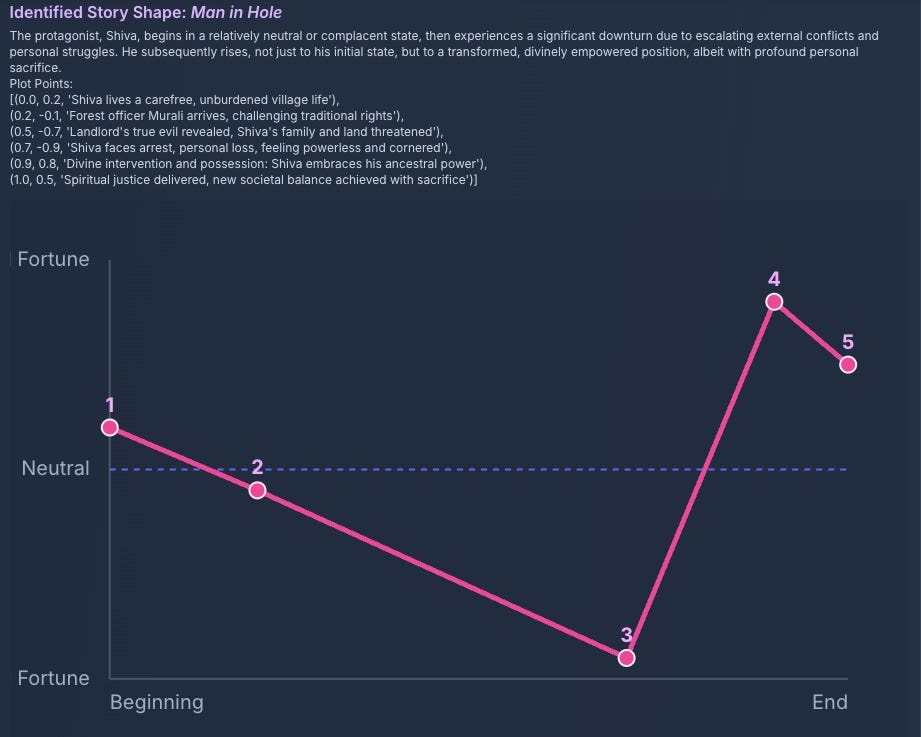
Identified Story Shape: Man In Hole
“Kantara: A Legend — Chapter 1” fits the “Man in Hole” story shape perfectly, with Shiva’s journey reflecting a fall into chaos followed by spiritual rebirth.
-
Shiva’s carefree village life: The story opens with a serene and uncomplicated setting — Shiva leads a carefree life in his village, blissfully ignorant of the impending conflicts.
-
Forest officer Murali arrives: His sudden appearance disrupts the village’s age-old beliefs, shattering Shiva’s peaceful existence and initiating the downward spiral.
-
Landlord’s evil revealed: The revelation of the landlord’s malevolence plunges Shiva’s family and land into jeopardy, intensifying his emotional and spiritual descent.
-
Shiva faces arrest and loss: This is the lowest point — he feels helpless and cornered, symbolising the depth of his “hole.”
-
Divine intervention: Shakti’s power awakens within Shiva, transforming his despair into strength and igniting his rise.
-
Spiritual justice achieved: Balance is restored through Shiva’s sacrifice and divine justice, symbolising the completion of his arc from downfall to transcendence.
Together, these points trace Shiva’s journey from peace to despair and finally to divine empowerment, the essence of the “Man in Hole” story shape.
Related Greybrainer Reads
GREYBRAINER
AI-Powered Cinematic Intelligence