GreyBrainer Report: The Roses (2025): Morphokinetics™ Narrative Pacing
Minute-by-minute audience retention risk vs. narrative tension. Identifies structural sag points and retention thresholds.
GreyBrainer Report: The Roses (2025)
Jay Roach's “The Roses (2025),” a reimagining of the classic “The War of the Roses,” delivers a sharply witty, albeit somewhat safe, exploration of marital disintegration, buoyed by the undeniable prowess of its lead actors. screenplay by Tony McNamara, the film stars Benedict Cumberbatch as Theo and Olivia Colman as Ivy, into an escalating domestic war, sparked by a reversal of their professional fortunes. This contemporary lens aims to dissect modern marriage dynamics, ego, and the painful art of letting go, all wrapped in a darkly comedic package. The film’s conceptualisation shines brightest in its casting. Colman and Cumberbatch are a masterstroke, their chemistry and verbal dexterity elevating McNamaras' acerbic dialogue to compelling heights. The narrative cleverly updates gender roles, positioning Ivy as the ascendant professional, which offers a fresh perspective on power struggles within a relationship. Visually, the film employs a “high gloss and sheen” that creates a “diverting disconnect” from the escalating chaos, with the couple’s meticulously designed, deconstructing house serving as a potent metaphor for their fractured union. However, this polished aesthetic, coupled with Roach’s comedic background, occasionally leads to a tonal imbalance, preventing the film from fully embracing the brutal satire of its source material and sometimes “flinching from the recognisable, tragicomic reality of a bad marriage.” While the script offers brilliant, biting exchanges, its “reimagining” often adheres too closely to the original, limiting truly fresh insights into modern relationships. Certain character motivations feel contrived, designed to escalate conflict rather than arising organically, and the integration of contemporary elements like deepfaking can feel superficial. Despite these narrative shortcomings, the performances are the film’s undeniable strength. Colman and Cumberbatch deliver nuanced, intense, and often hilarious portrayals, carrying the film through its less original moments. The supporting cast, including Andy Samberg and Kate McKinnon, provides effective comedic relief. Ultimately, “The Roses” is an engaging, well-acted dark comedy that, despite some missed opportunities for deeper thematic originality and a more unflinching satirical bite, resonates with its portrayal of the universal struggles within a crumbling relationship. The overall GreyBrainer score is 6.8/10.
GreyBrainer Layer Analysis
The GreyBrainer methodology analyses films through three core layers:
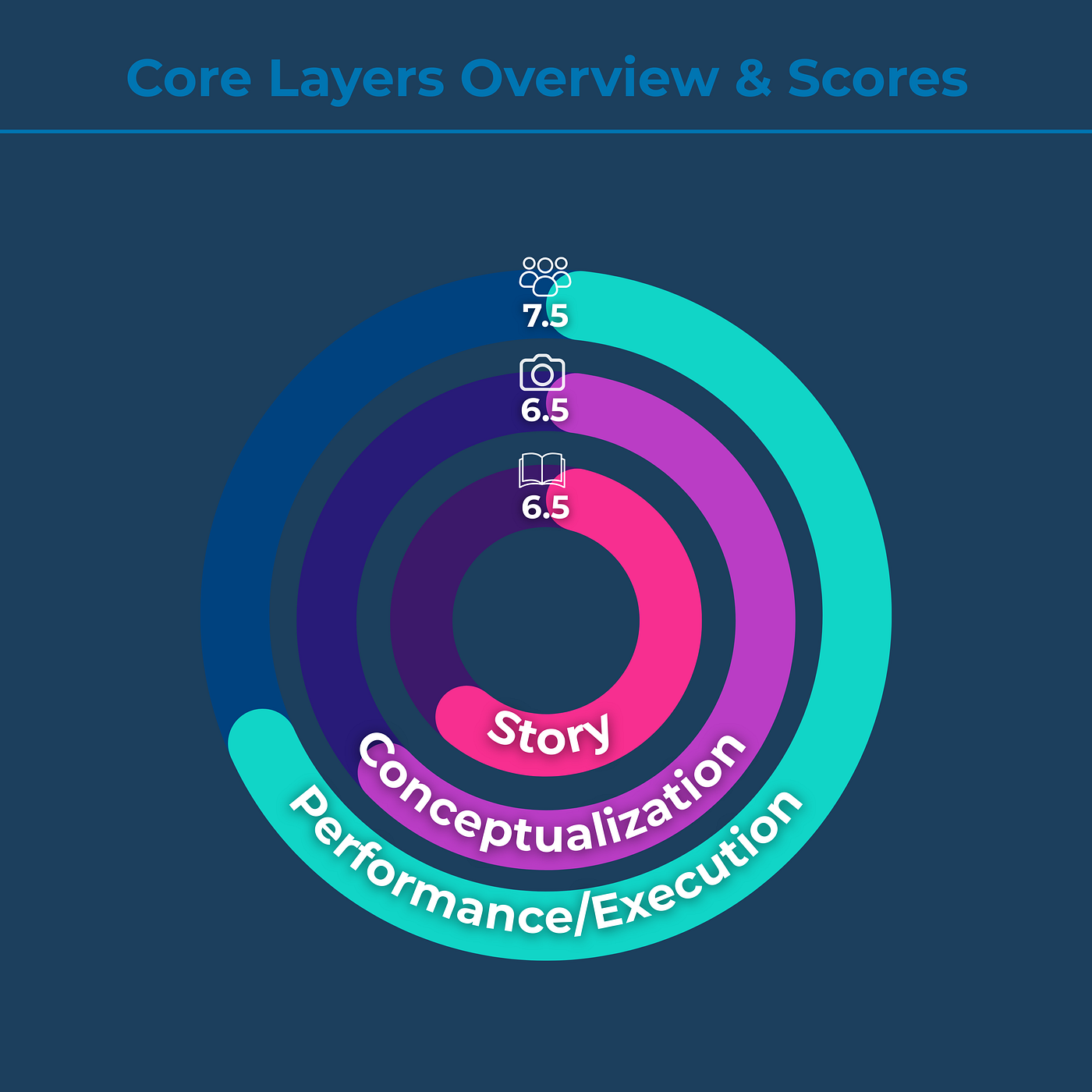
Core Ring: Magic of Story/Script — 6.5/10
Core idea, narrative, themes, character arcs, originality. As an expert film critic, I’ve had the opportunity to analyse “The Roses (2025),” a highly anticipated reimagining of the classic “The War of the Roses.” Directed by Jay Roach and penned by Tony McNamara, this dark comedy delves into the destructive unravelling of a seemingly perfect marriage. Released on August 29, 2025, the film stars Benedict Cumberbatch and Olivia Colman, portraying Theo and Ivy Rose, a couple whose idyllic life descends into an all-out war when their professional fortunes diverge.
1. Detailed Critique of the Magic of Story/Script
The core idea of “The Roses” is a compelling one, taking the foundational premise of Warren Adler’s novel and the 1989 film, a bitter divorce escalating into a no-holds-barred battle over their shared life and attempting to refract it through a contemporary lens. The narrative centres on Ivy and Theo, a couple whose outwardly successful careers, loving marriage, and great kids mask a brewing storm of competition and hidden resentment. This storm ignites when Theo’s career takes a nosedive just as Ivy’s ambitions begin to soar. Tony McNamara’s screenplay, known for its sharp wit in previous works, brings a certain acerbic quality to the dialogue, infusing the marital strife with barbed exchanges and dark humour. The film aims to explore themes such as the fragility of relationships, modern marriage dynamics, gender roles, and the delicate balance between work and family. It effectively showcases how jealousy, insecurity, and frustration can fester beneath a polished façade. The script particularly shines in illustrating the common, almost ordinary, conflicts that can tear a marriage apart, highlighting the profound difficulty of letting go of a relationship even when it becomes deeply hurtful. However, some critics note that despite its “reimagining” status, the script occasionally adheres too closely to the original “War of the Roses,” limiting its potential for truly fresh and incisive commentary on modern relationships. While it attempts to incorporate contemporary elements like deepfaking, these often feel like superficial gestures rather than deeply integrated thematic explorations. The narrative’s tendency to jump through time also sometimes hinders a more organic development of character motivations. For instance, Ivy’s sudden resentment towards Theo for his connection with their children can feel contrived rather than earned, designed primarily to escalate the conflict. Both Ivy and Theo are ultimately depicted as “selfish, egotistical, narcissistic workaholics,” which, while central to the dark comedy, can occasionally make their arcs feel less nuanced.
2. Strengths and Weaknesses
Strengths:
Witty and Incisive Dialogue: Tony McNamara’s screenplay delivers sharp, often brutal, dialogue that fuels the dark comedic tone and the escalating marital warfare. Relatable Core Conflict: The film powerfully portrays the breakdown of a relationship, tapping into universal themes of competition, resentment, and the pain of letting go, even when love still exists in some form. Strong Central Performances: The script provides a fertile ground for Benedict Cumberbatch and Olivia Colman to deliver intense and darkly humorous performances as the warring couple. Darkly Humorous Exploration: The story effectively uses satire to expose the darker instincts of human nature within a marital context, aiming to make audiences laugh while confronting uncomfortable truths. The final act, in particular, is noted for its “mean-spirited cackles”.
Weaknesses:
Lack of Originality in Reimagining: Despite being a “reimagining,” the script is criticised for sticking too close to the original film, potentially missing opportunities to offer more profound modern insights. Contrived Character Motivations: Certain character actions and emotional shifts, such as Ivy’s resentment regarding the children, feel forced to advance the plot rather than arising organically from their established personalities. Superficial Integration of Modern Elements: The inclusion of contemporary technologies or social commentaries (e.g., gender roles, work/family balance, deepfaking) sometimes lacks depth, merely gesturing at these issues without fully exploring them. Pacing and Time Jumps: The script’s temporal jumps can disrupt the flow and prevent a deeper dive into the characters’ emotional states and development over time.
3. How it Contributes to the Overall Film
The script is undeniably the backbone of “The Roses.” It dictates the film’s satirical black comedy genre, providing the blueprint for the escalating domestic warfare and the often-uncomfortable humour. The narrative structure, with its focus on the contrasting career trajectories of Theo and Ivy, directly drives the central conflict and the character arcs. McNamara’s sharp writing is crucial in establishing the tone, ensuring the film maintains its dark comedic edge even as the characters descend into increasingly destructive behaviour. Without a strong script, the film risks becoming a mere rehash, but the dialogue and thematic intentions aim to elevate it, making the audience complicit in the couple’s unravelling. The script’s ability to make the audience feel the “ordinary” conflicts of marriage, even in their extreme manifestation, is key to its impact.
4. Suggested Improvements
To enhance the “Magic of Story/Script,” future iterations or similar projects could consider the following: Deeper Modern Commentary: While being a “reimagining,” the script could benefit from a bolder departure from the original, offering more unique and profound commentary on contemporary marital pressures, societal expectations, and the digital age, beyond superficial inclusions. More Organic Character Development: Focus on allowing character motivations and emotional shifts to evolve more naturally, even within the satirical framework. This would involve spending more time developing the internal logic behind their escalating animosity rather than relying on plot devices. Integrated Thematic Exploration: If modern elements like deepfaking or specific gender role discussions are introduced, they should be woven more intricately into the narrative and character arcs, impacting the core themes with greater depth and purpose. Refined Pacing and Structure: While time jumps can be effective, a more deliberate approach that allows for sustained character exploration in key moments could strengthen the emotional resonance and narrative coherence.
Structured Data:
Main Cast: Benedict Cumberbatch (Theo Rose), Olivia Colman (Ivy Rose), Andy Samberg, Allison Janney, Belinda Bromilow, Sunita Mani, Ncuti Gatwa, Jamie Demetriou, Zoë Chao, Kate McKinnon Suggested Score: 6.5/10
Enhancement Opportunities:
Greater thematic originality in its modern adaptation.
More nuanced and organically developed character motivations.
Deeper integration of contemporary societal and technological themes.
Refined narrative pacing to allow for more sustained character exploration.
Middle Ring: Magic of Conceptualisation — 6.5/10
(Director’s vision, editing, casting, overall presentation.) “The Roses (2025)” emerges as a bold, if at times uneven, reimagining of a classic tale of marital discord, attempting to infuse modern sensibilities into the darkly comedic battleground of a crumbling marriage. Directed by Jay Roach and penned by Tony McNamara, the film’s conceptualisation is a fascinating blend of star power, sharp dialogue, and a glossy aesthetic that ultimately delivers a mixed bouquet of critical reception.
Detailed Critique of the Magic of Conceptualisation
The “Magic of Conceptualisation” in “The Roses” lies primarily in its audacious casting and the directorial vision to pivot the narrative towards a “verbal, character-driven black comedy”. Director Jay Roach, known for his work in comedies like “Austin Powers” and “Meet the Parents”, takes on the challenge of updating Warren Adler’s 1981 novel, previously adapted into the iconic 1989 film “The War of the Roses”. This reimagining centres on Theo (Benedict Cumberbatch), an architect whose career falters, and Ivy (Olivia Colman), an up-and-coming restaurateur whose ambitions soar. The conceptual shift places Ivy in a more dominant professional role, altering the traditional power dynamics of the original story. The choice of Benedict Cumberbatch and Olivia Colman as the sparring couple is arguably the film’s strongest conceptual stroke. Both are lauded for their dramatic and comedic prowess, and McNamara’s screenplay, designed to leverage their “incredibly verbally brilliant actors”, allows them to trade barbs with exquisite precision. The film aims for a high-gloss, “feel-good romcom style” in its presentation, which creates a “diverting disconnect” from the escalating domestic warfare. This stylistic choice, while visually appealing, has been noted by some critics as potentially softening the tragicomic reality of a truly bad marriage. Editing, though not explicitly detailed in available reviews, can be inferred to play a crucial role in balancing the film’s “blend of broad comedy and dark satire”. The tension between these two genres is a defining characteristic of the film’s conceptualisation, and the success of this balance dictates the overall impact. The narrative’s progression from a seemingly perfect life to an all-out war is intended to be both hilarious and painfully real.
Strengths and Weaknesses
Strengths:
Exceptional Casting: The pairing of Olivia Colman and Benedict Cumberbatch is a masterstroke. Their undeniable chemistry and individual talents elevate the material, making their descent into mutual hatred compelling to watch. Their ability to convey both subtle resentment and overt hostility provides the emotional core of the film. Sharp, Character-Driven Dialogue: Tony McNamara’s screenplay capitalises on the verbal dexterity of the lead actors, crafting witty and often brutal exchanges that drive the black comedy. Modern Reimagining: The updated gender dynamics, with Ivy’s surging career contrasting Theo’s professional setback, offer a fresh perspective on the underlying themes of ego, ambition, and marital power struggles. Visually Polished Presentation: The “high gloss and sheen” of the film creates an attractive, albeit at times contradictory, backdrop for the escalating chaos.
Weaknesses:
Tonal Imbalance: The film’s attempt to blend broad comedy with dark satire has been described as an “uneasy marriage”. Some critics felt that director Jay Roach’s comedic background might have prevented the film from fully embracing the sharp satire of its source material. This could lead to moments where the humour undermines the darker implications of the narrative. Flinching from Reality: Despite its dark comedic premise, the film has been criticised for “flinching from the recognisable, tragicomic reality of a bad marriage”. This suggests that the conceptualisation, while aiming for a stylish take, might have pulled its punches on the more brutal aspects of marital breakdown, potentially diminishing its emotional resonance. Pacing Issues: While praised for its clever writing, some scenes reportedly feel “a bit slow or over-the-top”, indicating potential issues in the editing or directorial choices regarding the rhythm of the film.
How it Contributes to the Overall Film
The conceptualisation is the bedrock of “The Roses”. The decision to cast Colman and Cumberbatch immediately sets a high bar for performance, guaranteeing an engaging central dynamic regardless of other elements. The focus on a “verbal, character-driven” approach shapes the entire narrative, making the dialogue a central force in conveying the escalating animosity. The glossy presentation, while a potential weakness in terms of raw realism, establishes a distinct aesthetic that differentiates it from its predecessor and aligns with a contemporary dark comedy style. Ultimately, the conceptualisation dictates the film’s identity as a satirical black comedy exploring ego and vulnerability.
Suggested Improvements
Lean into the Darker Satire: To fully realise the potential of the source material and the talented cast, the film could have benefited from a more unflinching embrace of its darker, more tragicomic elements. This might involve pushing the boundaries of the “uneasy marriage” between comedy and satire to create a more impactful and memorable experience. Refine Tonal Consistency: While a blend of tones can be effective, ensuring a more seamless transition between the broad comedic moments and the genuinely painful ones would strengthen the film’s emotional core and prevent it from feeling disjointed. Explore the “Why” More Deeply: While the surface-level reasons for the marital breakdown are presented (Theo’s career slump, Ivy’s success), a deeper dive into the psychological underpinnings of their mutual destruction could have added more weight and poignancy to the satire. More Incisive Social Commentary: Given the modern updates to the plot, further embedding sharper commentary on contemporary marriage dynamics, gender roles, and societal pressures could have elevated the film beyond a mere “reimagining” into a truly incisive work.
Main Cast: Benedict Cumberbatch (Theo Rose), Olivia Colman (Ivy Rose), Andy Samberg (Barry), Allison Janney (Eleanor), Kate McKinnon (Amy), Ncuti Gatwa (Jeffrey), Sunita Mani (Jane), Jamie Demetriou (Rory), Zoë Chao (Sally), Hala Finley (Hattie Rose), Wells Rappaport (Roy Rose), Belinda Bromilow (Janice) Suggested Score: 6.5/10
Enhancement Opportunities:
A more daring exploration of the darker satirical elements.
Improved tonal consistency to prevent jarring shifts between comedy and drama.
Deeper psychological exploration of the characters’ motivations for their destructive behaviour.
More pointed social commentary on modern marital pressures.
Outer Ring: Magic of Performance/Execution — 7.5/10
(Acting, music, cinematography, effects, and choreography.) “The Roses (2025)”, directed by Jay Roach and penned by Tony McNamara, offers a sharp, satirical, and often painfully hilarious reimagining of the classic marital warfare narrative. Released on August 29, 2025, this dark comedy delves into the spectacular unravelling of Theo and Ivy Rose’s seemingly idyllic marriage, fueled by shifting career dynamics and escalating resentment. The film’s success hinges significantly on its execution, particularly in its performances, visual style, and sonic landscape.
1. Detailed Critique of the Magic of Performance/Execution
Acting: The undeniable cornerstone of “The Roses” is the powerhouse duo of Olivia Colman as Ivy and Benedict Cumberbatch as Theo. Their performances are described as the heart of the movie, delivering sharp, funny, and deeply emotional portrayals of a couple consumed by ego and pride. Colman, as Ivy, masterfully navigates the character’s ascent in her career while her marriage crumbles, showcasing a blend of ambition, vulnerability, and a growing, delicious ruthlessness. Cumberbatch, as Theo, embodies the fragile male ego, his controlled life fracturing under professional setbacks and marital strain. Critics have highlighted his bravery in portraying a less immediately sympathetic character, embracing moral ambiguity. The chemistry between Colman and Cumberbatch is palpable, making their descent into psychological warfare both believable and tragically comedic. The supporting cast, featuring comedic stalwarts like Andy Samberg (Barry) and Kate McKinnon (Amy), provides crucial relief and additional layers to the marital mayhem. Samberg’s portrayal of a friend witnessing the marriage’s decline, who later becomes Theo’s divorce lawyer, adds a uniquely awkward and humorous dimension. McKinnon’s role as Amy, a confidante to Theo, injects her signature brand of quirky humour, balancing the intense central drama. Allison Janney, Ncuti Gatwa, and others further enrich the ensemble, each contributing to the film’s satirical edge. Music: Theodore Shapiro’s score for “The Roses” plays a vital role in setting and modulating the film’s unique tone. As a satirical black comedy, the music likely walks a tightrope between dramatic tension and comedic lightness, underscoring the absurdity and the heartbreak in equal measure. A composer of Shapiro’s calibre, known for his work in both comedies and dramas, would be expected to craft a score that enhances the shifting emotional landscape, perhaps using ironic melodies or escalating orchestrations to mirror the couple’s spiralling conflict. Cinematography: Florian Hoffmeister, as the Director of Photography, is responsible for the film’s visual aesthetic. Given the film’s premise of a picture-perfect life unravelling, the cinematography likely plays with contrasts, perhaps beginning with polished, almost aspirational visuals that gradually become more fractured, stark, or even claustrophobic as Theo and Ivy’s relationship deteriorates. The film’s setting, including scenes shot in Devon, England, and at Pinewood Studios, suggests a blend of picturesque exteriors and meticulously designed interiors. The production designer, Mark Ricker, intentionally designed the house to represent the deconstructed marriage, with visuals like a tilting window and open holes in the walls, which Hoffmeister’s cinematography would undoubtedly emphasise to symbolise the crumbling facade. Effects: As a character-driven satirical black comedy, “The Roses” would not typically rely on extensive visual effects in the blockbuster sense. Any “effects” would likely be subtle, serving to enhance the narrative or visual metaphors, such as the aforementioned deconstructed house elements. Practical effects might be employed for comedic physical gags or to underscore the destructive nature of the couple’s conflict. Choreography: While not a dance film, “The Roses” could incorporate a form of “choreography” in its blocking and the physical interactions between its characters, especially during their escalating arguments and petty acts of revenge. The way characters move within a space, their physical reactions to each other, and the pacing of their confrontations would be meticulously planned to maximise both dramatic impact and comedic timing.
2. Strengths and Weaknesses
Strengths:
Phenomenal Lead Performances: Colman and Cumberbatch deliver masterclasses in dark comedy, anchoring the film with their impeccable timing, emotional depth, and explosive chemistry. Their ability to convey both love and loathing simultaneously is a major draw. Sharp, Witty Screenplay: Tony McNamara’s writing is a significant asset, praised for its clever dialogue and ability to balance humour with drama. His Oscar-nominated work on “Poor Things” and “The Favourite” suggests a talent for biting satire and complex character dynamics. Effective Tone Management: Jay Roach’s direction, combined with McNamara’s script, adeptly navigates the tricky tonal shifts between poignant drama and laugh-out-loud dark comedy, making the audience connect on various levels. Symbolic Production Design and Cinematography: The intentional design of the Roses’ house as a metaphor for their fractured marriage, visually emphasised by Florian Hoffmeister, is a powerful and creative storytelling device.
Weaknesses:
Pacing Issues: Some critics noted that certain scenes felt “a bit slow or over-the-top,” which could occasionally disrupt the film’s flow. Familiarity of Premise: While a reimagining, the core premise of “The War of the Roses” is well-known, potentially leading to a sense of predictability for those familiar with the original. The film needed to find fresh ways to tell the story, which, by most accounts, it largely achieved through its cast and writing. Tonal Ambiguity (for some viewers): While a strength for many, the blend of dark humour and emotional realism might not resonate with all audiences, potentially leaving some unsure how to feel at certain moments.
3. How it Contributes to the Overall Film
The “Magic of Performance/Execution” is not just a component but the very engine of “The Roses.” Acting is paramount, as the film relies heavily on the nuanced portrayal of its central couple’s disintegration. Without the compelling performances of Colman and Cumberbatch, the emotional stakes and comedic beats would fall flat. Their ability to embody the characters’ flaws and vulnerabilities makes the satire land with greater impact. The music guides the audience through the film’s complex emotional landscape, signalling shifts in mood and amplifying both the comedic absurdity and the underlying tragedy. Cinematography and production design visually articulate the internal state of the marriage, transforming their home from a symbol of perfection into a physical manifestation of their fractured relationship. This visual storytelling deepens the thematic resonance of the film. The subtle “choreography” of character interactions and reactions, along with minimal, purposeful “effects,” contributes to the film’s overall polish and ensures that every element serves the narrative’s dark comedic intent.
4. Suggested Improvements
Tighten Pacing in Select Scenes: While the film is generally engaging, a sharper edit in moments identified as “slow” could enhance the overall rhythm and maintain consistent comedic and dramatic tension. Further Explore Supporting Character Arcs: While the focus is rightly on Theo and Ivy, a deeper dive into the perspectives or consequences for characters like Barry or Amy, perhaps through slightly expanded scenes, could add even more texture and commentary on the collateral damage of such a toxic marriage. Bolden Visual Metaphors: While the house design is strong, pushing the visual metaphors even further, perhaps through more surreal or exaggerated imagery, could further distinguish it from its predecessor and amplify the satirical elements. Main Cast: Benedict Cumberbatch (Theo Rose), Olivia Colman (Ivy Rose), Andy Samberg (Barry), Kate McKinnon (Amy), Allison Janney, Ncuti Gatwa, Jamie Demetriou, Zoë Chao, Belinda Bromilow, Sunita Mani Suggested Score: 7.5/10 Enhancement Opportunities: 1. Refine pacing in slower sequences. 2. Consider slightly expanding arcs for key supporting characters. 3. Explore bolder or more surreal visual metaphors to heighten satire.
Overall Enhancement Opportunities
Deepen Thematic & Psychological Nuance: While the film offers witty dialogue and strong performances, a bolder departure from the original’s narrative framework could have allowed for a more incisive and original commentary on contemporary marital pressures and the psychological depths of destructive behaviour, moving beyond superficial modern updates. Refine Tonal Consistency and Pacing: The film's oscillation between broad comedy and dark satire, alongside some noted pacing issues and abrupt time jumps, occasionally dilutes its impact. A more seamless integration of its comedic and dramatic elements, with a focus on organic character development and consistent narrative flow, would enhance its emotional resonance. Amplify Satirical Edge and Visual Metaphors: To truly distinguish itself, “The Roses” could have leaned more daringly into its darker satirical impulses, perhaps through more unflinching portrayals of marital acrimony. Further pushing the already strong visual metaphors of the deconstructing home could have visually amplified the narrative’s themes with greater artistic boldness. This analysis was generated using GreyBrainer AI, a comprehensive movie review methodology that evaluates films through multiple analytical layers. Methodology Note: GreyBrainer uses a three-layer concentric analysis approach: Core (Story): Narrative foundation, themes, character development Middle (Conceptualisation): Director’s vision, editing, casting decisions Outer (Performance): Acting, cinematography, music, technical execution
Related Greybrainer Reads
GREYBRAINER
AI-Powered Cinematic Intelligence