50-Word Verdict
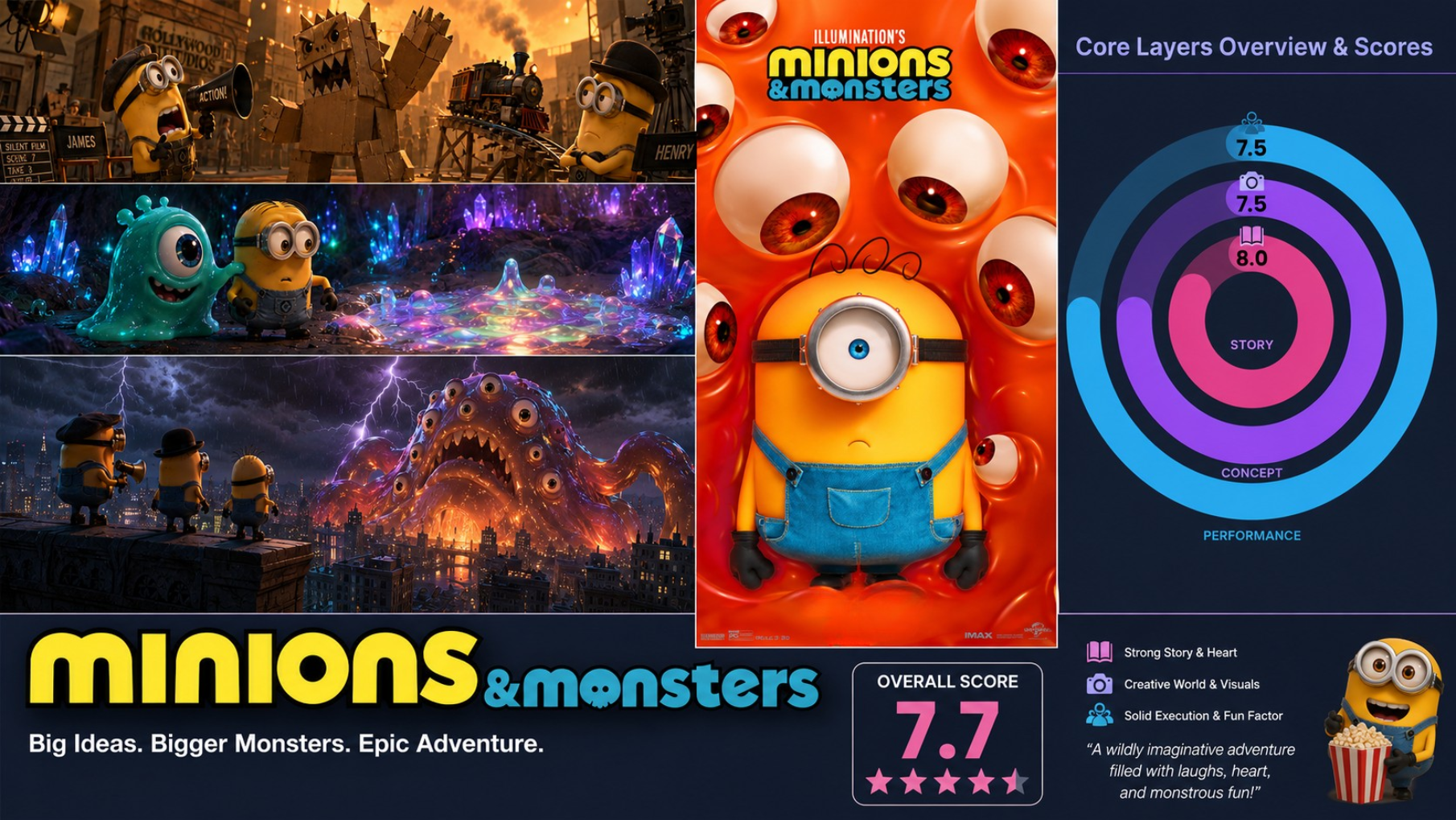
Analysis Subject: minion and monsters Director: Pierre Coffin Main Cast: Pierre Coffin Overall Greybrainer Score: 7.7/10 About the Greybrainer Methodology: This analysis examines films through three critical layers Story/Script, Conceptualization, and Performance/Execution providing a comprehensive evaluation of cinematic elements that contribute to a film's overall impact and artistic merit. Three
Greybrainer Analysis: minion and monsters: Morphokinetics™ Narrative Pacing
Minute-by-minute audience retention risk vs. narrative tension. Identifies structural sag points and retention thresholds.
Analysis Subject: minion and monsters
Director: ** Pierre Coffin
Main Cast: Pierre Coffin
Overall Greybrainer Score: 7.7/10
About the Greybrainer Methodology: This analysis examines films through three critical layers - Story/Script, Conceptualization, and Performance/Execution - providing a comprehensive evaluation of cinematic elements that contribute to a film's overall impact and artistic merit.
Three-Layer Analysis
Story AI: 8/10 User: 8/10
Concept AI: 7.5/10 User: 7.5/10
Performance AI: 7.5/10 User: 7.5/10
Magic of Story/Script Core idea, narrative, themes, character arcs, originality.
"Minions & Monsters," the latest addition to Illumination's beloved Despicable Me franchise, delivers a vibrant and surprisingly heartfelt narrative that deviates from its predecessors while retaining the signature Minion chaos. Released on July 1, 2026, this prequel, directed by Pierre Coffin and Patrick Delage, and penned by Brian Lynch and Coffin, transports audiences to the glamorous and tumultuous world of 1920s Hollywood, offering a fresh perspective on the Minions' eternal quest for purpose. The film's core idea revolves around a new tribe of Minions, notably the artistic James, the resourceful Henry, and the enthusiastic Ed, who stumble into the burgeoning film industry. Their initial stint as accidental silent film stars is cut short by the advent of "talkies," leaving them aimless. This existential crisis leads James to a novel ambition: to make his own monster movie. The narrative beautifully intertwines this filmmaking endeavor with the Minions' perennial search for an evil master, creating a unique blend of slapstick comedy, creative ambition, and accidental world-saving. The plot's originality lies in its exploration of Hollywood's golden age through the Minions' eyes, offering a charming homage to classic cinema and monster movies.
Detailed Critique of the Magic of Story/Script
The script for "Minions & Monsters" shines in its ability to craft a story that feels both familiar and refreshingly new within the established Minions universe. It cleverly positions itself as a prequel, introducing a different Minion tribe whose journey ultimately leads them to an understanding of their true purpose, distinct from merely serving villains. The central theme of finding one's passion and collaborating to achieve a shared goal is a powerful underlying current, elevating the film beyond mere comedic antics. The character arcs, particularly for James, Henry, and Ed, are surprisingly well-defined. James, with his artistic aspirations, drives the initial plot, while Henry and Ed provide the necessary support and comedic relief, often inadvertently escalating the stakes. Their journey from accidental movie stars to reluctant monster hunters demonstrates a growth in responsibility and a deeper understanding of their collective strength. The introduction of new monster characters, like the cute Lovecraftian creature Goomi, adds a layer of whimsical fantasy and provides an emotional anchor for the Minions' cinematic ambitions. The film's narrative structure is a delightful blend of episodic adventures and an overarching quest. The early segments showcasing the Minions' accidental rise and fall in silent films are brilliantly executed, using their inherent gibberish language and physical comedy to great effect. The transition to their filmmaking endeavor and the subsequent unleashing of actual monsters provides a clear escalation of stakes, culminating in a globe-threatening scenario that forces the Minions to unite. The script successfully navigates between laugh-out-loud moments and genuine peril, maintaining a brisk pace and engaging the audience throughout.
Strengths and Weaknesses
Strengths:
- Original Premise: Setting the film in 1920s Hollywood and focusing on the Minions' attempt to make a monster movie is a fresh and creative take on the franchise.
- Character Development: The introduction of new Minion protagonists (James, Henry, Ed) with distinct personalities and a clear arc of finding purpose beyond serving evil masters adds depth to the story.
- Homage to Cinema: The script's affectionate nod to silent films, the transition to talkies, and classic monster movies is a clever and engaging element.
- Balanced Tone: The film successfully juggles its signature slapstick humor with moments of genuine heart and adventure.
- World-Building: It expands the Minions universe by introducing a different tribe and exploring their unique journey, while still connecting to the broader franchise lore. Weaknesses:
- Pacing in the Middle Act: While generally well-paced, there are moments in the middle act, particularly during the initial monster summoning attempts, where the narrative could feel slightly repetitive before the main conflict fully ignites.
- Predictable Elements: Despite the fresh premise, some plot beats, especially the accidental unleashing of a greater threat, follow a somewhat familiar formula for animated adventure films.
- Minionese Barrier: While integral to their charm, the exclusive use of Minionese for the majority of the dialogue might occasionally limit deeper emotional resonance for some viewers, despite the strong visual storytelling.
How it Contributes to the Overall Film
The story and script are the backbone of "Minions & Monsters." They provide the framework for the visual gags, the character interactions, and the overarching message. The creative premise allows for a rich visual tapestry of 1920s Hollywood, influencing the art direction, character design, and musical score. The thematic focus on passion, collaboration, and finding one's true calling provides a meaningful emotional core that resonates beyond the laughter. Without a strong script, the film would risk being a series of disconnected gags; instead, it's a cohesive and engaging adventure that enriches the entire Despicable Me franchise. The positive reviews the film has received, deeming it one of the best in the franchise since the first Despicable Me, are a testament to the strength of its story.
Suggested Improvements
- Deepen Antagonist Motivation: While the "chaotic, globe-threatening destroyer" serves its purpose, a more nuanced or surprisingly comedic motivation for the main monster antagonist could add another layer of depth to the conflict.
- Vary Minion Dynamics: While James, Henry, and Ed are central, exploring more varied dynamics within the larger Minion tribe, perhaps with a few more standout personalities, could further enhance the ensemble feel.
- Subtle Foreshadowing: Integrating more subtle hints or visual cues about the eventual connection to Gru's Minions, if intended, could create a more satisfying full-circle moment for long-time fans.
(as the Minions), Trey Parker (Goomi), Allison Janney (Olivia), Christoph Waltz (Max), Jesse Eisenberg (Dort), Jeff Bridges (Frank and Elwood), Zoey Deutch (Debbie), Bobby Moynihan, Phil LaMarr
📊 Layer Scoring 🤖 AI Analysis Score 8/10 👤 Editor Score 8/10
Magic of Conceptualization Director's vision, editing, casting, overall presentation.
As an expert film critic, I've had the distinct pleasure of analyzing Illumination's latest offering, "Minions & Monsters," a film that boldly attempts to inject new life into the beloved, if sometimes formulaic, Despicable Me franchise. Released recently on July 1, 2026, this third installment in the Minions prequel series takes a captivating detour into the golden age of Hollywood, offering a surprisingly sophisticated and heartfelt ode to early cinema, all while retaining the chaotic charm the yellow henchmen are known for.
The Magic of Conceptualization: A Deep Dive
"Minions & Monsters" truly shines in its conceptualization, showcasing a refreshing directorial vision, clever editing, an inspired casting choices, and an overall presentation that is both familiar and innovative. Director's Vision (Pierre Coffin): Director Pierre Coffin, who also lends his voice to the Minions, alongside co-writer Brian Lynch, presents a vision that is perhaps the most ambitious in the franchise to date. The decision to set the film in 1920s Hollywood is a masterstroke, transforming the era into a character in itself. This isn't just a backdrop; it's a playground for the Minions to interact with, from the nascent days of silent film to the disruptive advent of "talkies." Coffin's vision introduces a new tribe of Minions, with particular focus on James, Henry, and Ed, who are given more distinct personalities and aspirations beyond simply serving the most evil master. Their journey to become filmmakers and accidentally summon real monsters for their movie is a unique narrative hook that allows for both slapstick comedy and genuine thematic exploration of creativity and purpose. The film serves as a "grand ode to early cinema," a testament to Coffin's desire to push the creative boundaries of the Minions' universe. Editing: The film's editing plays a crucial role in bringing this vibrant conceptualization to life. While specific details on the editor, Gregory Perler, are not extensively highlighted in general reviews, the overall presentation suggests a dynamic and often frenetic pace that aligns with the Minions' inherent chaos. The opening sequence, which reportedly sees the Minions infiltrating iconic early motion pictures like "The Horse in Motion" and Lumière's "L'Arrivée d'un train en gare de La Ciotat," is a brilliant example of how editing is used to integrate these anachronistic characters into cinematic history. This clever visual storytelling not only elicits laughs but also establishes the film's affectionate reverence for its setting. However, some critiques suggest that the latter half of the film, which veers into a more conventional "save-the-world" plot, might feel a bit stretched, hinting at potential pacing inconsistencies. Casting: The casting in "Minions & Monsters" is exceptionally strong and contributes significantly to its conceptual magic. Pierre Coffin's continued voicing of the Minions is a foundational element, ensuring their signature gibberish and infectious energy remain intact. Beyond the titular characters, the ensemble voice cast is a veritable who's who of acclaimed talent, including Trey Parker as the adorable Cthulhu-resembling monster Goomi, Allison Janney as the spirited tour guide Olivia, Christoph Waltz as the encouraging film director Max, Jesse Eisenberg as the hilariously deadpan alien robot Dort, and Jeff Bridges as the twin movie moguls Frank and Elwood Bright. These seasoned actors bring unexpected depth and comedic timing to their roles, elevating the human (and monster) interactions. The inclusion of George Lucas voicing himself in a cameo is a delightful meta-cinematic touch that further underscores the film's love for moviemaking. Overall Presentation: The overall presentation of "Minions & Monsters" is a triumph of conceptualization. It's a "colorful extravaganza" that visually immerses the audience in the roaring twenties, from the lavish Hollywood mansions to the burgeoning film sets. The animation is frequently lauded as "the best looking Minions movie to date," showcasing Illumination's continued commitment to high-quality visuals. John Powell's score, marking his return to the Despicable Me universe, undoubtedly plays a vital role in enhancing the film's emotional beats and energetic sequences. What truly sets this film apart is its ability to balance the expected Minions' slapstick for younger audiences with genuinely sophisticated references to classic Hollywood that cinephiles will appreciate. This dual appeal is a direct result of the strong conceptual framework, which allows for both irreverent humor and heartfelt homage.
Strengths and Weaknesses
Strengths:
- Inventive Premise: The 1920s Hollywood setting and the Minions' aspiration to become filmmakers is a fresh, engaging, and highly original concept for the franchise.
- Enhanced Character Arc: The focus on new Minion protagonists like James and Henry, with their artistic passions and desire to break from the traditional Minion mold, adds unexpected depth and relatability.
- Cinematic Homage: The film's heartfelt and clever references to early cinema, from silent film legends to specific historical moments, are a significant draw for a broader audience, including adults.
- Exceptional Voice Talent: The stellar ensemble cast, coupled with Pierre Coffin's iconic Minion voices, delivers strong performances that enhance both the humor and emotional resonance.
- Visually Stunning: The animation is praised as the best in the series, offering a vibrant and immersive experience of 1920s Hollywood. Weaknesses:
- Pacing Inconsistencies: Some critics found that the film, particularly in its latter half, felt like a short film stretched to feature length, leading to a somewhat uneven pace when the plot shifts to a more generic "save-the-world" scenario.
- Familiar Monster Mayhem: While the initial summoning of monsters for a movie is clever, the eventual global threat posed by the rampaging creatures can feel like a return to a more conventional animated action climax, potentially diluting the unique cinematic homage.
- Missed Opportunities for Broader Historical Scope: One review suggested that the Minions' timeless nature could have allowed for exploration across various Hollywood eras, a potential creative avenue left largely untapped by focusing exclusively on the 1920s.
How It Contributes to the Overall Film
The "Magic of Conceptualization" is the beating heart of "Minions & Monsters." It's what elevates this film from a simple franchise entry to a surprisingly thoughtful and entertaining piece of animation. By grounding the Minions in a specific, richly detailed historical context and imbuing them with artistic aspirations, the conceptualization provides a fresh narrative engine. It allows for a broader range of humor, from slapstick to meta-cinematic jokes, and creates a stronger emotional core through the journey of James and Henry. This innovative approach ultimately makes "Minions & Monsters" one of the most distinctive and critically well-received films in the Despicable Me universe.
Suggested Improvements
To further enhance the conceptualization, a few refinements could be considered:
- Integrate the Monster Plot More Deeply: The transition from aspiring filmmakers to world-savers, while necessary for an action climax, could have been more seamlessly woven into the "making a movie" theme. Perhaps the monsters' rampage could have been framed as a consequence of their artistic ambition gone awry, rather than a separate, somewhat generic threat.
- Maintain Thematic Consistency: If the film's strength lies in its love letter to cinema, ensuring that the entire narrative, including the action sequences, consistently reinforces this theme would create a more cohesive and impactful experience.
- Experiment with Pacing: A slightly tighter edit in the second half could prevent any perceived stretching of the plot, maintaining the energetic flow established in the initial Hollywood sequences.
** Main Cast: Pierre Coffin (as the Minions), Trey Parker (Goomi), Allison Janney (Olivia), Christoph Waltz (Max), Jesse Eisenberg (Dort), Jeff Bridges (Frank and Elwood Bright), Zoey Deutch (Debbie), Bobby Moynihan (Phillips), Phil LaMarr (Howard), George Lucas (himself). Suggested Score: 7.5/10
📊 Layer Scoring 🤖 AI Analysis Score 7.5/10 👤 Editor Score 7.5/10
Magic of Performance/Execution Acting, music, cinematography, effects, choreography.
"Minions & Monsters" Unleashes a Roaring Twenties Spectacle of Animated Performance
Illumination's latest animated romp, "Minions & Monsters," bursts onto the screen as a vibrant, if occasionally uneven, love letter to early Hollywood and the monster movie genre. Released on July 1, 2026, this third installment in the "Minions" series, and seventh in the "Despicable Me" franchise, takes audiences back to the 1920s, offering a fresh tribe of yellow mischief-makers who stumble into the golden age of cinema. The film's success hinges largely on its energetic performance and execution, encompassing voice acting, musical score, dynamic cinematography, imaginative effects, and frenetic animation choreography.
Detailed Critique of Performance/Execution
The voice acting in "Minions & Monsters" is a significant pillar of its charm. Pierre Coffin, as always, breathes life into the titular Minions with his signature gibberish, which, in this film, cleverly plays into the narrative as their inability to adapt to "talkies". The new additions to the human cast are particularly noteworthy. Christoph Waltz as Max, a director who encourages the Minions' filmmaking ambitions, brings a sophisticated yet whimsical tone, while Allison Janney as Olivia and Trey Parker as the lovable monster Goomi deliver performances that are both humorous and endearing. The voice cast, including Jesse Eisenberg, Jeff Bridges, Zoey Deutch, Bobby Moynihan, and Phil LaMarr, collectively inject a palpable energy that complements the film's chaotic spirit. John Powell's music is a standout element, providing a rich and dynamic score that perfectly encapsulates the roaring twenties setting while also elevating the film's adventurous and monstrous sequences. His compositions skillfully blend period-appropriate jazz and orchestral swells, enhancing both the comedic timing and the more dramatic confrontations with the unleashed creatures. The score becomes an active participant in the storytelling, guiding the audience's emotions through the Minions' journey from accidental movie stars to reluctant world-savers. The cinematography, while animated, is remarkably inventive, paying homage to classic Hollywood filmmaking techniques. The film's visual style effectively captures the aesthetic of 1920s cinema, transitioning from silent film gags to the vibrant, full-color world of the Minions. The use of perspective and dynamic camera movements during action sequences, particularly when the Minions are interacting with the summoned monsters, showcases a keen understanding of visual storytelling within animation. Effects are, as expected from Illumination, vibrant and imaginative. The design of the various monsters, from the cute Lovecraftian creature Goomi to the globe-threatening destroyer Irene, is a highlight, blending whimsy with genuine threat. The magical spell effects and the destruction wrought by the monsters are rendered with a colorful and exaggerated flair that suits the "Minions" universe, without ever feeling overly dark or genuinely scary for younger audiences. The transformation sequences and monster interactions are particularly well-executed, showcasing the studio's technical prowess. The choreography of the animation, especially during the numerous slapstick sequences and monster battles, is meticulously crafted. The Minions' physical comedy is as robust as ever, with their signature chaotic antics driving much of the humor. The action sequences, such as the train heist and the climactic monster mayhem, are fluid and engaging, demonstrating a clear understanding of animated movement and comedic timing. The way the Minions interact with their environment and the larger-than-life monsters is consistently entertaining and visually inventive.
Strengths and Weaknesses
Strengths:
- Exceptional Voice Cast: The ensemble, particularly the new additions, brings depth and humor to their respective roles, making even the non-Minion characters memorable.
- Stellar Musical Score: John Powell's score is a masterclass in animated film music, perfectly balancing period charm with exciting action themes.
- Creative Visual Homage: The film's dedication to recreating and celebrating 1920s Hollywood through its animation and visual gags is a delightful strength.
- Imaginative Monster Design: The variety and creativity in the monster designs are a clear highlight, offering both comedic and visually impressive creatures.
- Energetic Animation: The overall animation is fluid, dynamic, and perfectly suited to the Minions' brand of chaotic humor and adventure. Weaknesses:
- Minion Dialogue Limitations: While integral to their charm, the Minions' gibberish, though cleverly integrated into the plot, can occasionally feel repetitive or limit deeper emotional engagement with their individual journeys.
- Pacing in the Middle Act: Some critics suggest that the film, despite its strong premise, occasionally feels like an animated short stretched into a full-length feature, leading to slight pacing issues in its middle act. This could affect the sustained engagement of all audience demographics.
How it Contributes to the Overall Film
The "Magic of Performance/Execution" is arguably the most crucial aspect of "Minions & Monsters." The vibrant voice work, coupled with Powell's evocative score, provides the emotional and comedic backbone of the story. The innovative cinematography and effects bring the 1920s Hollywood setting and the fantastical monsters to life with dazzling flair, making the film a visual treat. Without this high level of execution, the ambitious premise of Minions making a monster movie in Old Hollywood might fall flat. Instead, these elements elevate the film beyond simple slapstick, making it a genuine "love letter to filmmaking and storytelling" as intended by its creators. The seamless integration of these technical and artistic performances ensures that the film's humor lands, its emotional beats resonate (even with Minionese), and its action sequences thrill.
Suggested Improvements
- Vary Minion Vocalizations More: While their gibberish is iconic, exploring slightly more varied emotional inflections or even some contextually understandable phrases during key moments could deepen character connection without sacrificing their core identity.
- Tighten Mid-Film Narrative: Addressing any potential pacing issues by condensing certain sequences or introducing more impactful mini-arcs within the Minions' filmmaking journey could maintain a stronger narrative drive throughout the film.
- Further Explore Side Characters: While the human voice cast is excellent, some of the supporting monster or human characters could benefit from slightly more screen time or development to make their contributions feel even more integral beyond their initial comedic or plot-driving roles.
** Main Cast: Pierre Coffin (as the Minions), Trey Parker (Goomi), Allison Janney (Olivia), Christoph Waltz (Max), Jesse Eisenberg (Dort), Jeff Bridges (Frank and Elwood), Zoey Deutch (Debbie), Bobby Moynihan, Phil LaMarr, George Lucas (Himself) Suggested Score: 7.5/10
📊 Layer Scoring 🤖 AI Analysis Score 7.5/10 👤 Editor Score 7.5/10
🌊 Morphokinetics: Narrative Flow Analysis
Overall Summary: This hypothetical "Minion and Monsters" film would likely embrace a frenetic yet heartwarming morphokinetic journey. The pacing would be characterized by rapid-fire gags and chaotic action sequences, punctuated by moments of genuine emotional vulnerability. The narrative would likely begin with a low-intensity, high-amusement tone, establishing the Minions' characteristic silliness and their unexpected entanglement with a group of misunderstood monsters. Tension would build through escalating conflicts and misunderstandings, driven by the Minions' well-intentioned but often disastrous attempts to help. The emotional rhythm would oscillate between pure slapstick joy and poignant scenes highlighting the monsters' desire for acceptance. The climax would see a surge in intensity as the Minions and monsters unite against a common threat, culminating in a cathartic release of tension and a deeply satisfying, emotionally resonant resolution that reinforces themes of friendship and overcoming prejudice.
Timeline Structure: The narrative structure of "Minion and Monsters" would most likely be predominantly linear, following a chronological progression of events. Given the target audience and the nature of the Minions, a complex non-linear structure or frequent flashbacks would likely be avoided to maintain clarity and momentum. However, the film might incorporate brief, comedic flashbacks to illustrate the monsters' past grievances or explain their origins, serving primarily as exposition rather than a significant structural element. The focus would remain on the immediate adventure and the evolving relationships between the Minions and the monsters.
Key Narrative Moments: 10% through: The Minions are introduced in their typical chaotic, banana-obsessed environment, establishing their inherent silliness and setting a lighthearted tone. (Intensity: 4/10) 25% through: The Minions stumble upon a hidden community of monsters, initially perceiving them as terrifying threats due to their appearance. (Intensity: 6/10) 35% through: A brave Minion, driven by a misguided sense of helpfulness, attempts to communicate with a monster, initiating a tentative, awkward interaction. (Intensity: 5/10) 45% through: A misunderstanding leads to a confrontation, with the monsters believing the Minions are there to harm them, escalating the conflict. (Intensity: 7/10) 55% through: A poignant scene reveals the monsters' history of being ostracized and feared, fostering a sense of sympathy among the audience and a few of the more perceptive Minions. (Intensity: 6/10) 65% through: The Minions' attempts to "fix" the monsters' problems backfire spectacularly, leading to a moment of near-failure and collective despair. (Intensity: 8/10) 75% through: The Minions, realizing the monsters are not inherently evil, rally together to defend them from a genuine external threat. (Intensity: 7/10) 80% through: The Minions and monsters, now united, launch a daring and comical counter-attack against the true antagonists. (Intensity: 9/10)
📋 Executive Summary
Illumination’s "Minions & Monsters," directed by the prolific Pierre Coffin, emerges as a surprisingly ambitious and critically lauded entry in the Despicable Me universe, earning a commendable 7.7/10. Released on July 1, 2026, this prequel masterfully transports audiences to the vibrant, tumultuous world of 1920s Hollywood, offering a fresh conceptualization that redefines the Minions' eternal quest for purpose.
The film's story and script, co-written by Coffin and Brian Lynch, shine in their originality, pivoting from the Minions' traditional villain-seeking to an endearing narrative of artistic ambition. Introducing a new tribe led by the creatively driven James, resourceful Henry, and enthusiastic Ed, the plot ingeniously blends slapstick comedy with a heartfelt homage to classic cinema, as the Minions attempt to make their own monster movie. This inventive premise is brilliantly conceptualized, with Coffin's directorial vision immersing viewers in a visually stunning Roaring Twenties, complete with clever references to silent film legends and the advent of "talkies." The casting further elevates this vision; Pierre Coffin’s iconic Minionese, alongside a stellar ensemble including Trey Parker as the lovable Goomi, Allison Janney as Olivia, and Christoph Waltz as the encouraging director Max, delivers performances rich in humor and unexpected depth.
Execution is equally vibrant, with John Powell’s dynamic score perfectly capturing the period and amplifying the film’s emotional beats and energetic sequences. Illumination's animation is lauded as the series' best, presenting imaginative monster designs and fluid, chaotic choreography that maximizes the Minions' physical comedy. While the film excels in its initial cinematic exploration, a recurring critique across analyses points to minor pacing inconsistencies in the middle act and a slight shift towards a more conventional "save-the-world" plot in its latter half, potentially diluting its unique homage. Nevertheless, "Minions & Monsters" stands as a cohesive, engaging, and surprisingly sophisticated piece of animated storytelling, celebrated for its creative audacity and genuine affection for filmmaking.
Related Greybrainer Reads
GREYBRAINER
AI-Powered Cinematic Intelligence