Greybrainer Analysis: Matka King (2026): Morphokinetics™ Narrative Pacing
Minute-by-minute audience retention risk vs. narrative tension. Identifies structural sag points and retention thresholds.
Greybrainer Analysis: Matka King (2026)
Nagraj Manjule’s “Matka King” (2026) plunges viewers into the vibrant, morally ambiguous world of 1960s Bombay, chronicling the rise of Brij Bhatti, a fictionalised figure inspired by gambling magnate Ratan Khatri. The series, streaming on Amazon Prime Video, adeptly reconstructs the era with meticulous detail, immersing audiences in the intoxicating atmosphere of a city poised on the edge of transformation. At its core, “Matka King” is a compelling character study, propelled by Vijay Varma’s riveting performance as Brij Bhatti, a man who carves out his empire with the intensity and hope of an “honest gambler.” Varma masterfully embodies Brij’s turbulent arc, revealing his ambition, vulnerability, and ruthlessness with precision.
The narrative’s strength lies in its exciting premise: the democratisation of gambling, transforming an elite pastime into a mass phenomenon. This shift evokes a sense of exhilaration and unpredictability as ambition, power, and the corrupting influence of wealth fuel the story, though some critics lament a sense of déjà vu with existing gangster sagas. While the script provides a solid foundation, it at times slows, creating moments of frustration and anticipation during its eight-episode run, feeling somewhat “indulgent”. Reflecting craft, the conceptualisation radiates energy through its vivid visual recreation of the period. Yet, the supporting characters, though competently performed by actors like Sai Tamhankar and Gulshan Grover, often feel sidelined and hollow compared to the complex central figure.
Manjule’s directorial vision, known for its social realism, emerges but occasionally wavers, leaving viewers torn between genre expectations and emotional resonance. Nonetheless, the series’ execution is elevated by its commanding lead performance and immersive period setting, making it a compelling, if flawed, crime drama.
Three-Layer Analysis

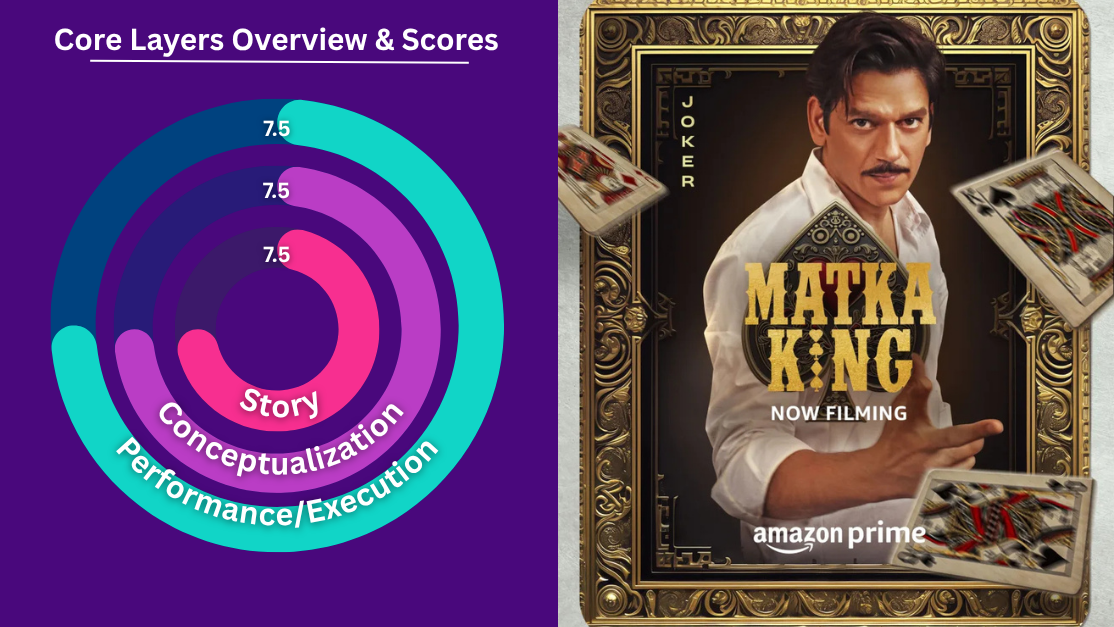
Layer Score Visualisation
Magic of Story/Script
(Core idea, narrative, themes, character arcs, originality)
The “Matka King” series, released April 17, 2026, on Amazon Prime Video, explores Brij Bhatti’s ascent, a fictional narrative inspired by real-life figure Ratan Khatri, who transformed gambling in 1960s and 70s Bombay. The story traces Brij’s progression from a modest cotton merchant to the founder of an expansive underground gambling network anchored by the Matka lottery.
Magic of Story/Script: Core Idea, Narrative, Themes, Character Arcs, Originality
1. Detailed Critique:
The core concept of “Matka King” is striking: the democratisation of gambling, shifting an exclusive pursuit into a widespread phenomenon open to ordinary people. The series examines ambition, authority, the corrupting impact of affluence, and the ethical dilemmas of creating an empire based on others’ appetites. The plot, while echoing classic gangster/rise-and-fall patterns as seen in “Scam 1992,” attempts to distinguish itself by emphasising the paradox of the “honest gambler.” Brij Bhatti’s character arc is vital, documenting his evolution from a principled man to a powerful, conflicted figure. Some critics contend the plot is occasionally formulaic and lapses into expected developments, with sluggish pacing in the mid-section and a sense of “indulgence” by episode 8. Originality arises from its unique historical backdrop and detailed portrayal of a morally complex protagonist who asserts integrity within his unlawful enterprise.
2. Strengths and Weaknesses
Strengths:
-
Compelling Premise: The idea of a gambling empire built on transparency and accessibility is compelling. Brij Bhatti’s character, his ambition, and inner conflict provide depth, supported by a strong performance. The authentic recreation of 1960s Bombay — its atmosphere and social dynamics — enhances the narrative, as does the exploration of socio-economic conditions and moral compromises.
-
Character Study: The focus on Brij Bhatti’s complex character, his ambitions, and his internal conflicts is a significant strength, anchored by a strong central performance.
-
Period Setting: The meticulous depiction of 1960s Bombay — its ambiance, style, and social dynamics — adds depth and authenticity.
-
Thematic Depth: The series delves into socio-economic conditions, the allure of quick wealth, and the moral compromises of ambition.
Weaknesses:
-
**Familiar Tropes: **The familiar rise-and-fall of an ambitious outsider leads to predictable plot points.
-
Pacing and Structure: Reviews highlight pacing concerns, especially in middle episodes, and note that the series feels prolonged and “indulgent” at eight episodes.
-
Underwritten Supporting Characters: While Brij’s arc is well-developed, several supporting characters are described as stock or underwritten, lacking the same depth.
-
**Confused Narrative Direction: **At times, the series struggles to unify its elements, muddying the distinction between thriller, biopic, and drama.
3. Contribution to Overall Film:
The script’s strength lies in its ability to craft a captivating historical drama centred on a morally ambiguous protagonist. With the period setting and the exploration of themes like ambition and the consequences of power, these aspects are crucial to the show’s impact and are directly reflected in the strengths outlined earlier. While the familiar narrative structure might be a weakness, it also provides a solid foundation for the character-driven story and suggests opportunities for the improvements noted below.
4. Suggested Improvements:
-
Streamline the Narrative: Condense the mid-section to improve pacing and enhance engagement.
-
Flesh out Supporting Characters: Creators, flesh out supporting characters. Give them more depth and agency for a richer ensemble.
-
Originality in Plot Progression: Add originality to plot progression. Surprise viewers with unconventional narrative twists.
Main Cast: Vijay Varma, Kritika Kamra, Sai Tamhankar, Gulshan Grover, Siddharth Jadhav, Bhupendra Jadawat
Suggested Score: 7.5/10
Layer Scoring
AI Analysis Score: 7.5/10
Editor Score: 7.5/10
Magic of Conceptualisation
(Director’s vision, editing, casting, and overall presentation)
The series “Matka King” (2026), directed by Nagraj Manjule, explores the rise of a gambling empire in 1960s Bombay. It excels at conceptualisation and the immersive depiction of the era, but struggles with pacing and supporting character development.
The Magic of Conceptualisation: Vision, Editing, Casting, and Presentation
1. Detailed Critique:
Nagraj Manjule’s directorial vision is evident in the rich, atmospheric depiction of 1960s Bombay. The series successfully transports the audience to a bygone era, capturing the fashion, social dynamics, and the undercurrent of ambition and desperation that fueled the city’s underground gambling scene. The conceptualisation of Brij Bhatti’s character as an “honest gambler” is a particularly strong hook, presenting a nuanced protagonist who profits from others’ misfortune while adhering to his own moral code.
The editing and pacing of the series have raised concerns. Reviews note that the plot can feel disjointed, with information delivered too rapidly or too densely. The eight-episode structure is perceived as excessive at times, particularly during the explanation of the Matka game. Strong period visuals sometimes contrast with inconsistent narrative momentum.
The casting is a significant strength. Vijay Varma delivers a “bravura performance” as Brij Bhatti, praised for his restrained intensity, effortless brilliance, and ability to portray the character’s many facets — ambitious, vulnerable, and ruthless. Sai Tamhankar as Barkha, Brij’s wife, provides an emotional anchor and serves as the story’s conscience. Kritika Kamra as Gulrukh, a journalist, and Gulshan Grover as Lalji bhai, an antagonist, also contribute to the ensemble.
2. Strengths and Weaknesses
Strengths:
-
**Compelling Protagonist: **Vijay Varma’s portrayal of Brij Bhatti is a standout, offering a complex and captivating central performance.
-
Atmospheric Period Recreation: The series excels at its detailed, immersive portrayal of 1960s Bombay.
-
Intriguing Premise: The concept of an “honest gambler” adds a unique ethical dimension to the crime drama.
-
**Strong Supporting Cast: **Performances from Sai Tamhankar, Kritika Kamra, and Gulshan Grover add depth to the narrative.
Weaknesses:
-
The series suffers from inconsistent pacing, leading some episodes to feel rushed while others to progress slowly.
-
Underwritten Supporting Characters: Beyond the core characters, many supporting roles feel like stock characters, lacking depth.
-
Familiar Narrative Arc: The “rise and fall” of a criminal empire is a well-trodden path, and “Matka King” doesn’t always offer a fresh perspective.
-
Some critics note that Manjule’s direction varies between realism and glamour, making it difficult to consistently define the series’ genre.
3. Contribution to the Overall Film
The conceptualisation of “Matka King” as a period crime drama centred on the birth of a gambling empire is its core strength. The director’s vision for recreating the era and the casting of a strong lead performance are crucial in drawing viewers into Brij Bhatti’s world. The series explores themes of ambition, morality, and the corrupting influence of power, set against the backdrop of a fascinating historical period. The meticulous attention to detail in the production design and costumes significantly enhances the viewer’s immersion.
4. Suggested Improvements
-
Refined Pacing: A tighter edit, especially in the mid-section, could improve the narrative flow and prevent the series from feeling indulgent.
-
Deeper Character Development: Expanding on the backstories and motivations of supporting characters would add more richness and complexity to the overall narrative.
-
Unique Narrative Voice: While the premise is strong, exploring more unconventional storytelling techniques could help the series stand out from similar crime dramas.
-
Balanced Genre Exploration: A clearer focus on whether the series aims to be a gritty thriller, a character study, or a historical drama would benefit its overall impact.
**Main Cast: **Vijay Varma, Kritika Kamra, Sai Tamhankar, Gulshan Grover, Siddharth Jadhav, Bhupendra Jadawat
Suggested Score: 7.5/10
Layer Scoring
AI Analysis Score: 7.5/10
Editor Score: 7.5/10
Magic of Performance/Execution
(Acting, music, cinematography, effects, choreography)
The recently released series “Matka King” (2026) offers a compelling dive into the 1960s Bombay gambling scene, driven by strong performances and a meticulous recreation of the era. Directed by Nagraj Manjule, the series stars Vijay Varma in the titular role of Brij Bhatti, a cotton trader who builds a formidable gambling empire.
The Magic of Performance and Execution
1. Detailed Critique
Acting: Vijay Varma delivers a standout performance as Brij Bhatti, a character who navigates the complexities of ambition, morality, and power. Critics have widely praised his ability to portray Bhatti’s multifaceted nature from his shrewd business acumen to his underlying vulnerability with “effortless precision” and “subtle intensity and emotional depth”. Sai Tamhankar, as Brij’s wife Barkha, provides a crucial emotional anchor and is noted for her “quiet strength”. Kritika Kamra, playing a journalist investigating Bhatti, brings “grace and a certain mystery” to her role, though some reviews suggest her character could have been more fleshed out. The ensemble cast, including veterans like Gulshan Grover as the antagonist Lalji bhai, and supporting actors like Siddharth Jadhav, Jamie Lever, and Bhupendra Jadawat, collectively adds significant texture and depth to the narrative.
Music: Reviews do not extensively detail the music’s contribution, but the score is noted for complementing the period setting and heightening dramatic tension.
Cinematography: The series features a meticulous recreation of 1960s Bombay. Cinematography provides an immersive view of the era’s atmosphere, fashion, and social dynamics. Visual storytelling highlights contrasts between bustling markets, crowded chawls, and the opulent world of gambling.
Effects: The series emphasises authentic set design and costuming over visual effects. The period detailing includes fixed telephones and newspaper advertisements, reflecting a grounded visual approach.
**Choreography: **Elaborate choreography is not the main focus. The series uses character-driven movements and social dynamics to enhance the overall performance.
2. Strengths and Weaknesses
Strengths:
-
**Vijay Varma’s Performance: **Widely considered the backbone of the series, Varma’s portrayal of Brij Bhatti is a significant draw.
-
Period Recreation: The immersive and detailed depiction of 1960s Bombay is highly praised.
-
**Ensemble Cast: **The supporting actors provide strong performances that enrich the narrative.
-
Exploration of Themes: The series explores ambition, integrity, power, and the moral ambiguity of success.
Weaknesses:
-
Pacing and Narrative Issues: Some critics found the pacing inconsistent, particularly in the midsection, and the narrative felt confused or overly indulgent at times.
-
Underwritten Characters: While some characters are well-developed, others, like Kritika Kamra’s journalist, are noted as being underwritten.
-
Familiar Tropes: The “Scarface-arc” narrative, while competently executed, felt predictable and derivative to some reviewers, especially given director Manjule’s previous work.
-
Manjule’s Direction: For a director known for his distinct style, some felt Manjule’s direction in “Matka King” was less impactful or settled for imitation compared to his earlier films.
3. Contribution to the Overall Film
The performances, particularly Vijay Varma’s, are central to the series’ success, carrying the narrative and making the complex character of Brij Bhatti compelling. The meticulously crafted period setting provides an authentic backdrop that enhances the storytelling and immerses the audience. The ensemble cast adds layers of complexity and credibility to the world of “Matka King.” While the narrative pacing and character development have some drawbacks, these elements collectively contribute to a gripping crime drama that explores the dark underbelly of ambition and the blurred lines between integrity and corruption.
4. Suggested Improvements
-
Refined Pacing: Addressing the pacing issues, especially in the middle episodes, could lead to a more consistently engaging viewing experience.
-
Character Development: Further development of supporting characters, particularly those who drive plot points or offer contrasting perspectives, would add greater depth to the narrative.
-
**Narrative Originality: **While the “rise to power” trope is effective, exploring more unique narrative avenues or subverting expectations could elevate the series beyond familiar territory.
Main Cast: Vijay Varma, Sai Tamhankar, Kritika Kamra, Gulshan Grover, Siddharth Jadhav, Bhupendra Jadawat
Suggested Score: 7.5/10
Layer Scoring
AI Analysis Score: 7.5/10
Editor Score: 7.5/10
Morphokinetics: Narrative Flow Analysis
Overall Summary:
“Matka King (2026)” unfolds with deliberate, simmering tension that gradually escalates into a gripping narrative of ambition and consequence. The film’s pacing is initially measured, allowing the audience to immerse themselves in the gritty underworld of illegal gambling and the protagonist’s rise. The score is visualised through shifting musical motifs that mirror the protagonist’s emotional journey, from tones of desperation and raw hunger to complex layers of triumph, paranoia, and moral ambiguity. Energy builds through a series of calculated risks and escalating stakes, punctuated by moments of sharp, often violent, confrontation, where the score becomes more pronounced to accentuate suspense. The film masterfully balances periods of intense strategic manoeuvring and suspense with brief respites that allow for character introspection and emotional resonance, highlighted by subtle changes in the soundtrack. The climax is a carefully choreographed explosion of conflict, leading to a cathartic yet sombre resolution that leaves a lasting emotional imprint, underscored by a poignant final musical theme that highlights the high cost of power.
Timeline Structure:
The narrative structure of “Matka King (2026)” is linear, tracing the protagonist’s ascent from obscurity to dominance. Strategically employed flashbacks offer insight into the protagonist’s past motivations and the origins of their ambition, deepening the audience’s understanding of present actions and their psychological underpinnings. The film avoids divergent timelines, maintaining focus on the central narrative arc and ensuring the audience remains invested in the protagonist’s immediate struggles and triumphs.
Key Narrative Moments:
-
10% through: The protagonist, facing financial ruin, makes a risky, last-ditch bet on a matka game, showcasing their initial desperation and burgeoning courage. (Intensity: 4/10)
-
25% through: The protagonist wins a significant sum, marking their first major success and the beginning of their ascent, introducing a surge of hope. (Intensity: 6/10)
-
35% through: A rival syndicate makes a subtle but menacing threat, introducing the first real danger and a shift in the protagonist’s emotional state towards apprehension. (Intensity: 7/10)
-
45% through: The protagonist orchestrates a clever move to outmanoeuvre a competitor, demonstrating their growing strategic prowess and a hardening of their resolve. (Intensity: 8/10)
-
**55% through: **A trusted confidante is revealed to be working against the protagonist, shattering their trust and introducing a significant plot twist that raises the stakes dramatically. (Intensity: 9/10) ⚡ Plot Twist
-
65% through: Facing a dire threat to their empire, the protagonist must make a morally questionable decision to secure their position, highlighting their internal conflict. (Intensity: 7/10)
-
**75% through: **A violent confrontation with a rival gang occurs, showcasing the brutal reality of their world and the personal danger involved. (Intensity: 8/10)
-
85% through: The protagonist makes a final, decisive move to consolidate their power, a high-stakes gamble that will determine the fate of their empire. (Intensity: 10/10)
Overall Greybrainer Score: 7.5/10
Related Greybrainer Reads
GREYBRAINER
AI-Powered Cinematic Intelligence