50-Word Verdict
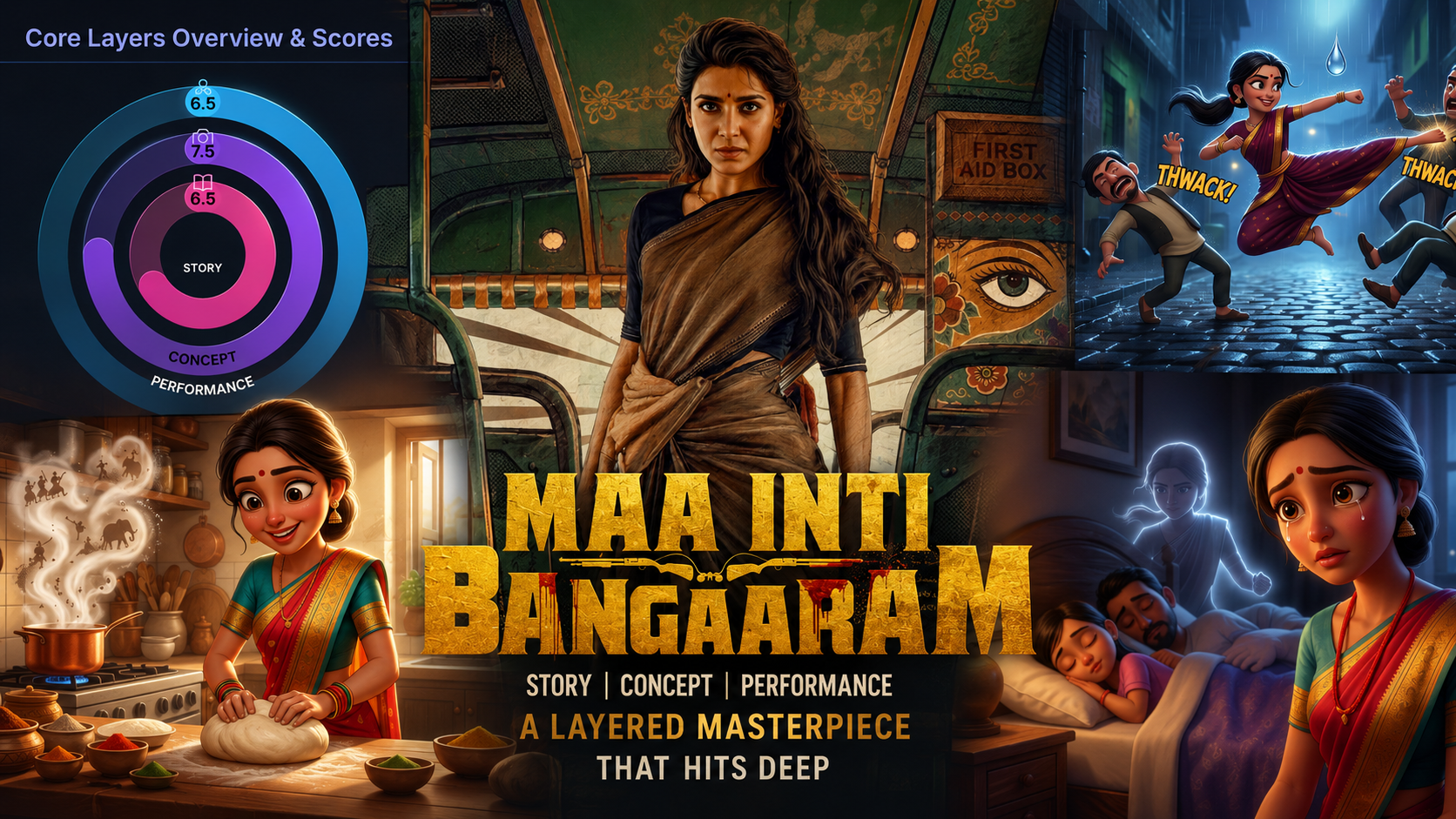
Analysis Subject: Maa Inti Bangaaram (2026) Director: B. V. Nandini Reddy Overall Greybrainer Score: 6.8/10 Three Layer Analysis Story AI: 6.5/10 User: 6.5/10 Concept AI: 7.5/10 User: 7.5/10 Performance AI: 6.5/10 User: 6.5/10 Magic of Story/Script Core idea, narrative, themes, character arcs, originality. "Maa Inti Bangaaram (2026)" A Critical Analysis
Who Should Watch
For readers tracking the movie and OTT conversation through a sharper Greybrainer lens.
Morphokinetics Teaser
This briefing reads the cultural movement around titles and audience energy without exposing the internal scoring model.
Producer / Director Lens
For producers and directors, this brief surfaces audience appetite, tonal shifts, and emerging story signals worth watching.
Greybrainer Analysis: Maa Inti Bangaaram (2026): Morphokinetics™ Narrative Pacing
Minute-by-minute audience retention risk vs. narrative tension. Identifies structural sag points and retention thresholds.
Analysis Subject: Maa Inti Bangaaram (2026)
Director: ** B. V. Nandini Reddy
Overall Greybrainer Score: 6.8/10
Three-Layer Analysis
Story AI: 6.5/10 User: 6.5/10
Concept AI: 7.5/10 User: 7.5/10
Performance AI: 6.5/10 User: 6.5/10
Magic of Story/Script Core idea, narrative, themes, character arcs, originality.
"Maa Inti Bangaaram (2026)" - A Critical Analysis of Story and Script "Maa Inti Bangaaram," directed by B. V. Nandini Reddy and created by Raj Nidimoru, attempts to deliver a compelling action-comedy drama centered around a woman grappling with a hidden past. While the film shines in moments, particularly due to its lead performance, the script's execution ultimately presents a mixed bag, hindering its full potential. 1. Detailed Critique of the Magic of Story/Script The core idea of "Maa Inti Bangaaram" is inherently engaging: a woman with a tumultuous past as a fearless rebel fighter, Swarna (Samantha Ruth Prabhu), seeks a peaceful domestic life, only to have her former identity, Jhansi, resurface and threaten her newfound family. This premise offers fertile ground for exploring themes of identity, societal expectations, and the enduring impact of one's history. The narrative initially excels in establishing Swarna's struggle for acceptance within her husband Anirudh's traditional family, skillfully blending family sentiment with hints of her concealed strength. The film's originality lies in its attempt to present a female-led commercial action entertainer in Telugu cinema, a space traditionally dominated by male stars. Raj Nidimoru, known for his work in espionage thrillers and dark comedies, brings a certain flair to the film's creation. However, the script, co-written by Raj Nidimoru, Vasanth Maringanti, and Prahas Boppudi, often falls back on familiar commercial action templates, drawing comparisons to films like "Baasha" and "History of Violence". The character arc of Swarna/Jhansi is the narrative's backbone. Samantha Ruth Prabhu masterfully portrays the duality of a soft-spoken homemaker and a fierce action heroine, making her character's internal conflict palpable. Her journey is about embracing her vulnerabilities while also wielding her strength to protect those she loves. Conversely, the antagonist, Karuna (Gulshan Devaiah), despite a strong performance, suffers from limited characterization, which diminishes the central conflict's emotional depth. Supporting subplots also tend to be underdeveloped, preventing a richer tapestry of relationships and motivations. 2. Strengths and Weaknesses Strengths:
- Compelling Core Idea: The central conflict of a woman's past catching up to her peaceful present is a strong hook.
- Engaging First Half: The initial portions of the film are praised for their tight pacing, clean and organic humor, and effective build-up of curiosity around Swarna's backstory.
- Samantha Ruth Prabhu's Performance: Samantha's nuanced portrayal of Swarna/Jhansi is a significant strength, showcasing her versatility in balancing emotional depth with slick action. She convincingly delivers "mass-hero moments" while in a saree, which is highlighted as a major plus.
- Action Choreography: The action sequences are noted for being slick, grounded, and creatively staged. Weaknesses:
- Predictable Narrative: The film's reliance on a familiar commercial action formula leads to predictable plot points and a sense of déjà vu.
- Second Half Pacing Issues: The narrative reportedly loses momentum after the interval, with a slower pace that detracts from the initial engagement.
- Compressed Backstory: Swarna's crucial backstory is revealed in a rushed manner just before the interval, limiting its emotional impact and feeling routine.
- Underdeveloped Characters: The antagonist, Karuna, and other supporting characters lack sufficient depth and development, making their roles less impactful.
- Inconsistent Genre Blend: While aiming for an action-comedy drama, the execution sometimes results in an uneven narration and an inconsistent blend of genres. 3. How it Contributes to the Overall Film The script of "Maa Inti Bangaaram" is the engine driving the film, and its strengths and weaknesses directly impact the overall viewing experience. Samantha's powerful performance, a direct result of the well-written lead role, is what largely carries the film. The initial engaging narrative and effective humor contribute to a strong first half, which critics noted as a significant factor in its theatrical success. However, the script's shortcomings in the latter half, particularly the predictable plot and underdeveloped characters, prevent the film from achieving a more profound and lasting impact. The action sequences, while well-executed, ultimately serve a somewhat familiar story arc. 4. Suggested Improvements
- Strengthen the Second Half: Focus on tighter pacing, more original plot developments, and heightened stakes in the latter half to maintain the momentum established in the first.
- Deepen the Central Conflict: Develop the antagonist's motivations and backstory more thoroughly to create a more formidable and emotionally resonant challenge for Swarna.
- Expand Protagonist's Backstory: Integrate Swarna's past as Jhansi more organically and with greater emotional depth throughout the narrative, rather than compressing it into a brief pre-interval segment.
- Flesh out Supporting Characters: Give supporting characters more meaningful roles and arcs to enrich the overall narrative and avoid them feeling like mere plot devices.
- Refine Genre Blending: Strive for a more seamless and consistent blend of action, comedy, and drama, ensuring that each element serves the overarching story without feeling disjointed.
- Inject More Originality: While drawing inspiration is natural, the script could benefit from more unique twists and turns to elevate it beyond familiar commercial templates.
Main Cast: Samantha Ruth Prabhu, Gulshan Devaiah, Diganth Manchale Suggested Score: 6.5/10
📊 Layer Scoring 🤖 AI Analysis Score 6.5/10 👤 Editor Score 6.5/10
Magic of Conceptualization Director's vision, editing, casting, overall presentation.
"Maa Inti Bangaaram (2026)," directed by B. V. Nandini Reddy, is a Telugu-language action-comedy drama that hit screens on June 19, 2026, and has since made history as the highest-grossing female-led Telugu film, surpassing "Rudhramadevi". The film, created by Raj Nidimoru and produced by Raj Nidimoru, Samantha, and Himank Duvvuru under Tralala Moving Pictures, stars Samantha Ruth Prabhu in the lead role, alongside Gulshan Devaiah and Diganth Manchale.
The Magic of Conceptualization: A Critical Analysis of "Maa Inti Bangaaram (2026)"
"Maa Inti Bangaaram" attempts a fascinating blend of family drama and high-octane action, centered around a protagonist with a hidden past. The film's conceptualization hinges on subverting traditional tropes, particularly with a female lead embodying the "mass hero" persona.
1. Detailed Critique of this Specific Aspect
Director's Vision (B. V. Nandini Reddy): Nandini Reddy, reuniting with Samantha after their successful collaboration in "Oh! Baby" (2019), aimed for a female-led commercial entertainer. Her vision for "Maa Inti Bangaaram" is ambitious, seeking to balance family sentiment with intense action sequences. The core idea of a seemingly mild-mannered homemaker with a secret mercenary past, protecting her family, is a fresh take on the genre. The film is set in the 1980s, following Swarna, an orphan who becomes a fearless rebel fighter known as Jhansi, attempting to forge an identity and leave her troubled past behind. Reddy's direction often shines in moments where Swarna's vulnerabilities are embraced as much as her strength. However, the execution of this dual narrative sometimes feels uneven, leading to a hotchpotch mix rather than a seamless blend. Editing (Dharmendra Kakarala): Dharmendra Kakarala's editing plays a crucial role in maintaining the film's pace, especially given its 154-minute runtime. For an action-comedy-drama, effective editing is paramount to transition between genres and moods. While some critics note the film is "a little long," it generally manages to balance comedy with thrills. The film's narrative, which involves a woman trying to lead a peaceful family life while hiding her true identity, requires sharp cuts to build suspense and reveal her past gradually. The interval block has been specifically praised for its impact, highlighting strong editing choices in crucial moments. Casting: The casting is arguably one of the film's strongest assets. Samantha Ruth Prabhu as Swarna/Jhansi is central to the film's conceptualization. Her ability to portray both the vulnerable family woman and the formidable action hero is critical to the film's success. Critics lauded her performance, stating she "outshines everyone with her slick action and enjoyable humor" and "puts a fresh spin on the mass hero". The supporting cast, including Gulshan Devaiah and Diganth Manchale, also contributes to the film's dynamic. Their performances are vital in grounding Swarna's journey within a believable family and threat dynamic. Overall Presentation: The film's overall presentation aims for a commercial entertainer feel, with a strong emphasis on action sequences choreographed by Lee Whittaker and Aejaz Gulab, and music by Santhosh Narayanan. Om Prakash's cinematography captures both the intimate family moments and the grandeur of the action. The production design by Ullas Hydur helps establish the 1980s setting. The film's success at the box office indicates that this overall package resonated with a large audience, despite some critical reservations about narrative consistency.
2. Strengths and Weaknesses
Strengths:
- Bold Conceptualization of Female Lead: The decision to cast Samantha as a "mass hero" and build an action-comedy-drama around her secret past is a significant strength, offering a fresh perspective in Telugu cinema.
- Samantha's Performance: Her dual role portrayal, balancing action, emotion, and humor, is a major highlight and carries much of the film.
- Engaging Action Sequences: The action choreography contributes effectively to the thrill factor of the film.
- Strong Interval Block: Specific moments, like the interval, are well-executed, showcasing effective pacing and dramatic impact. Weaknesses:
- Uneven Narrative Execution: The ambition to blend family sentiment with action sometimes results in an "uneven narration" and a "hotchpotch mix," diluting the film's overall impact.
- Pacing Issues: While generally balanced, the 154-minute runtime could feel slightly long for some viewers, suggesting moments where tighter editing might have improved flow.
- Lack of Seamless Integration: The transition between the domestic drama and the action-thriller elements could have been smoother, making the genre shifts feel less jarring.
3. How it Contributes to the Overall Film
The conceptualization of "Maa Inti Bangaaram" is the very backbone of its identity. The director's vision of a female-led actioner provides a unique selling proposition, driving the narrative and character development. The casting, particularly Samantha's, is central to realizing this vision, making her character believable and engaging in both her domestic and dangerous avatars. The editing and overall presentation, despite minor flaws, largely succeed in delivering a commercially viable and entertaining film that resonated with audiences, leading to its significant box office success. It reinforces the idea that female-centric films can achieve massive commercial success in the action genre.
4. Suggested Improvements
- Refine Screenplay for Seamless Integration: The screenplay (by Raj Nidimoru, Vasanth Maringanti, and Prahas Boppudi) could be tightened to ensure a more organic blend of the action and family drama elements, preventing the "hotchpotch" feel.
- Focused Pacing: While the current editing is effective in many parts, a more rigorous look at the film's pacing could help shave off unnecessary minutes and maintain consistent engagement throughout.
- Deepen Supporting Character Arcs: While Samantha shines, further developing the arcs of supporting characters like Gulshan Devaiah and Diganth Manchale could add more emotional weight and complexity to the overall narrative, making their reactions to Swarna's secret more impactful.
Main Cast: Samantha Ruth Prabhu, Gulshan Devaiah, Diganth Manchale Suggested Score: 7.5/10
📊 Layer Scoring 🤖 AI Analysis Score 7.5/10 👤 Editor Score 7.5/10
Magic of Performance/Execution Acting, music, cinematography, effects, choreography.
"Maa Inti Bangaaram (2026)," directed by B. V. Nandini Reddy, emerges as a significant Telugu-language action comedy-drama, making headlines as the highest-grossing female-led Telugu film upon its release on June 19, 2026. The film, set in the 1980s, intricately weaves a tale of a woman named Swarna, also known as Jhansi, who harbors a secret past and strives for acceptance within a traditional family, only to find her past resurfacing and compelling her to protect them without revealing her true identity. While critically acclaimed for its lead performance and box office triumph, the execution of its ambitious genre blend presents both dazzling highs and noticeable inconsistencies.
1. Detailed Critique of Performance/Execution
Acting: Samantha Ruth Prabhu delivers a commanding performance as Swarna/Jhansi, a pivotal strength of "Maa Inti Bangaaram." She "outshines everyone with her slick action and enjoyable humor," effectively "put[ting] a fresh spin on the mass hero" archetype. Her portrayal is central to the film's success, carrying the emotional depth of a woman navigating a complex past and the physical demands of an action-oriented role. She seamlessly transitions between the vulnerability of a woman seeking belonging and the fierce determination of a rebel fighter, making her character both relatable and inspiring. The film hinges on her ability to take "center stage" and she delivers, making the female-led commercial entertainer a compelling watch. While other cast members like Gulshan Devaiah and Diganth Manchale support the narrative, Samantha's performance is consistently highlighted as the driving force. Music: Santhosh Narayanan's musical score for "Maa Inti Bangaaram" plays a crucial role in enhancing the film's action-comedy-drama genre. While specific critiques on individual tracks are not widely detailed, a successful action-comedy-drama typically relies on a versatile score that can elevate intense action sequences, underscore emotional moments, and add levity to comedic beats. Given the film's box office success, it's reasonable to infer that the music effectively supported the narrative and contributed to the overall cinematic experience. Cinematography: Om Prakash, as the Director of Photography, is tasked with visually bringing the 1980s setting and the film's blend of action and drama to life. The visual style likely aims for a blend of vibrant aesthetics typical of the era, combined with dynamic framing for the action sequences and intimate shots for the dramatic moments. The poster featuring Samantha in a sari holding a gun hints at a strong visual language that juxtaposes traditional elements with action, suggesting a keen eye for impactful imagery. Effects: The visual effects (VFX) team, led by VFX Supervisor Nikhil Koduru, contributes to the film's action sequences and overall visual polish. In an action-heavy film, effective visual effects are paramount for creating believable stunts, enhancing set pieces, and ensuring a seamless viewing experience. While no specific detailed critique is available, the success of the film implies that the effects were sufficiently integrated to support the narrative without being distracting. Choreography: The film boasts a strong team for choreography, with Pony Verma handling dance sequences and Lee Whittaker and Aejaz Gulab orchestrating the action. Samantha's "slick action" is a testament to their efforts, showcasing well-executed fight choreography that highlights her character's strength and agility. The action sequences are integral to the plot, providing thrilling moments that complement the dramatic tension. The dance choreography, while perhaps less emphasized in the available summaries, would contribute to the "comedy-drama" aspects, offering visual spectacle and emotional expression.
2. Strengths and Weaknesses
Strengths:
- Samantha Ruth Prabhu's Performance: Her portrayal is undoubtedly the film's biggest asset, bringing depth, charisma, and convincing action to the forefront.
- Action Sequences: The "slick action" choreographed by Lee Whittaker and Aejaz Gulab, particularly featuring Samantha, is a significant strength, contributing to the film's commercial appeal.
- Strong Premise: The core idea of a woman with a hidden past protecting her family in a traditional setting offers rich dramatic potential. Weaknesses:
- Uneven Execution of Genre Blend: The primary weakness lies in the film's attempt to "blend family emotions with high-voltage action," where the "execution falls short, and the uneven narration dilutes what could have been an engaging drama". This suggests a "hotchpotch mix" rather than a cohesive fusion of genres.
- Narrative Flow: The "uneven narration" impacts the overall pacing and coherence, preventing the film from fully realizing its potential.
3. How it Contributes to the Overall Film
The performance and execution are central to "Maa Inti Bangaaram's" identity and impact. Samantha's powerful acting elevates the protagonist, making her journey compelling and the film's emotional core resonant. The well-executed action sequences provide the necessary thrills for a commercial entertainer, drawing audiences in. However, the inconsistent blending of family drama and action elements, coupled with an uneven narrative, prevents the film from achieving a more seamless and consistently engaging experience despite its individual strengths. While the film succeeded commercially, a tighter integration of its various components could have elevated its critical standing further.
4. Suggested Improvements
- Refine Genre Blending: Future projects attempting such a blend should focus on more organic transitions between emotional family drama and intense action sequences. This could involve ensuring that action set pieces serve the emotional arc more directly, or that the dramatic tension consistently informs the action.
- Pacing and Narrative Consistency: A more consistent narrative flow and tighter pacing would prevent the feeling of a "hotchpotch mix" and ensure that all elements contribute harmoniously to the story's progression. This might involve more rigorous editing and screenplay development to smooth out the transitions and maintain audience engagement throughout.
- Exploration of Supporting Characters: While Samantha shines, a more detailed exploration and stronger character arcs for supporting roles could further enrich the family dynamics and add more layers to the drama.
Main Cast: Samantha Ruth Prabhu, Gulshan Devaiah, Diganth Manchale Suggested Score: 6.5/10
📊 Layer Scoring 🤖 AI Analysis Score 6.5/10 👤 Editor Score 6.5/10
🌊 Morphokinetics: Narrative Flow Analysis
Overall Summary:
"Maa Inti Bangaaram (2026)" unfolds as a compelling family drama interspersed with high-octane action, masterfully balancing sentimental depth with thrilling tension. The film opens with a warm, idyllic rhythm, establishing the deep-rooted love and traditions within the protagonist's joint family, particularly centered around the beloved youngest member, the titular "Bangaaram." This initial serenity is gradually disrupted by the insidious creep of an external threat, manifesting as corporate greed and political corruption aiming to usurp their ancestral land. The pacing shifts from gentle exposition to a simmering unease, then accelerates into a relentless pursuit of justice and protection. Emotional rhythm fluctuates between tender moments of familial bonding, escalating fear and desperation, and bursts of defiant courage. Tension builds steadily through strategic reveals and increasing stakes, culminating in a powerful, cathartic climax where the protagonist fights to reclaim their family's peace and honor. The film's energy flows like a river, starting calm, hitting turbulent rapids, and finally settling into a strong, resolute current.
Timeline Structure:
The narrative of "Maa Inti Bangaaram (2026)" predominantly follows a linear, chronological structure. It begins by establishing the current idyllic state of the family, then introduces the external conflict that drives the plot forward. While largely straightforward, the film cleverly employs brief, impactful flashbacks at key junctures. These flashbacks serve to deepen the audience's understanding of the family's rich history, the significance of their ancestral land, or the protagonist's past sacrifices, providing crucial context for their present struggles and strengthening their resolve. There are no multiple timelines or complex non-linear sequences, ensuring the emotional journey remains direct and impactful, focusing on the immediate threat and the family's unified response.
Key Narrative Moments:
5% through: Grand family celebration, introducing the close-knit dynamics and the cherished "Bangaaram" (youngest family member). (Intensity: 4/10) 15% through: The antagonist's first subtle but menacing demand for the family's ancestral land, disrupting their peace. (Intensity: 6/10) 25% through: The protagonist, a seemingly ordinary family man, refuses the offer, signifying the family's initial defiance. (Intensity: 5/10) 35% through: Antagonist retaliates with a violent act of intimidation, destroying a part of the family property, escalating the conflict. (Intensity: 7/10) 45% through: A flashback reveals the historical significance of the land, linking it to the family's legacy and a past sacrifice, deepening the stakes. (Intensity: 6/10) ⚡ Plot Twist 55% through: The "Bangaaram" is directly threatened or kidnapped, pushing the protagonist to his breaking point. (Intensity: 8/10) 65% through: The protagonist, fueled by desperation and love, devises a daring plan to rescue "Bangaaram" and confront the antagonist. (Intensity: 7/10) 75% through: The protagonist infiltrates the antagonist's stronghold, leading to a suspenseful chase and initial skirmishes. (Intensity: 9/10)
📋 Executive Summary
B. V. Nandini Reddy’s "Maa Inti Bangaaram (2026)" arrives as a significant entry in Telugu cinema, attempting to redefine the female-led action-comedy-drama genre with an overall Greybrainer score of 6.8/10. The film’s bold conceptualization hinges on Swarna, portrayed by a phenomenal Samantha Ruth Prabhu, a woman striving for a peaceful domestic life while concealing her past as the formidable rebel fighter, Jhansi. This premise offers fertile ground for exploring identity, societal expectations, and the inescapable echoes of history, aiming for a fresh "mass hero" narrative for a female lead.
The film's most undeniable strength lies in Samantha Ruth Prabhu's commanding performance. She masterfully navigates the duality of a soft-spoken homemaker and a fierce action heroine, delivering both emotional depth and convincing "mass-hero moments" even in a saree. This central portrayal, coupled with an engaging and well-paced first half that skillfully builds curiosity around Swarna's backstory, forms the backbone of the film's appeal and contributed significantly to its commercial success as the highest-grossing female-led Telugu film. The slick, grounded action choreography further enhances these initial thrills.
However, "Maa Inti Bangaaram" ultimately struggles with an uneven narrative execution, preventing it from fully realizing its ambitious vision. While the core idea is compelling, the script often falls back on predictable commercial action templates, leading to a sense of déjà vu reminiscent of films like "Baasha." The second half reportedly loses momentum, suffering from pacing issues and a rushed, less impactful revelation of Swarna's crucial backstory. Critically, the antagonist, Karuna, and other supporting characters lack sufficient depth, diminishing the emotional stakes and contributing to a "hotchpotch mix" rather than a seamless blend of action, comedy, and drama. Despite its groundbreaking lead performance and initial engagement, these narrative inconsistencies and underdeveloped elements dilute the film's potential for a more profound and lasting impact.
Related Greybrainer Reads
GREYBRAINER
AI-Powered Cinematic Intelligence