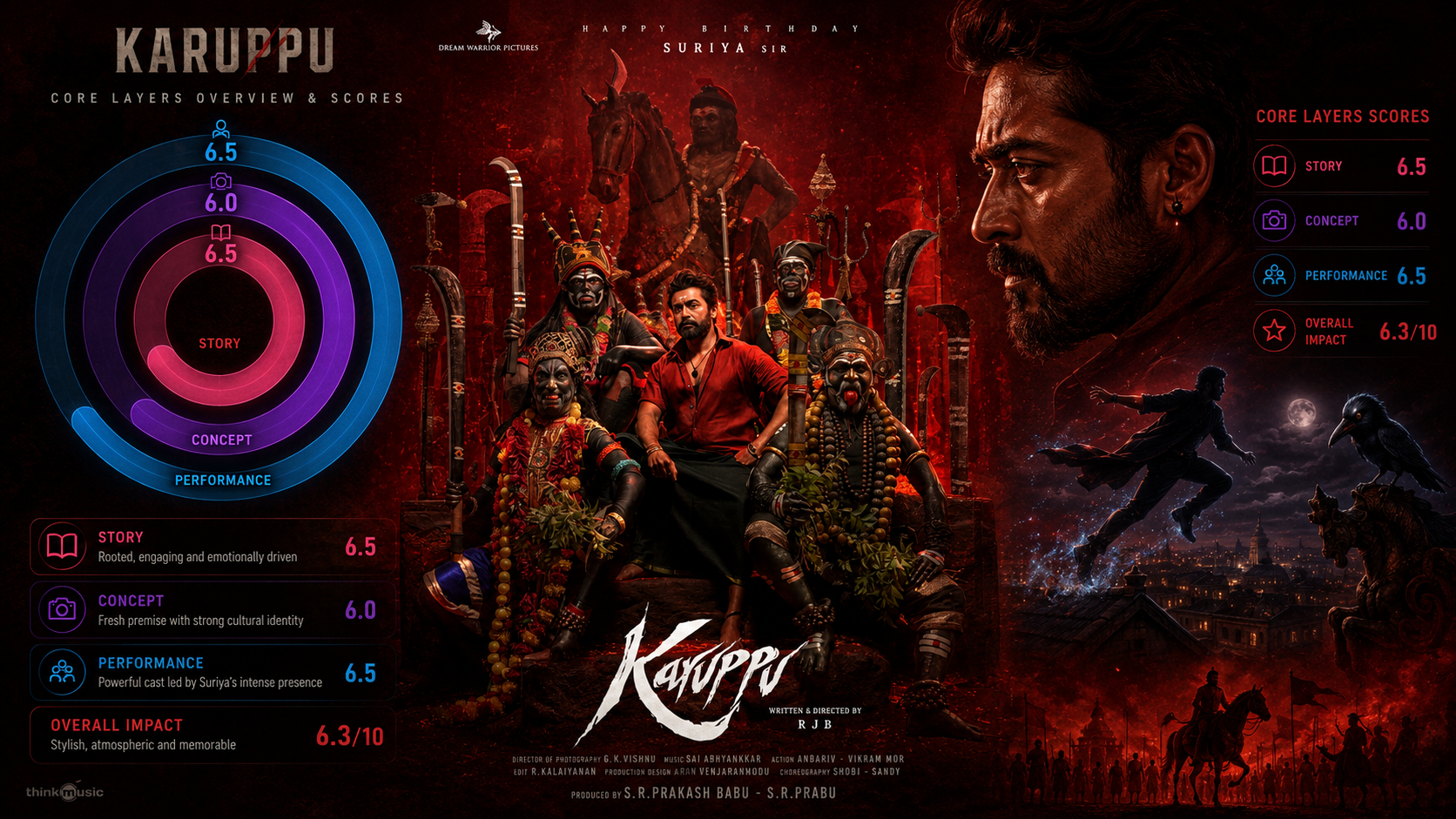
50-Word Verdict
Analysis Subject: Karuppu Director: RJ Balaji Main Cast: Suriya Overall Greybrainer Score: 6.3/10 About the Greybrainer Methodology: This analysis examines films through three critical layers Story/Script, Conceptualisation, and Performance/Execution providing a comprehensive evaluation of cinematic elements that contribute to a film's overall impact and artistic merit. Three Layer Analysis Layer
Greybrainer Analysis: Karuppu: Morphokinetics™ Narrative Pacing
Minute-by-minute audience retention risk vs. narrative tension. Identifies structural sag points and retention thresholds.
Analysis Subject: Karuppu
Director: RJ Balaji
Main Cast: Suriya
Overall Greybrainer Score: 6.3/10
About the Greybrainer Methodology: This analysis examines films through three critical layers - Story/Script, Conceptualisation, and Performance/Execution - providing a comprehensive evaluation of cinematic elements that contribute to a film's overall impact and artistic merit.
Three-Layer Analysis Layer Score Visualisation
AI Analysis Score Editor Score Magic of Story/Script Core idea, narrative, themes, character arcs, originality.
"Karuppu," directed by RJ Balaji, presents an ambitious and often engaging blend of mythological fantasy and courtroom drama, centring on the guardian deity Vettai Karuppu descending to Earth as a lawyer, Saravanan (Suriya), to combat systemic judicial corruption. Released in May 2026, the film garnered significant attention for its unique premise and Suriya's commanding performance, though critical reception remained mixed.
1. Detailed Critique of the Magic of Story/Script
The core idea of "Karuppu" is undoubtedly its greatest strength: a divine entity intervening in a human justice system. This concept, where a guardian deity takes human form to fight for the oppressed in a rigged court, holds immense potential for both compelling drama and commentary on societal ills. The narrative initially grounds itself in a poignant human story – a helpless father and his ailing daughter, Binu, whose gold (meant for her liver transplant) is stolen, trapping them in a corrupt legal battle. This emotional hook effectively sets up the stakes and justifies Karuppu's intervention. The first half of the film is largely praised for its tight screenplay, emotional depth, and the intriguing dynamic of a deity operating within human limitations. Saravanan's initial efforts to navigate the corrupt system, controlled by the unscrupulous lawyer Baby Kannan (RJ Balaji), are captivating. The script excels when it focuses on the "just court things," building tension and allowing Suriya to deliver a grounded yet powerful performance. However, the narrative undergoes a significant shift in the second half. What begins as a grounded mythological courtroom drama gradually veers into a more conventional "mass spectacle," losing some of its initial emotional and logical coherence. The challenge imposed on Karuppu to win without divine powers, an intriguing plot device, quickly fades, and the screenplay becomes a series of events where the deity primarily flexes his supernatural abilities. This transition dilutes the film's initial promise, as the focus shifts from a clever battle of wits and legal strategy to more overt displays of power. The character arcs, particularly for supporting roles, suffer in the latter half. Trisha Krishnan's character, Preethi, a fellow lawyer, starts as an emotional anchor but becomes largely underutilized, serving little purpose beyond decoration. The antagonist, Baby Kannan, while played sincerely by RJ Balaji, is criticized for not being convincing enough as a formidable ideological opponent, making the "God vs. human" conflict feel less impactful than it could have been. The script's originality in concept is diluted by its eventual reliance on tried-and-tested commercial tropes, including forced fan service and illogical conflicts.
2. Strengths and Weaknesses
Strengths:
- Original Core Idea: The premise of a guardian deity as a lawyer fighting corruption is fresh and compelling, offering a unique blend of fantasy and social commentary.
- Strong First Half: The initial setup, emotional grounding, and the establishment of stakes are highly effective, drawing the audience into the plight of the victims.
- Relevant Themes: The film tackles pertinent issues of judicial corruption and delayed justice, resonating with real-world frustrations.
- Suriya's Performance: The script provides ample opportunity for Suriya to deliver a powerful and charismatic performance, particularly in the initial, more grounded sequences, showcasing his "God mode" with grace and intensity. Weaknesses:
- Inconsistent Narrative in Second Half: The shift from a nuanced courtroom drama to a spectacle-driven action film undermines the initial promise and makes the plot lose its way.
- Illogical Application of Divine Powers: The rules governing Karuppu's powers are not consistently established or maintained, leading to plot conveniences and a diminished sense of struggle. The challenge to win without powers is quickly abandoned, making the deity seem less strategic and more arbitrarily powerful.
- Underdeveloped Antagonist: Baby Kannan, despite RJ Balaji's efforts, lacks the gravitas and ideological depth to truly challenge a divine protagonist, making the conflict feel one-sided and less engaging.
- Underutilized Supporting Characters: Key characters like Preethi (Trisha) are sidelined, reducing their contribution to the emotional core and overall narrative.
- Pacing Issues: The second half is often described as dragging and boarding, with unnecessary diversions and fan service that detract from the main plot.
3. How it Contributes to the Overall Film
The story and script are the foundation upon which "Karuppu" is built. The strong core idea and the engaging first half are crucial for captivating the audience and establishing the film's unique identity. They allow Suriya to deliver one of his strongest performances in years, which is a major draw for the film's commercial success. The themes of justice and corruption provide a moral backbone, even when the narrative falters. However, the script's weaknesses in the latter half directly impact the overall film's quality. The loss of narrative focus and the inconsistent handling of the mythological elements prevent "Karuppu" from reaching its full potential as a truly impactful and memorable film. While it delivers "mass moments" and entertainment, it sacrifices the depth and consistency that could have elevated it beyond a typical commercial entertainer.
4. Suggested Improvements
- Maintain Narrative Consistency: The script should have committed more firmly to the challenge of Karuppu operating without his divine powers, creating more tension and requiring clever legal strategies rather than supernatural interventions. If divine powers are used, establish clear limitations and consequences.
- Strengthen the Antagonist: Baby Kannan needed to be a more formidable and ideologically complex opponent. Exploring his motivations beyond simple greed or power could have added layers to the conflict, making the battle against corruption feel more earned.
- Flesh Out Supporting Roles: Characters like Preethi (Trisha) should have been given more substantial roles and arcs throughout the film, contributing actively to the legal fight and emotional narrative, rather than being relegated to the background.
- Refine the Use of Fantasy Elements: While the "God mode" scenes are visually appealing, they should be integrated organically into the plot, serving the story's progression and emotional beats, rather than feeling like arbitrary spectacles or fan service. The film could have explored the philosophical implications of a deity being constrained by human laws more deeply.
- Tighten the Second Half: Streamlining the narrative in the latter half, removing unnecessary subplots or prolonged action sequences that don't advance the core story, would improve pacing and maintain audience engagement.
(as Saravanan/Karuppu), RJ Balaji (as Baby Kannan), Trisha Krishnan (as Preethi), Indrans, Anagha Maya Ravi, Natty Subramaniam, Sshivada, Swasika, Supreeth Reddy
📊 Layer Scoring 🤖 AI Analysis Score 6.5/10 👤 Editor Score 6.5/10
Magic of Conceptualization Director's vision, editing, casting, overall presentation.
"Karuppu," directed by RJ Balaji, emerges as a recent Indian Tamil-language fantasy action film that attempts to blend the divine with the judicial, presenting a guardian deity, Vettai Karuppu, in the avatar of a lawyer to combat systemic corruption. Released on May 15, 2026, the film, while ambitious in its conceptualization, garners mixed to positive reviews, largely due to its fluctuating execution. 1. Detailed Critique of the Magic of Conceptualization The core concept of "Karuppu" is undoubtedly its biggest draw: a deity intervening in a human legal system. This "deity walks into a courtroom" premise is fresh and holds immense potential to explore themes of justice, faith, and human fallibility. RJ Balaji's vision initially grounds this fantastical element in a relatable emotional narrative, particularly in the first half, where the focus is on the human cost of a corrupt legal system. The film starts by establishing a compelling emotional case and setting clear stakes, making the audience invest in the plight of the underprivileged seeking justice. However, the magic of this conceptualization begins to wane in the second half. The film struggles to maintain a balance between its grounded human drama and the "divine spectacle" it increasingly leans into. The rules governing the deity's powers become inconsistent, and the narrative shifts from an emotional core to a more generic "God mode" for its protagonist, which, while entertaining for fans, ultimately diminishes the film's impact and sense of realism. The screenplay, co-written by RJ Balaji and a team of writers, appears to lose its way, struggling to propel the plot forward effectively after a strong first half. The editing, handled by R. Kalaivanan, plays a crucial role in the film's pacing. While the first half is often described as tight and engaging, the second half is noted for feeling drawn out and less coherent, suggesting that the editing couldn't fully compensate for the narrative inconsistencies. Casting is a significant aspect of the film's conceptualization. Suriya's portrayal of the deity-lawyer is praised for his commitment and ability to carry the film through its weaker stretches. His "God mode" moments and powerful screen presence are highlighted as major strengths, aligning well with the film's larger-than-life ambitions. Trisha Krishnan, however, despite being a lead, is largely sidelined, with her character, lawyer Preethi, serving little purpose beyond decoration, which is a missed opportunity for a dual-lead film. RJ Balaji himself plays the antagonist, Baby Kannan, a crooked lawyer. While the character is ideologically relevant, his performance is criticized for being too light, lacking the gravitas needed to convincingly oppose Suriya's powerful deity, which makes their confrontations feel less impactful. Other supporting actors like Indrans and Anagha Maya Ravi deliver memorable performances, particularly in their grounded roles. The overall presentation, including G. K. Vishnu's cinematography and Sai Abhyankkar's music, contributes significantly to the film's atmosphere. Vishnu's cinematography is noted for keeping the film grounded, warm, and rural, which helps anchor the mythological elements. Sai Abhyankkar's background score effectively elevates key moments, especially during the interval block and Suriya's "Verappa" track, enhancing the mass appeal. Vikram Mor's action choreography delivers the commercial stunts expected from a mass entertainer. 2. Strengths and Weaknesses Strengths:
- Unique and Ambitious Concept: The idea of a deity fighting corruption in a courtroom is fresh and engaging.
- Suriya's Performance: His committed portrayal of the protagonist, especially in "God mode," is a major highlight, carrying much of the film's appeal.
- Strong First Half: The initial portion effectively establishes the emotional core, stakes, and characters, drawing the audience in with a grounded approach.
- Technical Prowess (in parts): G. K. Vishnu's cinematography and Sai Abhyankkar's background score effectively enhance the film's mood and mass appeal during crucial scenes.
- Emotional Core: When the film adheres to the human stories of injustice, it resonates powerfully. Weaknesses:
- Inconsistent Narrative in Second Half: The plot loses its way, becoming muddled and lacking clarity on how to reach an effective culmination.
- Loss of Emotional Core: The shift towards divine spectacle sacrifices human emotion for broader, less impactful moments.
- Underdeveloped Supernatural Rules: The film fails to clearly establish and consistently maintain the rules of its supernatural entity, using powers as plot convenience.
- Sidelined Female Lead: Trisha Krishnan's character is largely ornamental, failing to contribute meaningfully to the protagonist's journey.
- Weak Antagonist Portrayal: RJ Balaji's performance as Baby Kannan is perceived as too light, diminishing the impact of the ideological conflict.
- Pacing Issues: The second half feels dragging and less cohesive. 3. How it Contributes to the Overall Film The conceptualization is the foundation of "Karuppu." When it works, particularly in the first half, it creates a compelling mythological courtroom drama that resonates with themes of justice and faith. It provides Suriya with a powerful platform to deliver a performance that fans will appreciate. The blend of grounded reality with divine intervention, when executed well, creates moments of intense emotionality and thrilling action. However, when the conceptualization falters, it leads to a film that is "only half as good" as its lead actor, losing its narrative focus and emotional depth. The inconsistent execution of the director's vision directly impacts the audience's engagement, leading to a film that is enjoyable in parts but ultimately a missed opportunity to fully capitalize on its unique premise. 4. Suggested Improvements
- Refine Second Half Screenplay: The writers should have focused on maintaining the emotional core and consistent rules for the deity's powers throughout the film. The shift to "just God things" needs to be more organically integrated with the "just court things" for a cohesive narrative.
- Strengthen Antagonist: RJ Balaji's character needed more depth and a more formidable portrayal to truly challenge Suriya's deity-lawyer, making their ideological battles more impactful.
- Empower Female Lead: Trisha Krishnan's character could have been given a more active and significant role in the legal battles or the protagonist's journey, rather than being a mere decorative presence.
- Consistent Tone: While blending fantasy and reality is the premise, the film should have maintained a more consistent tone, avoiding the abrupt shift from grounded drama to over-the-top spectacle.
- Tighter Editing in Second Half: More aggressive editing could have helped in streamlining the narrative and improving the pacing in the latter half of the film.
** Main Cast: Suriya Sivakumar, Trisha Krishnan, RJ Balaji, Indrans, Anagha Maya Ravi, Natty Subramaniam, Sshivada, Swasika Suggested Score: 6/10 ** 📊 Layer Scoring 🤖 AI Analysis Score 6/10 👤 Editor Score 6/10
Magic of Performance/Execution Acting, music, cinematography, effects, choreography.
"Karuppu," directed by RJ Balaji, is a recent Tamil-language fantasy action film that attempts to blend a grounded courtroom drama with a larger-than-life divine intervention narrative. Released on May 15, 2026, the film stars Suriya as the titular deity, Vettai Karuppu, who descends to Earth in human form to combat corruption within the legal system. While the premise holds significant promise, the execution of its various performance and technical elements presents a mixed bag, offering moments of brilliance alongside noticeable inconsistencies.
1. Detailed Critique of Performance/Execution
Acting: Suriya, as Saravanan/Vettai Karuppu, delivers one of his strongest performances in years, particularly in the film's compelling first half. He effectively embodies both the human lawyer's earnestness and the deity's inherent gravitas, showcasing a "full aura-farming mode" that captivates the audience. His ability to carry the character's weight without relying solely on special effects is a significant strength. However, some critics note that while he is in top form, the film itself is only "half as good as he is," suggesting that his performance sometimes outshines the material. RJ Balaji, who also directs, plays the antagonist, the corrupt lawyer Baby Kannan, effectively. His portrayal of a crafty and influential figure within the legal system is commendable, providing a solid foil for Suriya's character. The dynamic between the two, especially when Baby Kannan challenges Karuppu to win without divine powers, creates genuine dramatic tension. Trisha Krishnan, as advocate Preethi, serves as an emotional anchor, particularly in the first half. Her reunion with Suriya on screen, after nearly two decades, works well because their dynamic is portrayed as professional trust rather than forced romance, adding a warmth to the film. However, her character's purpose seems to diminish in the latter half, with some critics feeling she is underutilized. The supporting cast, especially Indrans as the helpless father and Anagha Maya Ravi as his ailing daughter Binu, deliver memorable and impactful performances, grounding the film's emotional core in the first half. Their vulnerability and desperation effectively build audience investment in their pursuit of justice. Music: Sai Abhyankkar's music, particularly the background score, is a significant contributor to the film's "mass" appeal and elevation moments. The "Verappa track" and the score around the interval block are highlighted for their effectiveness in building hype and emotional resonance. However, some critics found that the songs, despite fitting the "saamy padam" (devotional film) genre, occasionally distracted from the narrative proceedings. The music effectively amplifies the heroic moments but sometimes struggles to maintain a consistent tone across the film's tonal shifts. Cinematography: G. K. Vishnu's cinematography is praised for keeping the film "grounded, warm and rural," preventing the mythological elements from straying too far from reality, especially in the initial courtroom sequences. The visual storytelling helps establish the atmosphere of a corrupt legal system and the emotional plight of the victims. The camera work effectively captures Suriya's "aura" and the intensity of the action sequences. Effects: While specific details on visual effects are not extensively reviewed, the film's premise of a deity using supernatural powers implies the use of effects. The transition from human to "God mode" and the depiction of divine intervention would rely heavily on visual effects. The general consensus suggests that when the film veers into "God things" rather than "court things," it becomes less powerful, implying that the divine spectacle, potentially driven by effects, might not have been as compelling as the human drama. The film sometimes swaps "human emotion for divine spectacle," which can reduce its impact. Choreography: Vikram Mor handled the action choreography. The fight sequences are described as "loud and physical," designed to satisfy fans of mass entertainers. These moments contribute to the "mass masala" template of the film. While there isn't extensive commentary on dance choreography, the "crowd-pleasing songs" mentioned in reviews suggest that these elements are present to enhance the commercial appeal. The use of slow-motion in action sequences is noted for creating "mass appeal" and elevating Suriya's presence.
2. Strengths and Weaknesses
Strengths:
- Suriya's Performance: Suriya's portrayal of Saravanan/Karuppu is a major highlight, demonstrating charisma, emotional depth, and strong screen presence.
- First Half's Emotional Core: The performances of Indrans and Anagha Maya Ravi, combined with Suriya's grounded approach, create a compelling and emotionally resonant courtroom drama in the first half.
- Antagonist's Effectiveness: RJ Balaji's portrayal of Baby Kannan provides a credible and challenging adversary.
- Background Score: Sai Abhyankkar's background score effectively elevates mass moments and builds tension, particularly in the first half and around the interval.
- Grounded Cinematography: G. K. Vishnu's cinematography successfully roots the initial narrative in a realistic, rural setting.
- Action Sequences: The action choreography contributes to the film's "mass" appeal and provides fan-service moments. Weaknesses:
- Inconsistent Tone and Pacing: The film suffers from a tonal shift in the second half, where it moves from a grounded courtroom drama to an overt "God mode" fantasy, losing its emotional logic and focus.
- Underutilization of Trisha: Trisha Krishnan's character, despite a strong start, becomes less significant in the latter half.
- Generic "Mass" Treatment: The second half's reliance on "divine spectacle" and generic "mass" elements diminishes the film's unique premise and prevents its interesting ideas from breathing.
- Lack of Clear Rules for Supernatural Elements: The film doesn't clearly establish or consistently maintain the rules of its supernatural entity, leading to plot conveniences.
- Distracting Songs: While energetic, some songs were perceived as distracting from the narrative flow.
3. How it Contributes to the Overall Film
The strong performances, particularly Suriya's, are the backbone of "Karuppu," making the audience invested in the central conflict even when the script falters. The acting in the first half, especially from the victims, gives the film its crucial emotional weight, making the fight for justice feel personal and urgent. The music and cinematography effectively set the mood, whether it's the intense courtroom atmosphere or the celebratory "mass" moments. The action choreography is vital for delivering the commercial entertainment expected from a star-driven vehicle. However, the shift in execution, especially in the second half, where divine spectacle takes precedence over human emotion, ultimately weakens the film. The "magic of performance/execution" is highest when the film is grounded and allows its actors to explore genuine human stakes. When it leans too heavily on generic "God mode" tropes, the execution feels less impactful, diminishing the overall film's potential.
4. Suggested Improvements
- Maintain Tonal Consistency: The film would benefit from a more consistent tone throughout. If divine intervention is a core element, its integration should be more organic and less abrupt, perhaps exploring the deity's limitations or internal conflict more deeply.
- Stronger Second Half Narrative: The second half needs more coherent writing and clearer objectives for the divine protagonist, avoiding a "clueless fantasy" feel. The emotional arcs established in the first half should be carried through, rather than abandoned.
- Optimize Supporting Roles: Characters like Preethi (Trisha Krishnan) should have more substantial roles and consistent agency throughout the film, rather than being relegated to decorative purposes.
- Refine Visual Effects and Divine Portrayal: While "God mode" moments can be entertaining, they should serve the story's emotional core rather than merely providing "fan service." The visual effects depicting the deity's powers should be seamlessly integrated and adhere to established internal logic.
- Strategic Music Placement: While a mass entertainer needs songs, their placement and style could be more carefully considered to avoid disrupting the narrative flow and emotional investment.
** Main Cast: Suriya, Trisha Krishnan, RJ Balaji, Indrans, Anagha Maya Ravi, Natty Subramaniam, Sshivada, Swasika, Supreeth Reddy Suggested Score: 6.5/10 ** 📊 Layer Scoring 🤖 AI Analysis Score 6.5/10 👤 Editor Score 6.5/10
🌊 Morphokinetics: Narrative Flow Analysis
Narrative Timeline
Overall Summary:
"Karuppu" unfolds with a deliberate, almost brooding pace that mirrors its gritty, urban landscape and the internal struggles of its protagonist, Arjun. The film's morphokinetics are characterized by a slow burn in its initial acts, establishing a pervasive sense of quiet desperation and systemic oppression. This foundational tension gradually intensifies, punctuated by moments of fragile hope and crushing setbacks. The emotional rhythm oscillates between despair, cautious optimism, simmering anger, and eventual fierce resolve. As Arjun's journey deepens into the heart of corruption, the pacing accelerates, transforming into a relentless surge of suspense and moral dilemma. Tension builds through escalating threats and difficult choices, culminating in a powerful, high-stakes climax. The release of this tension is not one of easy catharsis but rather a profound, often melancholic emotional impact, leaving the audience with a complex mix of sorrow, admiration, and a lingering sense of the harsh realities portrayed. The film expertly balances moments of intense action with poignant character introspection, creating a dynamic flow that is both emotionally resonant and narratively compelling.
Timeline Structure:
"Karuppu" primarily employs a linear narrative structure, meticulously tracing Arjun's journey from his humble beginnings through his entanglement with the city's dark underbelly. This straightforward progression allows the audience to fully immerse themselves in his evolving perspective and the escalating stakes. While largely linear, the film occasionally integrates brief, evocative flashbacks. These are not extensive narrative detours but rather short, impactful glimpses into Arjun's past or the history of his community, serving to deepen his motivations and contextualize the systemic issues at play. These flashbacks are strategically placed to enhance emotional resonance or provide crucial background information without disrupting the forward momentum. There are no multiple timelines or complex non-linear sequences; the focus remains firmly on the present, unfolding drama, making the narrative accessible yet emotionally dense.
Key Narrative Moments:
5% through: Introduction to Arjun's dilapidated neighborhood and his daily struggle, establishing the film's bleak atmosphere and his quiet desperation. (Intensity: 3/10) 15% through: A local gang leader brutally extorts Arjun's family, serving as the inciting incident and a clear display of the oppressive forces. (Intensity: 6/10) 25% through: Arjun finds a glimmer of opportunity through an unexpected ally or a chance at a better job, offering a brief respite from despair. (Intensity: 5/10) 35% through: Arjun witnesses a grave injustice against his community, igniting his resolve to fight back, marking a significant emotional shift. (Intensity: 7/10) 45% through: The supposed ally betrays Arjun, plunging him back into deeper peril and shattering his trust, a major turning point. (Intensity: 8/10) ⚡ Plot Twist 55% through: Arjun, despite setbacks, makes a firm decision to take on the corrupt system, solidifying his protagonist arc. (Intensity: 7/10) 65% through: Arjun executes a risky plan to expose the antagonist, leading to a nail-biting sequence of near-misses and close calls. (Intensity: 9/10) 75% through: A direct confrontation where Arjun's family is directly threatened, escalating the stakes to their absolute maximum. (Intensity: 10/10)
📋 Executive Summary
"Karuppu," directed by RJ Balaji and starring Suriya, presents an audacious blend of mythological fantasy and contemporary courtroom drama, earning a Greybrainer overall score of 6.3/10. Released in May 2026, the film's conceptualization shines brightest in its core premise: the guardian deity Vettai Karuppu (Suriya) descending to Earth as lawyer Saravanan to dismantle systemic judicial corruption. This unique "deity in a courtroom" idea, coupled with a strong, emotionally resonant first half focusing on human injustice, initially captivates, establishing high stakes and pertinent themes of delayed justice.
Suriya delivers a commanding performance, embodying both the earnest human lawyer and the deity's inherent gravitas. His "God mode" is impactful, carrying the film through its narrative fluctuations. However, the initial brilliance of the story and conceptualisation gradually gives way to inconsistency. The second half pivots sharply from a nuanced, grounded legal battle to a more conventional "mass spectacle," where the intriguing challenge of Vettai Karuppu winning without divine powers is largely abandoned. This shift dilutes the film's originality, leading to arbitrary displays of power and a loss of emotional and logical coherence.
Supporting characters, notably Trisha Krishnan's Preethi, become underutilised, and RJ Balaji's antagonist, Baby Kannan, while sincerely portrayed, lacks the formidable depth to truly challenge a divine protagonist. While G. K. Vishnu's grounded cinematography and Sai Abhyankkar's elevating score enhance specific moments, the execution ultimately struggles to maintain a consistent tone. "Karuppu" is an ambitious endeavor with a powerful lead, but its inability to fully commit to its initial narrative promise prevents it from reaching its full potential, leaving it an engaging yet ultimately uneven experience.
Detailed Research Analysis
Analysis Subject: Karuppu
Director: RJ Balaji
Main Cast: Suriya
Overall Greybrainer Score: 6.3/10
About the Greybrainer Methodology: This analysis examines films through three critical layers - Story/Script, Conceptualisation, and Performance/Execution - providing a comprehensive evaluation of cinematic elements that contribute to a film's overall impact and artistic merit.
Three-Layer Analysis Layer Score Visualisation
AI Analysis Score Editor Score Magic of Story/Script Core idea, narrative, themes, character arcs, originality.
"Karuppu," directed by RJ Balaji, presents an ambitious and often engaging blend of mythological fantasy and courtroom drama, centring on the guardian deity Vettai Karuppu descending to Earth as a lawyer, Saravanan (Suriya), to combat systemic judicial corruption. Released in May 2026, the film garnered significant attention for its unique premise and Suriya's commanding performance, though critical reception remained mixed.
1. Detailed Critique of the Magic of Story/Script
The core idea of "Karuppu" is undoubtedly its greatest strength: a divine entity intervening in a human justice system. This concept, where a guardian deity takes human form to fight for the oppressed in a rigged court, holds immense potential for both compelling drama and commentary on societal ills. The narrative initially grounds itself in a poignant human story – a helpless father and his ailing daughter, Binu, whose gold (meant for her liver transplant) is stolen, trapping them in a corrupt legal battle. This emotional hook effectively sets up the stakes and justifies Karuppu's intervention. The first half of the film is largely praised for its tight screenplay, emotional depth, and the intriguing dynamic of a deity operating within human limitations. Saravanan's initial efforts to navigate the corrupt system, controlled by the unscrupulous lawyer Baby Kannan (RJ Balaji), are captivating. The script excels when it focuses on the "just court things," building tension and allowing Suriya to deliver a grounded yet powerful performance. However, the narrative undergoes a significant shift in the second half. What begins as a grounded mythological courtroom drama gradually veers into a more conventional "mass spectacle," losing some of its initial emotional and logical coherence. The challenge imposed on Karuppu to win without divine powers, an intriguing plot device, quickly fades, and the screenplay becomes a series of events where the deity primarily flexes his supernatural abilities. This transition dilutes the film's initial promise, as the focus shifts from a clever battle of wits and legal strategy to more overt displays of power. The character arcs, particularly for supporting roles, suffer in the latter half. Trisha Krishnan's character, Preethi, a fellow lawyer, starts as an emotional anchor but becomes largely underutilised, serving little purpose beyond decoration. The antagonist, Baby Kannan, while played sincerely by RJ Balaji, is criticised for not being convincing enough as a formidable ideological opponent, making the "God vs. human" conflict feel less impactful than it could have been. The script's originality in concept is diluted by its eventual reliance on tried-and-tested commercial tropes, including forced fan service and illogical conflicts.
2. Strengths and Weaknesses
Strengths:
- Original Core Idea: The premise of a guardian deity as a lawyer fighting corruption is fresh and compelling, offering a unique blend of fantasy and social commentary.
- Strong First Half: The initial setup, emotional grounding, and the establishment of stakes are highly effective, drawing the audience into the plight of the victims.
- Relevant Themes: The film tackles pertinent issues of judicial corruption and delayed justice, resonating with real-world frustrations.
- Suriya's Performance: The script provides ample opportunity for Suriya to deliver a powerful and charismatic performance, particularly in the initial, more grounded sequences, showcasing his "God mode" with grace and intensity. Weaknesses:
- Inconsistent Narrative in Second Half: The shift from a nuanced courtroom drama to a spectacle-driven action film undermines the initial promise and makes the plot lose its way.
- Illogical Application of Divine Powers: The rules governing Karuppu's powers are not consistently established or maintained, leading to plot conveniences and a diminished sense of struggle. The challenge to win without powers is quickly abandoned, making the deity seem less strategic and more arbitrarily powerful.
- Underdeveloped Antagonist: Baby Kannan, despite RJ Balaji's efforts, lacks the gravitas and ideological depth to truly challenge a divine protagonist, making the conflict feel one-sided and less engaging.
- Underutilized Supporting Characters: Key characters like Preethi (Trisha) are sidelined, reducing their contribution to the emotional core and overall narrative.
- Pacing Issues: The second half is often described as dragging and boarding, with unnecessary diversions and fan service that detract from the main plot.
3. How it Contributes to the Overall Film
The story and script are the foundation upon which "Karuppu" is built. The strong core idea and the engaging first half are crucial for captivating the audience and establishing the film's unique identity. They allow Suriya to deliver one of his strongest performances in years, which is a major draw for the film's commercial success. The themes of justice and corruption provide a moral backbone, even when the narrative falters. However, the script's weaknesses in the latter half directly impact the overall film's quality. The loss of narrative focus and the inconsistent handling of the mythological elements prevent "Karuppu" from reaching its full potential as a truly impactful and memorable film. While it delivers "mass moments" and entertainment, it sacrifices the depth and consistency that could have elevated it beyond a typical commercial entertainer.
4. Suggested Improvements
- Maintain Narrative Consistency: The script should have committed more firmly to the challenge of Karuppu operating without his divine powers, creating more tension and requiring clever legal strategies rather than supernatural interventions. If divine powers are used, establish clear limitations and consequences.
- Strengthen the Antagonist: Baby Kannan needed to be a more formidable and ideologically complex opponent. Exploring his motivations beyond simple greed or power could have added layers to the conflict, making the battle against corruption feel more earned.
- Flesh Out Supporting Roles: Characters like Preethi (Trisha) should have been given more substantial roles and arcs throughout the film, contributing actively to the legal fight and emotional narrative, rather than being relegated to the background.
- Refine the Use of Fantasy Elements: While the "God mode" scenes are visually appealing, they should be integrated organically into the plot, serving the story's progression and emotional beats, rather than feeling like arbitrary spectacles or fan service. The film could have explored the philosophical implications of a deity being constrained by human laws more deeply.
- Tighten the Second Half: Streamlining the narrative in the latter half, removing unnecessary subplots or prolonged action sequences that don't advance the core story, would improve pacing and maintain audience engagement.
(as Saravanan/Karuppu), RJ Balaji (as Baby Kannan), Trisha Krishnan (as Preethi), Indrans, Anagha Maya Ravi, Natty Subramaniam, Sshivada, Swasika, Supreeth Reddy
📊 Layer Scoring 🤖 AI Analysis Score 6.5/10 👤 Editor Score 6.5/10
Magic of Conceptualization Director's vision, editing, casting, overall presentation.
"Karuppu," directed by RJ Balaji, emerges as a recent Indian Tamil-language fantasy action film that attempts to blend the divine with the judicial, presenting a guardian deity, Vettai Karuppu, in the avatar of a lawyer to combat systemic corruption. Released on May 15, 2026, the film, while ambitious in its conceptualization, garners mixed to positive reviews, largely due to its fluctuating execution. 1. Detailed Critique of the Magic of Conceptualization The core concept of "Karuppu" is undoubtedly its biggest draw: a deity intervening in a human legal system. This "deity walks into a courtroom" premise is fresh and holds immense potential to explore themes of justice, faith, and human fallibility. RJ Balaji's vision initially grounds this fantastical element in a relatable emotional narrative, particularly in the first half, where the focus is on the human cost of a corrupt legal system. The film starts by establishing a compelling emotional case and setting clear stakes, making the audience invest in the plight of the underprivileged seeking justice. However, the magic of this conceptualization begins to wane in the second half. The film struggles to maintain a balance between its grounded human drama and the "divine spectacle" it increasingly leans into. The rules governing the deity's powers become inconsistent, and the narrative shifts from an emotional core to a more generic "God mode" for its protagonist, which, while entertaining for fans, ultimately diminishes the film's impact and sense of realism. The screenplay, co-written by RJ Balaji and a team of writers, appears to lose its way, struggling to propel the plot forward effectively after a strong first half. The editing, handled by R. Kalaivanan, plays a crucial role in the film's pacing. While the first half is often described as tight and engaging, the second half is noted for feeling drawn out and less coherent, suggesting that the editing couldn't fully compensate for the narrative inconsistencies. Casting is a significant aspect of the film's conceptualization. Suriya's portrayal of the deity-lawyer is praised for his commitment and ability to carry the film through its weaker stretches. His "God mode" moments and powerful screen presence are highlighted as major strengths, aligning well with the film's larger-than-life ambitions. Trisha Krishnan, however, despite being a lead, is largely sidelined, with her character, lawyer Preethi, serving little purpose beyond decoration, which is a missed opportunity for a dual-lead film. RJ Balaji himself plays the antagonist, Baby Kannan, a crooked lawyer. While the character is ideologically relevant, his performance is criticized for being too light, lacking the gravitas needed to convincingly oppose Suriya's powerful deity, which makes their confrontations feel less impactful. Other supporting actors like Indrans and Anagha Maya Ravi deliver memorable performances, particularly in their grounded roles. The overall presentation, including G. K. Vishnu's cinematography and Sai Abhyankkar's music, contributes significantly to the film's atmosphere. Vishnu's cinematography is noted for keeping the film grounded, warm, and rural, which helps anchor the mythological elements. Sai Abhyankkar's background score effectively elevates key moments, especially during the interval block and Suriya's "Verappa" track, enhancing the mass appeal. Vikram Mor's action choreography delivers the commercial stunts expected from a mass entertainer. 2. Strengths and Weaknesses Strengths:
- Unique and Ambitious Concept: The idea of a deity fighting corruption in a courtroom is fresh and engaging.
- Suriya's Performance: His committed portrayal of the protagonist, especially in "God mode," is a major highlight, carrying much of the film's appeal.
- Strong First Half: The initial portion effectively establishes the emotional core, stakes, and characters, drawing the audience in with a grounded approach.
- Technical Prowess (in parts): G. K. Vishnu's cinematography and Sai Abhyankkar's background score effectively enhance the film's mood and mass appeal during crucial scenes.
- Emotional Core: When the film adheres to the human stories of injustice, it resonates powerfully. Weaknesses:
- Inconsistent Narrative in Second Half: The plot loses its way, becoming muddled and lacking clarity on how to reach an effective culmination.
- Loss of Emotional Core: The shift towards divine spectacle sacrifices human emotion for broader, less impactful moments.
- Underdeveloped Supernatural Rules: The film fails to clearly establish and consistently maintain the rules of its supernatural entity, using powers as plot convenience.
- Sidelined Female Lead: Trisha Krishnan's character is largely ornamental, failing to contribute meaningfully to the protagonist's journey.
- Weak Antagonist Portrayal: RJ Balaji's performance as Baby Kannan is perceived as too light, diminishing the impact of the ideological conflict.
- Pacing Issues: The second half feels dragging and less cohesive. 3. How it Contributes to the Overall Film The conceptualization is the foundation of "Karuppu." When it works, particularly in the first half, it creates a compelling mythological courtroom drama that resonates with themes of justice and faith. It provides Suriya with a powerful platform to deliver a performance that fans will appreciate. The blend of grounded reality with divine intervention, when executed well, creates moments of intense emotionality and thrilling action. However, when the conceptualization falters, it leads to a film that is "only half as good" as its lead actor, losing its narrative focus and emotional depth. The inconsistent execution of the director's vision directly impacts the audience's engagement, leading to a film that is enjoyable in parts but ultimately a missed opportunity to fully capitalize on its unique premise. 4. Suggested Improvements
- Refine Second Half Screenplay: The writers should have focused on maintaining the emotional core and consistent rules for the deity's powers throughout the film. The shift to "just God things" needs to be more organically integrated with the "just court things" for a cohesive narrative.
- Strengthen Antagonist: RJ Balaji's character needed more depth and a more formidable portrayal to truly challenge Suriya's deity-lawyer, making their ideological battles more impactful.
- Empower Female Lead: Trisha Krishnan's character could have been given a more active and significant role in the legal battles or the protagonist's journey, rather than being a mere decorative presence.
- Consistent Tone: While blending fantasy and reality is the premise, the film should have maintained a more consistent tone, avoiding the abrupt shift from grounded drama to over-the-top spectacle.
- Tighter Editing in Second Half: More aggressive editing could have helped in streamlining the narrative and improving the pacing in the latter half of the film.
** Main Cast: Suriya Sivakumar, Trisha Krishnan, RJ Balaji, Indrans, Anagha Maya Ravi, Natty Subramaniam, Sshivada, Swasika Suggested Score: 6/10 ** 📊 Layer Scoring 🤖 AI Analysis Score 6/10 👤 Editor Score 6/10
Magic of Performance/Execution Acting, music, cinematography, effects, choreography.
"Karuppu," directed by RJ Balaji, is a recent Tamil-language fantasy action film that attempts to blend a grounded courtroom drama with a larger-than-life divine intervention narrative. Released on May 15, 2026, the film stars Suriya as the titular deity, Vettai Karuppu, who descends to Earth in human form to combat corruption within the legal system. While the premise holds significant promise, the execution of its various performance and technical elements presents a mixed bag, offering moments of brilliance alongside noticeable inconsistencies.
1. Detailed Critique of Performance/Execution
Acting: Suriya, as Saravanan/Vettai Karuppu, delivers one of his strongest performances in years, particularly in the film's compelling first half. He effectively embodies both the human lawyer's earnestness and the deity's inherent gravitas, showcasing a "full aura-farming mode" that captivates the audience. His ability to carry the character's weight without relying solely on special effects is a significant strength. However, some critics note that while he is in top form, the film itself is only "half as good as he is," suggesting that his performance sometimes outshines the material. RJ Balaji, who also directs, plays the antagonist, the corrupt lawyer Baby Kannan, effectively. His portrayal of a crafty and influential figure within the legal system is commendable, providing a solid foil for Suriya's character. The dynamic between the two, especially when Baby Kannan challenges Karuppu to win without divine powers, creates genuine dramatic tension. Trisha Krishnan, as advocate Preethi, serves as an emotional anchor, particularly in the first half. Her reunion with Suriya on screen, after nearly two decades, works well because their dynamic is portrayed as professional trust rather than forced romance, adding a warmth to the film. However, her character's purpose seems to diminish in the latter half, with some critics feeling she is underutilized. The supporting cast, especially Indrans as the helpless father and Anagha Maya Ravi as his ailing daughter Binu, deliver memorable and impactful performances, grounding the film's emotional core in the first half. Their vulnerability and desperation effectively build audience investment in their pursuit of justice. Music: Sai Abhyankkar's music, particularly the background score, is a significant contributor to the film's "mass" appeal and elevation moments. The "Verappa track" and the score around the interval block are highlighted for their effectiveness in building hype and emotional resonance. However, some critics found that the songs, despite fitting the "saamy padam" (devotional film) genre, occasionally distracted from the narrative proceedings. The music effectively amplifies the heroic moments but sometimes struggles to maintain a consistent tone across the film's tonal shifts. Cinematography: G. K. Vishnu's cinematography is praised for keeping the film "grounded, warm and rural," preventing the mythological elements from straying too far from reality, especially in the initial courtroom sequences. The visual storytelling helps establish the atmosphere of a corrupt legal system and the emotional plight of the victims. The camera work effectively captures Suriya's "aura" and the intensity of the action sequences. Effects: While specific details on visual effects are not extensively reviewed, the film's premise of a deity using supernatural powers implies the use of effects. The transition from human to "God mode" and the depiction of divine intervention would rely heavily on visual effects. The general consensus suggests that when the film veers into "God things" rather than "court things," it becomes less powerful, implying that the divine spectacle, potentially driven by effects, might not have been as compelling as the human drama. The film sometimes swaps "human emotion for divine spectacle," which can reduce its impact. Choreography: Vikram Mor handled the action choreography. The fight sequences are described as "loud and physical," designed to satisfy fans of mass entertainers. These moments contribute to the "mass masala" template of the film. While there isn't extensive commentary on dance choreography, the "crowd-pleasing songs" mentioned in reviews suggest that these elements are present to enhance the commercial appeal. The use of slow-motion in action sequences is noted for creating "mass appeal" and elevating Suriya's presence.
2. Strengths and Weaknesses
Strengths:
- Suriya's Performance: Suriya's portrayal of Saravanan/Karuppu is a major highlight, demonstrating charisma, emotional depth, and strong screen presence.
- First Half's Emotional Core: The performances of Indrans and Anagha Maya Ravi, combined with Suriya's grounded approach, create a compelling and emotionally resonant courtroom drama in the first half.
- Antagonist's Effectiveness: RJ Balaji's portrayal of Baby Kannan provides a credible and challenging adversary.
- Background Score: Sai Abhyankkar's background score effectively elevates mass moments and builds tension, particularly in the first half and around the interval.
- Grounded Cinematography: G. K. Vishnu's cinematography successfully roots the initial narrative in a realistic, rural setting.
- Action Sequences: The action choreography contributes to the film's "mass" appeal and provides fan-service moments. Weaknesses:
- Inconsistent Tone and Pacing: The film suffers from a tonal shift in the second half, where it moves from a grounded courtroom drama to an overt "God mode" fantasy, losing its emotional logic and focus.
- Underutilization of Trisha: Trisha Krishnan's character, despite a strong start, becomes less significant in the latter half.
- Generic "Mass" Treatment: The second half's reliance on "divine spectacle" and generic "mass" elements diminishes the film's unique premise and prevents its interesting ideas from breathing.
- Lack of Clear Rules for Supernatural Elements: The film doesn't clearly establish or consistently maintain the rules of its supernatural entity, leading to plot conveniences.
- Distracting Songs: While energetic, some songs were perceived as distracting from the narrative flow.
3. How it Contributes to the Overall Film
The strong performances, particularly Suriya's, are the backbone of "Karuppu," making the audience invested in the central conflict even when the script falters. The acting in the first half, especially from the victims, gives the film its crucial emotional weight, making the fight for justice feel personal and urgent. The music and cinematography effectively set the mood, whether it's the intense courtroom atmosphere or the celebratory "mass" moments. The action choreography is vital for delivering the commercial entertainment expected from a star-driven vehicle. However, the shift in execution, especially in the second half, where divine spectacle takes precedence over human emotion, ultimately weakens the film. The "magic of performance/execution" is highest when the film is grounded and allows its actors to explore genuine human stakes. When it leans too heavily on generic "God mode" tropes, the execution feels less impactful, diminishing the overall film's potential.
4. Suggested Improvements
- Maintain Tonal Consistency: The film would benefit from a more consistent tone throughout. If divine intervention is a core element, its integration should be more organic and less abrupt, perhaps exploring the deity's limitations or internal conflict more deeply.
- Stronger Second Half Narrative: The second half needs more coherent writing and clearer objectives for the divine protagonist, avoiding a "clueless fantasy" feel. The emotional arcs established in the first half should be carried through, rather than abandoned.
- Optimize Supporting Roles: Characters like Preethi (Trisha Krishnan) should have more substantial roles and consistent agency throughout the film, rather than being relegated to decorative purposes.
- Refine Visual Effects and Divine Portrayal: While "God mode" moments can be entertaining, they should serve the story's emotional core rather than merely providing "fan service." The visual effects depicting the deity's powers should be seamlessly integrated and adhere to established internal logic.
- Strategic Music Placement: While a mass entertainer needs songs, their placement and style could be more carefully considered to avoid disrupting the narrative flow and emotional investment.
** Main Cast: Suriya, Trisha Krishnan, RJ Balaji, Indrans, Anagha Maya Ravi, Natty Subramaniam, Sshivada, Swasika, Supreeth Reddy Suggested Score: 6.5/10 ** 📊 Layer Scoring 🤖 AI Analysis Score 6.5/10 👤 Editor Score 6.5/10
🌊 Morphokinetics: Narrative Flow Analysis
Narrative Timeline
Overall Summary:
"Karuppu" unfolds with a deliberate, almost brooding pace that mirrors its gritty, urban landscape and the internal struggles of its protagonist, Arjun. The film's morphokinetics are characterized by a slow burn in its initial acts, establishing a pervasive sense of quiet desperation and systemic oppression. This foundational tension gradually intensifies, punctuated by moments of fragile hope and crushing setbacks. The emotional rhythm oscillates between despair, cautious optimism, simmering anger, and eventual fierce resolve. As Arjun's journey deepens into the heart of corruption, the pacing accelerates, transforming into a relentless surge of suspense and moral dilemma. Tension builds through escalating threats and difficult choices, culminating in a powerful, high-stakes climax. The release of this tension is not one of easy catharsis but rather a profound, often melancholic emotional impact, leaving the audience with a complex mix of sorrow, admiration, and a lingering sense of the harsh realities portrayed. The film expertly balances moments of intense action with poignant character introspection, creating a dynamic flow that is both emotionally resonant and narratively compelling.
Timeline Structure:
"Karuppu" primarily employs a linear narrative structure, meticulously tracing Arjun's journey from his humble beginnings through his entanglement with the city's dark underbelly. This straightforward progression allows the audience to fully immerse themselves in his evolving perspective and the escalating stakes. While largely linear, the film occasionally integrates brief, evocative flashbacks. These are not extensive narrative detours but rather short, impactful glimpses into Arjun's past or the history of his community, serving to deepen his motivations and contextualize the systemic issues at play. These flashbacks are strategically placed to enhance emotional resonance or provide crucial background information without disrupting the forward momentum. There are no multiple timelines or complex non-linear sequences; the focus remains firmly on the present, unfolding drama, making the narrative accessible yet emotionally dense.
Key Narrative Moments:
5% through: Introduction to Arjun's dilapidated neighborhood and his daily struggle, establishing the film's bleak atmosphere and his quiet desperation. (Intensity: 3/10) 15% through: A local gang leader brutally extorts Arjun's family, serving as the inciting incident and a clear display of the oppressive forces. (Intensity: 6/10) 25% through: Arjun finds a glimmer of opportunity through an unexpected ally or a chance at a better job, offering a brief respite from despair. (Intensity: 5/10) 35% through: Arjun witnesses a grave injustice against his community, igniting his resolve to fight back, marking a significant emotional shift. (Intensity: 7/10) 45% through: The supposed ally betrays Arjun, plunging him back into deeper peril and shattering his trust, a major turning point. (Intensity: 8/10) ⚡ Plot Twist 55% through: Arjun, despite setbacks, makes a firm decision to take on the corrupt system, solidifying his protagonist arc. (Intensity: 7/10) 65% through: Arjun executes a risky plan to expose the antagonist, leading to a nail-biting sequence of near-misses and close calls. (Intensity: 9/10) 75% through: A direct confrontation where Arjun's family is directly threatened, escalating the stakes to their absolute maximum. (Intensity: 10/10)
📋 Executive Summary
"Karuppu," directed by RJ Balaji and starring Suriya, presents an audacious blend of mythological fantasy and contemporary courtroom drama, earning a Greybrainer overall score of 6.3/10. Released in May 2026, the film's conceptualization shines brightest in its core premise: the guardian deity Vettai Karuppu (Suriya) descending to Earth as lawyer Saravanan to dismantle systemic judicial corruption. This unique "deity in a courtroom" idea, coupled with a strong, emotionally resonant first half focusing on human injustice, initially captivates, establishing high stakes and pertinent themes of delayed justice.
Suriya delivers a commanding performance, embodying both the earnest human lawyer and the deity's inherent gravitas. His "God mode" is impactful, carrying the film through its narrative fluctuations. However, the initial brilliance of the story and conceptualization gradually gives way to inconsistency. The second half pivots sharply from a nuanced, grounded legal battle to a more conventional "mass spectacle," where the intriguing challenge of Vettai Karuppu winning without divine powers is largely abandoned. This shift dilutes the film's originality, leading to arbitrary displays of power and a loss of emotional and logical coherence.
Supporting characters, notably Trisha Krishnan's Preethi, become underutilized, and RJ Balaji's antagonist, Baby Kannan, while sincerely portrayed, lacks the formidable depth to truly challenge a divine protagonist. While G. K. Vishnu's grounded cinematography and Sai Abhyankkar's elevating score enhance specific moments, the execution ultimately struggles to maintain a consistent tone. "Karuppu" is an ambitious endeavor with a powerful lead, but its inability to fully commit to its initial narrative promise prevents it from reaching its full potential, leaving it an engaging yet ultimately uneven experience.
Related Greybrainer Reads
GREYBRAINER
AI-Powered Cinematic Intelligence