Greybrainer Analysis: Jana Nayagan: Morphokinetics™ Narrative Pacing
Minute-by-minute audience retention risk vs. narrative tension. Identifies structural sag points and retention thresholds.
Greybrainer Analysis: Jana Nayagan
H. Vinoth’s “Jana Nayagan,” positioned as actor Vijay’s cinematic farewell before his political debut, arrives amidst considerable anticipation and controversy, notably its identity as a remake of “Bhagavanth Kesari” and a pre-release leak. This Tamil-language political action thriller, with an overall Greybrainer score of 5.8/10, attempts to craft a “People’s Hero” narrative, but its execution presents a complex critical landscape. The story centers on Vettri Kondan (Vijay), a former police officer drawn back into the fight against systemic corruption and injustice, particularly a cold case of child abuse. This core premise, rich in themes of justice, political awakening, and the common man’s power, aligns perfectly with Vijay’s real-life political trajectory, aiming to solidify his image as a “torchbearer of democracy.” However, the script’s most significant weakness lies in its lack of originality, being a direct adaptation, which limits its capacity for fresh storytelling. Compounding this, the conceptualization reportedly leans into overt political messaging, with every dialogue potentially serving as a campaign reference, risking a shift from a nuanced political drama to a didactic manifesto. The casting is strategically strong, leveraging Vijay’s immense popularity alongside a formidable ensemble including Bobby Deol as a menacing antagonist, Pooja Hegde, and Mamitha Baiju. While Vijay’s performance has drawn mixed early reactions, Mamitha Baiju received positive mentions, suggesting pockets of strong delivery. Technically, Anirudh Ravichander’s music and Sathyan Sooryan’s cinematography are expected to be significant assets, providing crucial emotional and visual depth. Yet, the film’s execution faces considerable hurdles, with early reports citing “poor AI usage” and “unnecessary robot scenes” as glaring technical shortcomings. The extended three-hour runtime further raises concerns about pacing and narrative tightness, potentially diluting the impact of its high-stakes premise. Ultimately, “Jana Nayagan” is a film deeply intertwined with its star’s political aspirations. While its thematic relevance and star power are undeniable strengths, the foundational choice of a remake, coupled with reported heavy-handed political messaging and inconsistent technical execution, prevents it from achieving its full potential as a truly original and cinematically compelling swansong.
Three-Layer Analysis
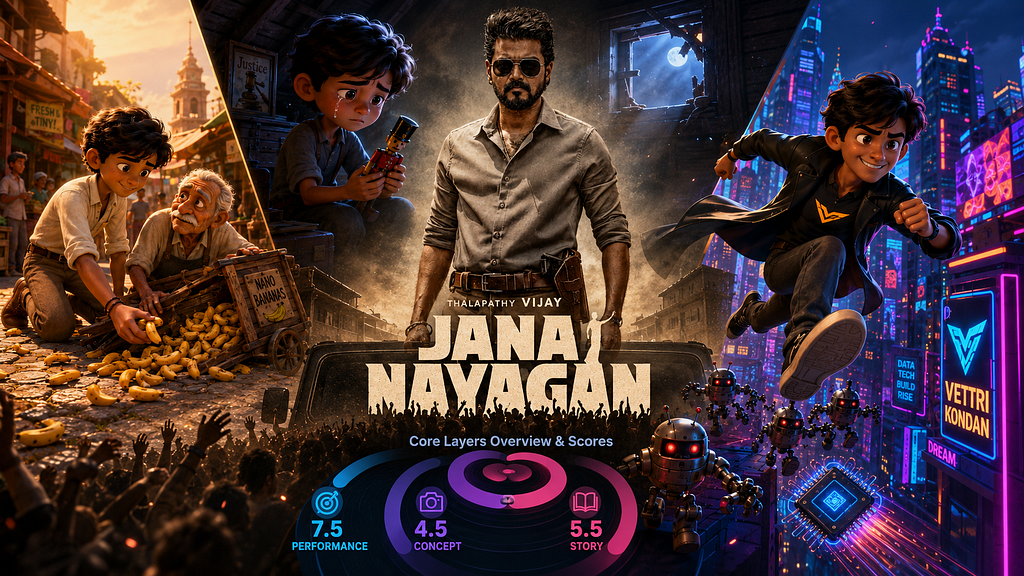
Layer Score Visualisation
Magic of Story/Script
Core idea, narrative, themes, character arcs, originality.
Jana Nayagan arrives shrouded in controversy and high expectations, primarily serving as a swansong for actor Vijay before his full-fledged political debut. Directed by H. Vinoth, this Tamil-language political action thriller has unfortunately been marred by an early online leak and the revelation that it is a remake of the 2023 Telugu film Bhagavanth Kesari. This context is vital when dissecting the magic of its story and script.
Detailed Critique of Story/Script
Core Idea: The fundamental premise of Jana Nayagan revolves around an ordinary, albeit former, police officer, Vettri Kondan (Vijay), who is thrust into the public eye and becomes a People’s Hero (the film’s literal translation). His journey is ignited by a local injustice — specifically, a fifteen-year-old closed case involving child abuse and political conspiracy — that reopens and exposes deep-seated corruption among powerful leaders and criminal syndicates. The core idea is a classic underdog story: an honest individual challenging a corrupt system, seeking justice for the voiceless.
Narrative: The narrative structure appears to follow a familiar trajectory of a reluctant hero rising to the occasion. It establishes Vettri Kondan’s past and how a child’s silent fear reignites a dormant conflict, forcing him to confront a powerful antagonist who thrives on control. The story is designed to be a clash of ideologies between the protagonist fighting for the people and the antagonist representing systemic corruption. The reopening of the old case, with its layers of hidden evidence, missing files, and political cover-ups, provides the central mystery and propels the plot forward. The film reportedly aims for a Western-style political drama with a classy approach, focusing on an immersive three-hour experience.
Themes: The most prominent themes are justice, corruption, political awakening, and the power of the common man. Given Vijay’s impending political career, the film overtly leans into themes of democracy, leadership, and social responsibility, portraying Vettri Kondan as a torchbearer of democracy. It explores how corruption deeply controls people’s lives and the emotional toll it takes. The film intends to resonate with audiences through references to political figures and a strong message against injustice.
Character Arcs:
Vettri Kondan (Vijay): The central character’s arc is from a seemingly ordinary or perhaps disillusioned former police officer to a reluctant, then resolute, People’s Hero. His personal reinvestigation of the old case, despite pressure, signifies his moral compass and commitment to truth. The expectation is a transformation from bystander to powerful leader, navigating danger, ideals, and community expectations. This arc is heavily intertwined with Vijay’s real-life political aspirations, making the character a thinly veiled extension of his public persona.
Antagonist (Bobby Deol): The antagonist is depicted as a power-hungry individual who benefits from the corrupt system, representing the forces Vettri Kondan must overcome. Their clash is ideological and personal, driving much of the conflict.
Supporting Characters: Characters like Pooja Hegde and Mamitha Baiju are part of the main cast, suggesting potential arcs for them, perhaps as allies, love interests, or catalysts for the protagonist’s actions. The plot mentions a child’s silent fear as a catalyst, indicating a potential emotional arc tied to innocence and victimhood.
Originality: This is where the script faces its most significant weakness. Jana Nayagan is a confirmed remake of Bhagavanth Kesari. While producers initially claimed originality, this revelation significantly dampens the script’s perceived freshness, especially for Vijay’s final film before entering politics. Choosing a remake for such a pivotal film, particularly one with strong political undertones, raises questions about the creative team’s ability or willingness to craft a truly original narrative that could have left a more unique and lasting impact. The plot elements, such as a former officer fighting corruption and a child’s plight, are archetypal but, in this case, directly adapted.
Strengths and Weaknesses
Strengths:
Timely and Relevant Themes: The focus on political corruption, justice for the common man, and the rise of a people’s hero is highly topical, especially in the context of Indian politics and Vijay’s own political aspirations.
Clear Conflict and Stakes: The clash between an honest officer and powerful, corrupt forces, with innocent lives (specifically a child’s past trauma) at stake, provides a strong emotional core and high stakes.
Mass Appeal: The narrative structure, featuring a charismatic star like Vijay in an action-oriented, politically charged role, is designed for broad commercial appeal, leveraging the actor’s image as a champion of the people.
Engaging Premise: The idea of reopening a cold case to uncover deep-seated conspiracies offers potential for a gripping investigative thriller aspect.
Weaknesses:
Lack of Originality: As a remake, the script inherently suffers from a lack of originality, which is particularly problematic for a film intended to be a landmark in Vijay’s career. This choice may limit its ability to offer fresh perspectives or innovative storytelling.
Potential for Overt Propaganda: Early reviews from the leaked version suggest the film is a heavy propaganda film favoring Vijay’s political party, with every dialogue having a political or party campaign reference. If the political messaging overshadows the narrative, it can alienate viewers seeking a compelling story over a political manifesto.
Predictability: Drawing from a known template (remake) and a common political drama archetype, the narrative might become predictable, reducing suspense and genuine character development.
Execution Concerns (from leaked reviews): While focusing on the script, it’s worth noting that some leaked reviews criticized poor AI usage and unnecessary robot scenes. If these elements are integral to the script, they represent a weakness in conceptualization or integration, potentially disrupting the serious political drama.
How it Contributes to the Overall Film
The story and script are the absolute backbone of Jana Nayagan, particularly given its significance as Vijay’s final film before politics.
Defines Star Image: The script is crafted to solidify Vijay’s image as a strong, principled leader committed to justice, serving as a cinematic bridge to his political career. The People’s Hero persona is central to this.
Drives Audience Engagement: The political action thriller genre, combined with a popular star and relevant themes, aims to draw in a large audience, creating discussion and engagement around its message.
Sets the Tone: The serious political drama tone, with its focus on corruption and societal issues, dictates the film’s overall mood and style.
Impacts Critical Reception: The perceived originality (or lack thereof) and the balance between storytelling and political messaging will heavily influence critical evaluation, shaping its legacy as Vijay’s farewell film.
Suggested Improvements
Re-contextualize the Remake: If the remake status cannot be changed, the script could have been more deeply adapted to the Tamil context, perhaps introducing unique cultural nuances or contemporary political issues specific to Tamil Nadu, rather than a direct translation of Bhagavanth Kesari.
Subtler Political Messaging: Reduce the overt propaganda elements. Instead of direct political dialogues or references, allow the character’s actions and the narrative’s consequences to convey the political message more organically. A compelling story that happens to have political resonance is often more effective than a political message wrapped in a thin plot.
Enhance Original Elements: Even within a remake framework, specific subplots, character motivations, or twists could have been introduced to surprise audiences familiar with the original and add a layer of freshness.
Refine Character Arcs Beyond the Hero: Develop more nuanced arcs for supporting characters, particularly female leads like Pooja Hegde and Mamitha Baiju, to make them more integral to the central conflict rather than just catalysts or emotional support.
Integrate Action/Sci-Fi Elements Cohesively: If elements like robot scenes or AI are part of the script, ensure they are seamlessly woven into the narrative and serve a clear purpose, rather than feeling tacked on or poorly executed, as suggested by some early reactions.
Focus on Universal Themes: While political, the script could emphasize universal themes of human resilience, moral courage, and systemic critique that transcend immediate political agendas, giving it broader appeal and longevity.
Main Cast: Vijay, Pooja Hegde, Bobby Deol, Mamitha Baiju, Gautham Vasudev Menon, Prakash Raj, Narain, Priyamani Suggested Score: 5.5/10 (Based on the premise, themes, and potential, but significantly lowered due to the remake status and reported overt political messaging which detracts from pure storytelling)
Layer Scoring
AI Analysis Score 5.5/10
Editor Score 5.5/10
Magic of Conceptualization
Director’s vision, editing, casting, overall presentation.
Jana Nayagan, directed by H. Vinoth, is an Indian Tamil-language political action thriller that has garnered significant attention, not least for its unfortunate journey through production and release delays, culminating in an online leak. Positioned as actor Vijay’s final film before his political foray, the movie is a remake of the 2023 Telugu film Bhagavanth Kesari. This context is vital when dissecting the Magic of Conceptualization, as the film’s very existence is intertwined with its star’s political ambitions. : 4.5/10
Detailed Critique of the Magic of Conceptualization The conceptualization of Jana Nayagan is ambitious, aiming to deliver a potent political message wrapped in a commercial action thriller format. H. Vinoth’s vision appears to be a classy Western-style political drama, intending to portray Vijay’s character, Vetri Kondan, as a torch bearer of democracy. The narrative arc, which sees a principled police officer resign to form a political movement and become Chief Minister, is clearly designed to resonate with Vijay’s real-life political aspirations. The reported emphasis on a child abuse scene from the original, which deeply impacted Vijay, suggests a thematic core beyond mere political posturing, aiming for an emotional anchor.
However, the execution of this vision, based on early reactions and the film’s premise, seems to struggle with subtlety. The film is described as full of politics, with every single dialogue having a political or campaign reference. While this is expected given the star’s trajectory, an overt approach can often dilute the cinematic experience, turning a film into a manifesto rather than a nuanced story. The clash of ideologies — one fighting for the people, the other thriving on control — is a compelling premise, but its translation needs to avoid simplistic good-versus-evil portrayals.
The casting, featuring Vijay in the lead, is undoubtedly a strategic move, leveraging his immense popularity to amplify the film’s message. The ensemble cast, including Bobby Deol as the antagonist and talents like Pooja Hegde, Mamitha Baiju, Gautham Vasudev Menon, and Prakash Raj, promises strong performances. However, the effectiveness of these actors depends heavily on well-etched characters and meaningful contributions to the plot. Early, albeit informal, reactions are sharply divided on Vijay’s performance, with some calling it career-best and others absolute worst ever done. Mamitha Baiju’s performance, however, received some positive mentions.
Editing, handled by Pradeep E. Ragav, along with the overall presentation, has drawn some critical remarks even from early viewers. The incorporation of AI and robot scenes has been criticized as literally so bad and very very unnecessary. Such technical shortcomings can severely detract from the intended impact of a high-stakes political thriller. The reported runtime of 3 hours and 6 minutes for an action thriller also raises concerns about pacing and narrative tightness, especially if the political messaging bogs down the story. Cinematography by Sathyan Sooryan and music by Anirudh Ravichander are generally strong technical assets, with Anirudh’s background scores often praised.
Strengths and Weaknesses Strengths: Timely & Relevant Theme: The film’s political narrative aligns perfectly with Vijay’s real-world political entry, creating immense pre-release buzz and immediate relevance for a significant audience segment. Strong Core Premise: The idea of a common man or a principled officer rising to challenge a corrupt system holds universal appeal and offers fertile ground for a compelling story. Ensemble Cast: The presence of established actors like Vijay, Bobby Deol, Pooja Hegde, and Gautham Vasudev Menon offers a strong performance potential across the board. Anirudh Ravichander’s Music: Known for his impactful scores, Anirudh’s contribution is a significant asset, often elevating the emotional and action sequences.
Weaknesses: Overly Overt Political Messaging: The film’s heavy-handed political dialogues and campaign-like feel risk alienating viewers seeking a more balanced cinematic experience. Remake Challenges: As a remake, the film needs to justify its existence by bringing a unique perspective or superior execution. Simply rehashing the original, especially with reported weaknesses in certain aspects, can be a drawback. Technical Execution Issues: Criticisms regarding poor AI usage, unnecessary robot scenes, and the portrayal of supporting elements like the army as background NPCs indicate a lapse in visual effects and action choreography. Pacing and Length: A runtime exceeding three hours for an action thriller, coupled with a dense political narrative, can lead to uneven pacing and audience fatigue. Unresolved Release & Piracy: The film’s troubled release, including censorship issues and an online leak, severely impacts its ability to be evaluated fairly and reach its intended audience in a controlled manner.
How it Contributes to the Overall Film The conceptualization of Jana Nayagan is the very backbone of its identity. The director’s vision to craft a political action thriller around a people’s hero directly shapes the narrative, character arcs, and thematic focus. The casting of Vijay is not just about star power but about embodying the political aspirations projected onto his character, aiming to create a symbiotic relationship between the reel and real-life persona. When executed effectively, this can lead to a powerful, resonant film that transcends entertainment.
However, when elements like editing and special effects falter, as suggested by some early reactions regarding the bad AI and unnecessary robot scenes, they undermine the conceptual strength. A grand political vision requires robust technical backing to be believable and immersive. Similarly, if the political message overshadows the storytelling, it risks reducing the film’s artistic merit and its ability to engage a broader audience on a purely cinematic level. The ambition behind the conceptualization is clear, but its full contribution to a cohesive, high-quality film is hampered by reported inconsistencies in execution.
Suggested Improvements
- Integrate Political Themes Organically: Instead of explicit political dialogues, the narrative should allow the political message to emerge naturally through character actions, plot developments, and subtle symbolism. A show, don’t tell approach would enhance the film’s depth.
- Refine Visual Effects and Action: Invest significantly in improving the quality of AI and robot sequences, ensuring they are seamlessly integrated and serve a genuine purpose in the story rather than feeling tacked on or poorly rendered. Action choreography should be innovative and strategic, making supporting elements like the army feel competent, not just background fillers.
- Streamline Editing for Pacing: Re-evaluate the 3-hour-plus runtime. Pradeep E. Ragav could look for opportunities to tighten sequences, remove redundant scenes, and ensure a consistent pace that maintains audience engagement throughout.
- Character Development for Ensemble: While Vijay is the central figure, the strong ensemble cast should be utilized to its full potential with well-defined characters and subplots that enrich the main narrative, rather than merely serving the protagonist’s journey.
- Transcend Remake Status: The film should strive to offer a fresh perspective or deeper thematic exploration than its Telugu original, Bhagavanth Kesari. This could involve unique character interpretations, enhanced emotional depth, or a more contemporary political commentary that resonates specifically with the Tamil audience.
Layer Scoring
AI Analysis Score 4.5/10
Editor Score 4.5/10
Magic of Performance/Execution
Acting, music, cinematography, effects, choreography.
“Jana Nayagan,” directed by H. Vinoth, emerges as a significant, albeit controversially unreleased, political action thriller. Starring a formidable ensemble led by Vijay, Pooja Hegde, Bobby Deol, and Mamitha Baiju, the film has garnered immense attention, particularly as it is touted to be Vijay’s final cinematic outing before his full-time political foray. Despite its official theatrical release being indefinitely delayed due to censorship issues and an unfortunate online leak in April 2026, a critical analysis of its performance and execution elements is still possible, offering insights into its artistic and technical aspirations.
Detailed Critique of the Magic of Performance/Execution “Jana Nayagan” aims to deliver a powerful narrative, and its execution hinges heavily on the combined might of its cast, technical crew, and creative vision.
Acting: Vijay, in what is anticipated to be his swansong from cinema, carries the film’s immense weight. His performance as Vetri Kondan ‘Thalapathy’ IPS is expected to be a blend of his signature charisma and a more mature, politically charged gravitas. The role likely demands a nuanced portrayal of a leader fighting injustice, requiring both mass appeal in action sequences and depth in emotional moments. Pooja Hegde as Kayal and Mamitha Baiju as Viji Srikanth are crucial to the emotional core, providing support and driving key narrative arcs. Bobby Deol’s portrayal of the antagonist, Sajjad Ali Mooradabadi, is anticipated to bring a menacing presence, a critical element for any compelling action thriller. The supporting cast, including stalwarts like Gautham Vasudev Menon, Prakash Raj, and Priyamani, are expected to lend significant credibility and experience, enriching the film’s dramatic fabric.
Music: Anirudh Ravichander’s score and songs are a major highlight, a driving force behind the film’s energy and emotional resonance. Known for his high-octane background scores and chart-topping songs, Anirudh’s contribution is pivotal in elevating action sequences and amplifying the film’s political undertones. Tracks like “Thalapathy Kacheri,” “Oru Pere Varalaaru,” “Chella Magale,” and “Raavana Mavandaa” were released prior to the film’s troubles, signaling a mix of celebratory anthems, emotional ballads, and intense thematic pieces. The music undoubtedly plays a crucial role in setting the tone and pace, making the audience feel the pulse of the narrative.
Cinematography: Sathyan Sooryan, who previously collaborated with director H. Vinoth on “Theeran Adhigaaram Ondru” and with Vijay on “Master,” brings his expertise to “Jana Nayagan.” His cinematography is likely to be characterized by gritty realism in political and action sequences, contrasting with visually appealing frames for songs and dramatic scenes. The visual storytelling would aim to immerse the audience in the film’s world, capturing the intensity of confrontations and the emotional landscape of the characters. Given the political action thriller genre, dynamic camera movements and impactful lighting are expected to be key elements in enhancing the narrative’s tension and scale.
Effects: For a political action thriller, visual effects (VFX) would primarily serve to enhance realism in action sequences, elaborate set pieces, or potentially subtle environmental augmentations. The focus would typically be on seamless integration rather than overt fantastical elements. Practical effects, especially in fight choreography and stunts, would be crucial for delivering impactful and believable action. The quality of these effects directly contributes to the film’s credibility and the audience’s immersion in the high-stakes narrative.
Choreography: The film’s choreography would encompass both action and dance. Action choreography is vital for a political action thriller, needing to be raw, impactful, and realistic to convey the intensity of the conflict. Given Vijay’s prowess as an action star, the fight sequences are expected to be meticulously planned and executed to showcase his capabilities. Dance choreography, particularly for Anirudh’s energetic tracks, would be designed to appeal to Vijay’s massive fan base, featuring energetic and mass-appealing moves that are integral to his star image.
Strengths and Weaknesses
Strengths:
- Star Power and Performance: Vijay’s presence, especially in his potentially last film, brings an unparalleled level of anticipation and performance gravitas. His ability to blend mass appeal with dramatic acting is a significant asset.
- Strong Technical Team: The collaboration of H. Vinoth, Anirudh Ravichander, and Sathyan Sooryan ensures a high standard in direction, music, and visuals, respectively.
- Remake Advantage: Being a remake of “Bhagavanth Kesari” provides a proven story structure, allowing the team to focus on refining the execution for the Tamil audience.
- Antagonist’s Impact: Bobby Deol’s casting as the antagonist promises a formidable challenge to the protagonist, a critical element for a compelling action narrative.
Weaknesses:
- Remake Comparison: While a strength in terms of story, being a remake can also lead to direct comparisons with the original, potentially diluting the perceived originality of performances or technical choices if not executed with a fresh perspective.
- Censorship and Leak Impact: The film’s troubled release and leak could overshadow its artistic merits, impacting how it’s received and reviewed, regardless of its quality. This external factor unfortunately hinders its potential for widespread, unbiased critical appreciation.
- Pacing (Potential): Political action thrillers can sometimes struggle with pacing, balancing political commentary with action and emotional beats. Maintaining a consistent engaging rhythm is crucial.
How it Contributes to the Overall Film The “Magic of Performance/Execution” is the very soul of “Jana Nayagan.” Vijay’s acting anchors the emotional and heroic journey, making the audience invest in his character. Anirudh’s music provides the essential emotional and adrenaline-fueled backdrop, elevating every significant moment. Sathyan Sooryan’s cinematography ensures the film is visually engaging and effectively communicates the narrative’s tone and scale. The choreography, both action and dance, are integral to defining the film’s genre identity and providing the “mass” moments expected from a Vijay starrer. Collectively, these elements are designed to create an immersive and impactful cinematic experience, delivering both entertainment and a resonant message about leadership and justice.
Suggested Improvements
- Originality in Remake: While a remake, ensuring that the performances, particularly Vijay’s, and the overall execution bring a distinct Tamil flavor and fresh interpretation to the original material would be beneficial. This could involve subtle cultural nuances in dialogue, character interactions, or even the visual style.
- Emotional Depth over Spectacle: While action and mass moments are crucial, focusing on genuine emotional depth in performances, especially during dramatic confrontations, could elevate the film beyond a typical action thriller.
- Innovative Action Choreography: Given the genre, pushing the boundaries with innovative and realistic action choreography that avoids clichés could set it apart.
- Seamless VFX Integration: If significant visual effects are used, ensuring their seamless integration to enhance realism rather than detract from it would be paramount.
Main Cast: Vijay, Pooja Hegde, Bobby Deol, Mamitha Baiju Suggested Score: 7.5/10 (Based on the high caliber of the talent involved and the potential of the story, acknowledging the limitations of its unreleased status and leak.)
Layer Scoring
AI Analysis Score 7.5/10
Editor Score 7.5/10
Morphokinetics: Narrative Flow Analysis
Overall Summary:
“Jana Nayagan” (The People’s Leader) would likely be a powerful social drama, meticulously crafting a journey of emotional ebb and flow that reflects the struggle for justice. The film’s pacing would initiate with a deliberate, almost melancholic rhythm, establishing the oppressive conditions and the quiet despair of a marginalized community. This slow burn would gradually intensify, building a potent undercurrent of simmering resentment and burgeoning hope. Tension would meticulously accumulate through escalating acts of injustice and the protagonist, Surya’s, reluctant awakening. The emotional rhythm would shift from individual helplessness to collective defiance, punctuated by moments of inspiring unity and devastating setbacks. Energy would build through strategic narrative pivots, public rallies, and personal sacrifices, leading to a series of high-stakes confrontations. The climax would deliver a cathartic release of this built-up energy, resolving the primary conflict with a blend of triumph and bittersweet reflection, leaving the audience with a profound sense of the cost and reward of true leadership.
Timeline Structure:
The narrative structure of “Jana Nayagan” would predominantly be linear, following the chronological transformation of Surya from an ordinary, somewhat cynical individual into the revered “Jana Nayagan.” Occasional, brief flashbacks, perhaps triggered by a specific event or memory, might be employed early on to establish the historical context of the community’s suffering or a foundational trauma in Surya’s past. This serves to deepen emotional resonance without disrupting the forward momentum. The plot would weave personal character arcs with the broader socio-political struggle, creating a dual-layered narrative that constantly reinforces the stakes for both the individual and the collective. The structure would build steadily towards a powerful, unified climax, demonstrating how individual courage can spark a revolution.
Key Narrative Moments:
- 5% through: Introduction to the impoverished community, showcasing their daily struggles and systemic neglect under a corrupt system. (Intensity: 3/10)
- 15% through: A pivotal incident of blatant injustice (e.g., land confiscation, brutal eviction) ignites initial outrage among the villagers. (Intensity: 5/10)
- 25% through: Surya, a quiet observer, witnesses the suffering and the failure of existing channels for recourse, feeling profound powerlessness. (Intensity: 6/10)
- 35% through: A personal tragedy or a direct plea from a vulnerable individual forces Surya to shed his reluctance and commit to action. (Intensity: 7/10)
- 45% through: Surya organizes the first successful collective protest or legal challenge, demonstrating the power of unity and sparking initial hope. (Intensity: 8/10)
- 55% through: A trusted political ally or community leader betrays Surya’s movement, leading to a significant setback and disillusionment. (Intensity: 9/10) ⚡ Plot Twist
- 65% through: Surya faces severe personal consequences (e.g., arrest, threat to family), pushing him to the brink of abandoning the fight. (Intensity: 8/10)
- 75% through: The community, inspired by Surya’s resilience, rallies around him, reaffirming their faith and reigniting his determination. (Intensity: 9/10)
Overall Greybrainer Score: 5.8/10
Related Greybrainer Reads
GREYBRAINER
AI-Powered Cinematic Intelligence