50-Word Verdict
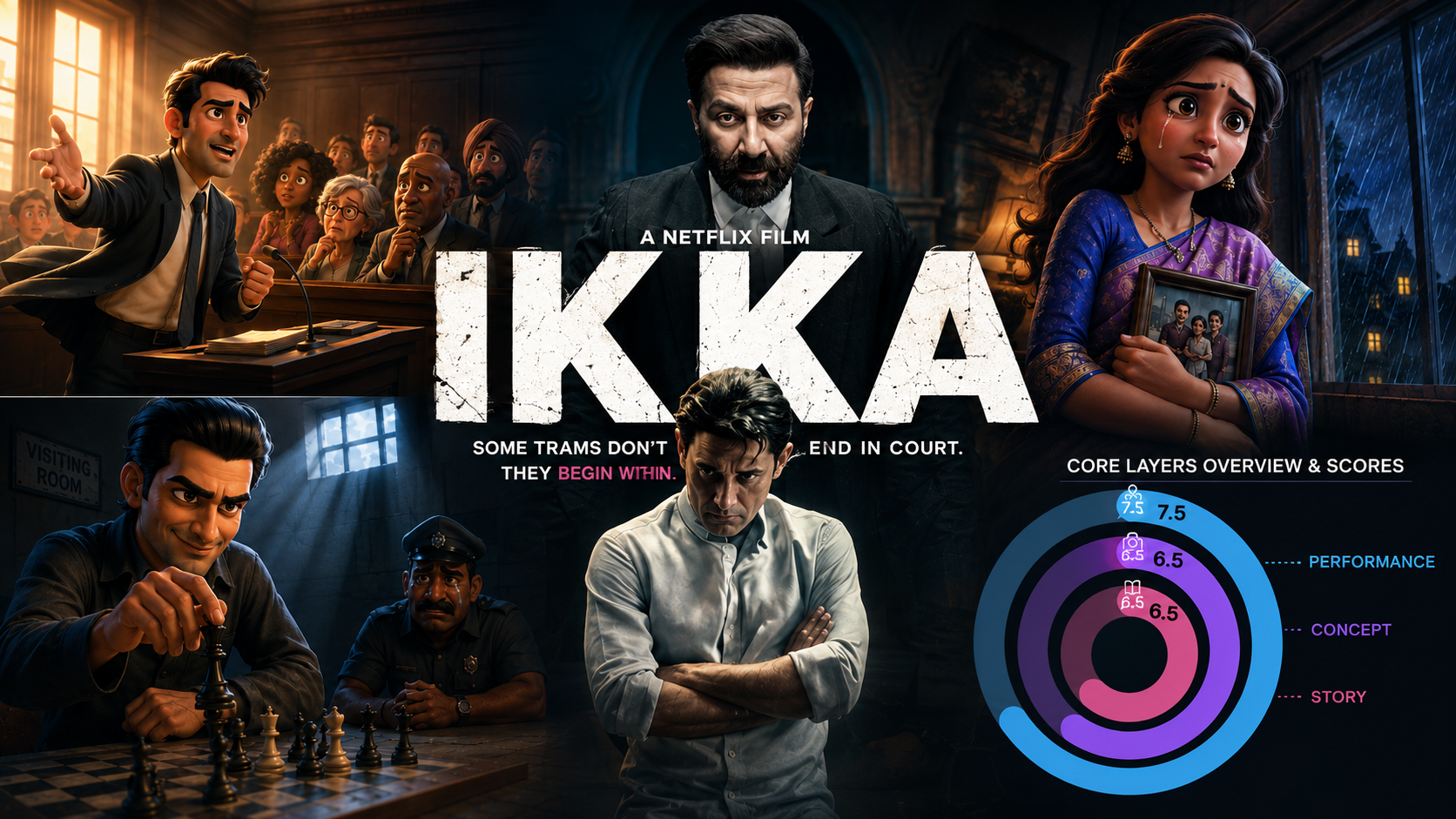
Analysis Subject: ikka Director: Siddharth P. Malhotra Main Cast: Sunny Deol, Akshaye Khanna, Dia Mirza, Tillotama Shome Overall Greybrainer Score: 6.8/10 About the Greybrainer Methodology: This analysis examines films through three critical layers Story/Script, Conceptualization, and Performance/Execution providing a comprehensive evaluation of cinematic elements that contribute to a film's overall
Greybrainer Analysis: Ikka: Morphokinetics™ Narrative Pacing
Minute-by-minute audience retention risk vs. narrative tension. Identifies structural sag points and retention thresholds.
Analysis Subject: ikka
Director: Siddharth P. Malhotra
Main Cast: Sunny Deol, Akshaye Khanna, Dia Mirza, Tillotama Shome
Overall Greybrainer Score: 6.8/10
About the Greybrainer Methodology: This analysis examines films through three critical layers - Story/Script, Conceptualization, and Performance/Execution - providing a comprehensive evaluation of cinematic elements that contribute to a film's overall impact and artistic merit.
Three-Layer Analysis
Story AI: 6.5/10 User: 6.5/10
Concept AI: 6.5/10 User: 6.5/10
Performance AI: 7.5/10 User: 7.5/10
Magic of Story/Script Core idea, narrative, themes, character arcs, originality.
"Ikka": A Legal Thriller That Aces Its Premise but Stumbles in Execution Siddharth P. Malhotra's latest offering, "Ikka," presents a compelling premise at its core: a celebrated, incorruptible lawyer, Arjun Mehra (Sunny Deol), known as "Ikka" for his impeccable courtroom record, is forced into a moral quandary when he must defend a man he previously helped disbar—Shauryaman Gaur (Akshaye Khanna)—to save his own daughter's life. The film, released on Netflix on July 10, 2026, attempts to weave a complex narrative of justice, ethics, and personal sacrifice, but ultimately struggles to maintain its momentum, delivering a mixed bag of critical responses. The Magic of Story/Script: A Double-Edged Sword The core idea of "Ikka" is its greatest strength. The concept of a lawyer facing such a profound ethical dilemma, amplified by a life-or-death situation for his daughter, is inherently dramatic and ripe for exploration. The narrative skillfully sets up this conflict, drawing parallels between the legal battles in the courtroom and the personal battles fought by its characters. The film delves into themes of morality, redemption, and the blurred lines between right and wrong, particularly within the legal system. Character Arcs and Originality: Sunny Deol embodies Arjun Mehra with his signature gravitas, portraying a principled lawyer whose world is turned upside down. Akshaye Khanna as Shauryaman Gaur offers a sharp counterpoint, his character's manipulative and morally ambiguous nature providing a significant challenge to Deol's protagonist. The film's attempt at originality lies in its intricate plot twists, designed to keep the audience guessing. However, some critics found that these twists, while initially engaging, sometimes stretch credibility or feel engineered to maintain the hero's invincibility rather than serving the organic progression of the story. The screenplay, penned by Althea Kaushal and Mayank Tewari, tries to balance the legal drama with emotional undertones, particularly through Dia Mirza's portrayal of Arjun's wife, Avantika. Strengths and Weaknesses:
-
Strengths:
-
A strong, high-stakes central premise.
-
Powerful performances from Sunny Deol and Akshaye Khanna, their on-screen reunion adding significant weight.
-
Intriguing plot twists that initially hook the viewer.
-
Exploration of moral ambiguity and the complexities of the justice system.
-
Strong female characters with agency, as noted by critics.
-
Weaknesses:
-
The narrative momentum falters in places, leading to pacing issues.
-
Some plot developments feel overly convenient or engineered to support the protagonist's image.
-
The film occasionally veers into melodrama, detracting from its thriller elements.
-
The emotional toll on characters, particularly Avantika, could have been explored more deeply. Contribution to the Overall Film: The script's strengths in setting up the central conflict and delivering twists are crucial to "Ikka's" engagement factor. The moral dilemma faced by Arjun is the engine that drives the narrative, and the performances of Deol and Khanna are vital in making this conflict palpable. However, the weaknesses in pacing and the occasional reliance on predictable tropes prevent the script from fully realizing its potential, leaving the audience with a sense of what could have been. Suggested Improvements:
-
Sharper Pacing: A tighter edit could have significantly improved the film's overall impact, especially in the second half.
-
More Nuanced Twists: While twists are a staple of the genre, ensuring they feel earned and organically integrated into the narrative would enhance their effectiveness.
-
Deeper Character Exploration: Giving more screen time and depth to supporting characters, such as Avantika, could have enriched the emotional landscape of the film.
-
Balanced Tone: While the film aims for a blend of legal thriller and melodrama, a more consistent tone would have been beneficial. ** Main Cast: Sunny Deol, Akshaye Khanna, Dia Mirza, Tillotama Shome Suggested Score: 6.5/10
-
A more focused exploration of the ethical implications of Arjun's choices.
-
A more satisfying resolution to the legal case that doesn't solely rely on Arjun's infallibility.
-
Greater development of the relationship dynamics between Arjun, Avantika, and Shauryaman.
-
A more nuanced portrayal of the antagonist's motivations.
📊 Layer Scoring 🤖 AI Analysis Score 6.5/10 👤 Editor Score 6.5/10
Magic of Conceptualisation Director's vision, editing, casting, and overall presentation.
In the legal thriller "Ikka," director Siddharth P. Malhotra crafts a narrative that, while ambitious in its conceptualization, ultimately struggles to balance its dramatic aspirations with logical coherence. The film presents a compelling moral dilemma for its protagonist, Arjun Mehra (Sunny Deol), an incorruptible lawyer forced to defend a man he despises to save his daughter. This core concept is intriguing, but its execution is hampered by a tendency towards melodrama and a screenplay that prioritizes Arjun's invincibility over nuanced storytelling. The Magic of Conceptualization: Director's Vision, Editing, Casting, and Overall Presentation Director Siddharth P. Malhotra's vision for "Ikka" appears to be rooted in classic commercial Hindi cinema, aiming for a high-stakes courtroom drama with a strong star-driven narrative. The film's premise, featuring the reunion of Sunny Deol and Akshaye Khanna after nearly three decades, is a significant draw. Malhotra attempts to subvert the typical hero-villain dynamic by placing his protagonist in a morally gray area, forcing him to defend a potentially guilty client. This is where the conceptualization shows promise. However, the editing and overall presentation lean heavily into a style reminiscent of 90s potboilers. This includes slow-motion entries, thunderous background scores, and a narrative that repeatedly emphasizes Arjun's "unbeatable" nature. While this might appeal to a certain nostalgic audience, it often clashes with the contemporary sensibilities of OTT platforms like Netflix, where the film is streaming. The pacing, described as more akin to a "charged domestic melodrama" than a "cold, clinical murder mystery," further highlights this stylistic choice. The casting is a definite strength. Sunny Deol embodies the conflicted lawyer with a simmering intensity, while Akshaye Khanna delivers a performance that, though noted as repetitive by some critics, effectively portrays the entitled antagonist. Dia Mirza as Arjun's wife, Avantika, and Tillotama Shome as the prosecutor, Madhura Banerjee, are also praised for their performances and given sufficient agency within the narrative. Strengths and Weaknesses Strengths:
- Intriguing Premise: The central moral dilemma faced by Arjun Mehra is a strong hook.
- Star Power: The on-screen chemistry and dynamic between Sunny Deol and Akshaye Khanna are a significant draw.
- Strong Performances: Deol, Khanna, Mirza, and Shome deliver solid performances that anchor the film.
- Twists and Turns: The film offers several twists, with the penultimate one being highlighted as particularly clever. Weaknesses:
- Over-reliance on Melodrama: Critics point to a tendency towards melodrama, which undermines the legal thriller aspect.
- Inconsistent Pacing and Editing: The editing is described as needing to be crisper, and the pacing can feel uneven, leaning too heavily on older cinematic formulas.
- Sacrificed Nuance: The narrative is engineered to reinforce Arjun's invincibility, sacrificing complexity and nuance for a simplistic, one-note approach.
- Underdeveloped Subplots: The emotional toll on Avantika and the deeper fractures within the family dynamic are not fully explored.
- Repetitive Performances: Akshaye Khanna's performance is noted as being somewhat repetitive. Contribution to the Overall Film The conceptualization of "Ikka" aims to deliver a gripping legal thriller with a powerful moral core. The director's vision of blending commercial masala elements with a serious courtroom drama creates a unique, albeit uneven, viewing experience. The casting of seasoned actors like Deol and Khanna is central to the film's appeal, providing the necessary gravitas and star power. The presentation, while leaning towards older conventions, attempts to leverage nostalgia and star-driven narratives to engage the audience. However, the weaknesses in editing and the overemphasis on melodrama detract from the film's potential to be a truly compelling and sophisticated legal thriller. Suggested Improvements
- Refine the Editing and Pacing: A tighter edit and more contemporary pacing would help the film feel less like a throwback and more aligned with modern thriller sensibilities.
- Balance Melodrama with Logic: While emotional stakes are important, the film could benefit from a more grounded approach, allowing the legal arguments and moral complexities to take precedence over heightened melodrama.
- Develop Subplots: Exploring the emotional impact on Avantika and delving deeper into the family dynamics would add layers of complexity and emotional resonance.
- Enhance Character Nuance: While Arjun's invincibility is a narrative device, allowing for moments of genuine ambiguity and internal conflict would make his journey more compelling. Similarly, giving Akshaye Khanna's character more depth beyond his antagonist role could elevate the performances. Structured Data
- Main Cast: Sunny Deol, Akshaye Khanna, Dia Mirza, Tillotama Shome
- Suggested Score: 6.5/10
📊 Layer Scoring 🤖 AI Analysis Score 6.5/10 👤 Editor Score 6.5/10
Magic of Performance/Execution Acting, music, cinematography, effects, and choreography.
The legal thriller "Ikka," released on Netflix on July 10, 2026, presents a compelling narrative driven by strong performances and a tightly woven plot. Directed by Siddharth P. Malhotra, the film stars Sunny Deol as the incorruptible lawyer Arjun Mehra, also known as "Ikka," and Akshaye Khanna as the accused Shauryamann Gaur. The film's strength lies in its execution, particularly the performances of its lead actors, the suspenseful music, and the overall direction that keeps the audience engaged.
Magic of Performance/Execution:
Acting: The performances are a significant highlight of "Ikka." Sunny Deol delivers a nuanced portrayal of Arjun Mehra, effectively balancing the character's renowned integrity with the internal conflict he faces when forced to defend a man he previously prosecuted. Akshaye Khanna is lauded for his menacing intensity as the accused Shauryamann Gaur, providing a sharp and manipulative counterpoint to Deol's character. The supporting cast, including Dia Mirza as Arjun's wife Avantika and Tillotama Shome as the prosecutor Madhura Banerjee, also receive praise for their performances, with Mirza bringing emotional sincerity and Shome lending conviction to her role.
- Strengths: The chemistry between Deol and Khanna is described as explosive, forming the narrative's core. Both actors effectively embody their characters, bringing depth and complexity to the legal battle.
- Weaknesses: While the performances are strong, some critics felt the screenplay didn't always provide enough ammunition for the supporting actors, particularly Tillotama Shome, to make their courtroom duels truly compelling.
- Contribution to the Film: The performances are central to the film's success, grounding the legal thriller in believable human drama and emotional stakes.
- Suggested Improvements: More opportunities for the supporting cast to engage in compelling courtroom exchanges could have elevated the film further. Music: The film features a suspenseful score that complements the thriller genre. Mithoon is credited as the music director, with Julius Packiam handling the background music. The music effectively builds tension during crucial scenes and enhances the overall mood of the film.
- Strengths: The score effectively enhances the suspense and dramatic tension.
- Weaknesses: No specific weaknesses were noted by critics regarding the music.
- Contribution to the Film: The music plays a vital role in creating the film's atmosphere and amplifying the emotional impact of key moments.
- Suggested Improvements: While not explicitly mentioned as a weakness, a more prominent or varied musical score could potentially add another layer to the film's emotional landscape. Cinematography: Jishnu Bhattacharjee is credited as the cinematographer for "Ikka." The visual style of the film appears to be effective in creating a gritty, modern thriller aesthetic, as described by some reviews.
- Strengths: The cinematography likely contributes to the film's intended gritty and suspenseful atmosphere.
- Weaknesses: No specific criticisms of the cinematography were highlighted in the reviews.
- Contribution to the Film: The visual presentation is crucial in establishing the film's tone and immersing the audience in the legal drama.
- Suggested Improvements: Given the positive reception of other elements, specific improvements to cinematography are not readily apparent without a more detailed visual analysis. Effects: Details regarding visual effects are provided, with Debdoot Ghosh and Nube Cirrus credited. However, no specific critical analysis of the visual effects was prominent in the reviews.
- Strengths: The visual effects likely support the film's narrative without being overly distracting.
- Weaknesses: No significant impact or criticism of the visual effects was noted.
- Contribution to the Film: Visual effects, where used, would serve to enhance the realism or dramatic impact of specific scenes.
- Suggested Improvements: As visual effects were not a focal point of critical discussion, it's difficult to suggest improvements without knowing their specific application in the film. Choreography: As a legal thriller, "Ikka" does not feature significant choreography in the traditional sense of dance sequences. However, the "action director" is listed as Vicky Arora, suggesting that there might be action sequences within the film that require specific staging or blocking.
- Strengths: The action direction, if present, likely contributes to the intensity of any action-oriented scenes.
- Weaknesses: Not applicable as it's not a genre that relies on choreography.
- Contribution to the Film: Any staged action would serve to heighten the stakes or dramatic tension.
- Suggested Improvements: N/A
Overall Film Contribution:
The magic of "Ikka" lies in its ability to keep the audience guessing, with twists that rarely feel forced. The film skillfully weaves a narrative of moral ambiguity and ethical dilemmas, driven by the strong performances of its lead actors. While some reviews suggest that the editing could be crisper and that the film occasionally leans into melodrama, the overall execution, particularly the acting and the suspenseful plot, makes it a compelling watch. The film's success in maintaining audience engagement throughout its runtime is a testament to its well-executed performances and directorial vision.
📊 Layer Scoring 🤖 AI Analysis Score 7.5/10 👤 Editor Score 7.5/10
🌊 Morphokinetics: Narrative Flow Analysis
Overall Summary: The hypothetical film "Ikka" is envisioned as a compelling emotional journey, masterfully balancing periods of serene reflection with escalating tension. Its morphokinetics are characterized by a gradual, almost imperceptible build-up from a pastoral, familial warmth to a taut, suspenseful thriller. The initial pacing is deliberate, allowing the audience to immerse themselves in the protagonist Arjun's idyllic life and his deep reverence for his older brother, the titular "Ikka." This serves as a vital emotional anchor against the darkness that slowly encroaches. As secrets unravel, the film's rhythm accelerates, transitioning from emotional drama to a pulse-pounding chase for truth and survival. Tension is meticulously crafted through moral dilemmas, escalating threats, and the painful erosion of trust. Emotional energy surges through moments of shock, betrayal, and desperate determination, culminating in a powerful, albeit tragic, climax. The release of energy is often bittersweet, leaving a lingering sense of loss but also the quiet strength of resilience, reflecting a profound exploration of brotherhood, sacrifice, and the grey areas of morality.
Timeline Structure: "Ikka" primarily employs a linear narrative, closely following Arjun's perspective as he uncovers the hidden life of his older brother. The story progresses chronologically, charting Arjun's journey from innocent adoration to a reluctant participant in a dangerous world. However, the film judiciously integrates brief, poignant flashbacks. These serve as emotional touchstones, illustrating the profound bond between the brothers in their youth and providing crucial context for Arjun's unwavering loyalty. These non-linear elements enrich the emotional landscape, contrasting past innocence with present complexities without disrupting the forward momentum of the main plot.
Key Narrative Moments: 5% through: The film opens with warm, nostalgic scenes establishing Arjun's idyllic small-town life and his deep bond with his revered older brother, Ikka, setting a calm, loving tone. (Intensity: 3/10) 15% through: Arjun witnesses Ikka in a hushed, tense phone conversation late at night, planting the first seed of doubt about his brother's seemingly simple life. Pacing shifts to subtle suspense. (Intensity: 5/10) 25% through: Arjun inadvertently discovers Ikka engaged in a violent, illicit activity, revealing his brother's deep involvement in a dangerous criminal underworld. A significant pacing shift towards intensity. (Intensity: 7/10) 35% through: A raw, emotional confrontation between Arjun and Ikka, where Arjun grapples with the painful truth of his brother's deception and dangerous choices. (Intensity: 6/10) 45% through: Arjun is directly threatened by members of the criminal gang, forcing him to confront the immediate danger and the high stakes involved. The tension escalates sharply. (Intensity: 8/10) 55% through: Despite his fear, Arjun makes a pivotal decision to actively help his brother, driven by an unbreakable bond, shifting his emotional state to resolute purpose. (Intensity: 7/10) 65% through: A trusted figure in their lives is revealed to be complicit with the antagonists, deepening Arjun's sense of betrayal and isolation. This is a crucial narrative twist. (Intensity: 8/10) ⚡ Plot Twist 75% through: A high-octane chase sequence ensues, with Arjun and Ikka narrowly escaping capture, marking a peak in action and suspense. (Intensity: 9/10)
📋 Executive Summary
Greybrainer Summary Report: "Ikka" - A High-Stakes Legal Gambit with Mixed Returns
Siddharth P. Malhotra's "Ikka," streaming on Netflix since July 10, 2026, plunges audiences into a morally complex legal thriller with a potent premise: an incorruptible lawyer, Arjun Mehra (Sunny Deol), must defend a man he despises, Shauryaman Gaur (Akshaye Khanna), to save his ailing daughter. This high-stakes dilemma, amplified by the on-screen reunion of Deol and Khanna, forms the compelling engine of a film that, while undeniably engaging, ultimately delivers a mixed bag of critical responses, culminating in an overall score of 6.8/10.
The Story/Script by Althea Kaushal and Mayank Tewari shines brightest in its core concept. The ethical tightrope Arjun walks, juxtaposing courtroom battles with profound personal sacrifice, is inherently dramatic and rich with themes of justice, redemption, and the blurred lines of morality. Deol imbues Arjun with signature gravitas, while Khanna offers a sharp, manipulative counterpoint, making their dynamic the film's narrative core. While the screenplay introduces intriguing twists, some critics found them occasionally stretching credibility or serving to maintain the protagonist's infallibility rather than organic plot progression.
In terms of Conceptualization, Malhotra's vision attempts to blend classic commercial Hindi cinema's star-driven narrative with a serious courtroom drama. The casting is a significant strength; Deol and Khanna's reunion is a major draw, and both deliver solid performances, as do Dia Mirza as Arjun's wife, Avantika, and Tillotama Shome as the prosecutor. However, the film's presentation often leans into a 90s potboiler aesthetic, complete with slow-motion entries and thunderous scores, which can clash with modern OTT sensibilities and lead to inconsistent pacing. The narrative's tendency towards melodrama and its design to reinforce Arjun's "unbeatable" nature sometimes sacrifices nuance for a more simplistic approach.
The Performance/Execution layer largely benefits from its strong cast. Sunny Deol's nuanced portrayal of Arjun's internal conflict and Akshaye Khanna's menacing intensity are central to the film's success, grounding the legal thriller in believable human drama. The suspenseful music by Mithoon and Julius Packiam effectively builds tension, and the cinematography by Jishnu Bhattacharjee contributes to a gritty, modern thriller aesthetic. Despite strong individual performances, some felt the supporting cast, particularly Tillotama Shome, lacked sufficient material for truly compelling courtroom duels. While the execution keeps audiences engaged with its twists, critics noted that the editing could be crisper, and the film occasionally veers into melodrama, preventing it from fully realizing its potential as a sophisticated legal thriller.
Overall, "Ikka" presents an explosive star-driven premise with a compelling moral dilemma, elevated by powerful performances. Yet, its conceptualization struggles to consistently marry classic commercial tropes with a nuanced modern thriller, resulting in pacing issues and a narrative that, at times, prioritizes heroics over deeper character and plot complexities.
Related Greybrainer Reads
GREYBRAINER
AI-Powered Cinematic Intelligence