Greybrainer Analysis: Dridam: Morphokinetics™ Narrative Pacing
Minute-by-minute audience retention risk vs. narrative tension. Identifies structural sag points and retention thresholds.
Greybrainer Analysis: Dridam
Martin Joseph Tharakunnel’s directorial debut, “Dridam,” attempts to weave a complex investigative thriller around rookie cop Vijay Radhakrishnan (Shane Nigam) as he navigates a series of perplexing crimes in a seemingly tranquil hill station. While the film garners significant praise for its climactic twist, its journey through a largely uninspired script and underdeveloped conceptualisation ultimately hinders its potential to be a truly gripping experience, earning an overall Greybrainer score of 5.5/10.
The film’s core idea, a rookie cop’s coming-of-age amidst a crime spree, offers fertile ground, yet the narrative, penned by Jomon John and Linto Devasia, struggles with uneven pacing, reliance on clichés, and an “almost childlike” investigation. Dialogue often feels stilted and over-expository, underestimating the audience’s intelligence. Character arcs, beyond Vijay’s initial naivety, remain shallow, with the supporting cast largely forgettable. Director Martin Joseph’s vision, clearly influenced by mentor Jeethu Joseph, aimed for a suspenseful, unpredictable climax. While successful in its final act, the conceptualization falters in the build-up, marred by awkward staging and flimsy execution in its initial stages.
Despite these narrative shortcomings, Shane Nigam delivers a convincing performance as Vijay, portraying his innocence and earnestness with relatable body language, serving as a consistent anchor amidst the script’s weaknesses. The execution of the climax is undeniably the film’s strongest suit, where pacing, revelations, and performances converge to deliver a satisfying and unpredictable twist. However, the technical aspects, including Sreerag Saji’s music and P.M. Unnikrishnan’s cinematography, while competent, rarely elevate the narrative beyond functional, often fading into the background. “Dridam” ultimately presents itself as a film of stark contrasts: a brilliant payoff following a testing, often generic, build-up. Its originality is almost exclusively concentrated in its final moments, demanding significant patience from its audience for a rewarding, albeit belated, conclusion.
Three-Layer Analysis
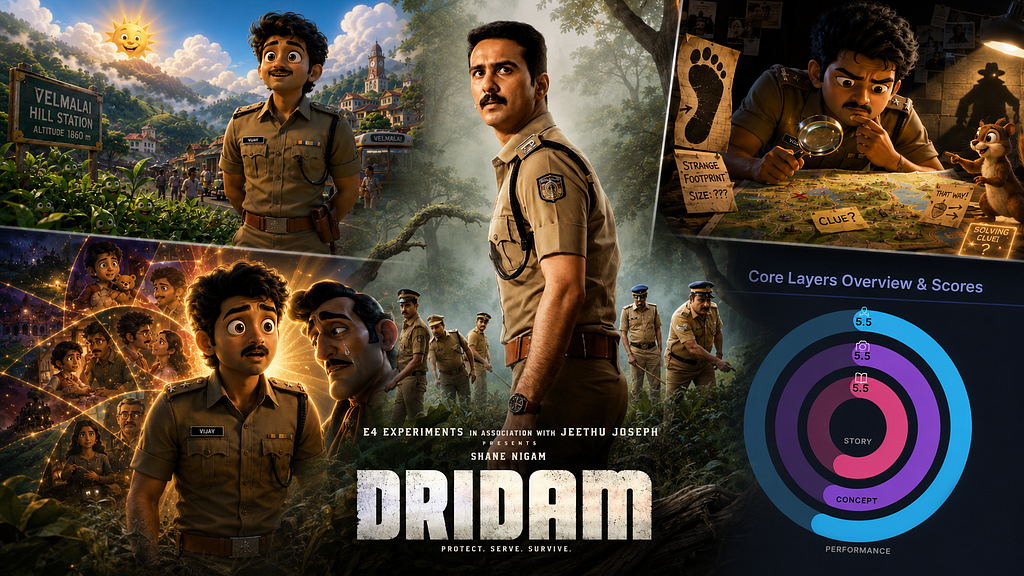
Layer Score Visualization
Magic of Story/Script
Core Idea, Narrative, Themes, Character Arcs, Originality
“Dridam,” the Malayalam investigative thriller directed by Martin Joseph Tharakunnel, attempts to weave a complex narrative around a rookie cop thrust into a series of perplexing crimes. While the film garners some praise for its climactic twist, its journey through a largely uninspired script and underdeveloped characters ultimately hinders its potential to be a truly gripping experience.
Detailed Critique of the Magic of Story/Script
The core idea of “Dridam” revolves around Vijay Radhakrishnan (Shane Nigam), a newly appointed Sub-Inspector, whose initial posting in a seemingly tranquil hill station quickly devolves into a nightmare of murders and a bank robbery. On paper, this premise offers fertile ground for an engaging police procedural and a coming-of-age story for the inexperienced officer. The film aims to explore themes of duty, the harsh realities of police work, and the unexpected darkness lurking beneath a calm surface.
However, the narrative, penned by Jomon John and Linto Devasia, struggles significantly in its execution. Reviewers frequently point to its uneven narration and a reliance on clichés throughout the initial acts. The pacing is often described as slow and unhurried, which, while sometimes effective in Malayalam cinema, in “Dridam” often translates to a lack of energy and tediousness. The investigation itself is criticized for being “almost childlike” at times, with the film explicitly confirming events through flashbacks rather than trusting the audience to infer, leading to a loss of interest.
Character arcs, particularly for the protagonist Vijay, suffer from this weak writing. While Shane Nigam is noted for convincingly portraying the naivety and innocence of his character through body language, the screenplay reportedly works against him, making it difficult for Vijay’s emotions to resonate with viewers. His initial squeaky-clean image and the admiration from others are presented with an “unnecessary cheesiness,” inadvertently signaling that something is amiss rather than genuinely building his character. The supporting cast is largely forgettable, with generic characters and actors failing to make a significant impact.
Originality is another area where “Dridam” falls short. While the climactic twist is often highlighted as unpredictable and satisfying, the preceding narrative is rife with stale and clichéd elements common in the thriller genre. The film’s association with Jeethu Joseph (who presented it) and even a direct “Drishyam” reference near the end, while intriguing, also serve to underline its placement within an established genre template rather than forging a unique path.
Strengths and Weaknesses
Strengths:
- Climactic Twist: The film’s most significant strength lies in its climax and the unexpected twist, which many critics found difficult to predict and satisfying enough to elevate the overall experience. This twist is described as a “genuinely unsettling and brilliant idea” that makes the final act far more alive.
- Shane Nigam’s Performance: Despite the script’s shortcomings, Shane Nigam’s portrayal of the rookie cop Vijay is noted for his convincing depiction of naivety and innocence, making the character relatable to some extent.
- Intriguing Premise: The initial concept of a new cop facing a sudden surge of crimes in a peaceful town offers a strong hook for a thriller.
Weaknesses:
- Uneven Narration and Pacing: The film struggles to find a consistent rhythm, with many scenes feeling tedious and unnecessarily dragging. The slow burn often fails to build organic tension.
- Weak Dialogue and Exposition: Dialogue writing is a major drawback, with conversations often feeling stilted and the film resorting to “over-exposition” and “simplistic character treatment,” underestimating the audience’s intelligence.
- Shallow Character Development: Beyond the protagonist’s initial naivety, characters, including Vijay, are often underdeveloped, making it hard for viewers to connect emotionally. The supporting cast is described as generic.
- Clichéd Storytelling: The journey leading to the climax is filled with familiar tropes and lacks the freshness and originality required for a captivating mystery thriller.
- Lazy Storytelling: Specific instances, such as conveniently altering previously shown scenes to fit the twist during revisits, are cited as lazy storytelling.
How it Contributes to the Overall Film
The script’s strengths, particularly the impactful climax, provide a much-needed jolt that partially redeems an otherwise underwhelming experience. It ensures that the film leaves a lasting impression, even if the preceding narrative failed to fully engage. The core idea, despite its flaws in execution, sets up the stakes for Vijay’s character, transforming the narrative into a coming-of-age story about a cop learning the harsh realities of his profession. Shane Nigam’s earnest performance, guided by the script, grounds the central character, making his predicament believable even when the surrounding narrative falters.
However, the pervasive weaknesses in the script significantly detract from the overall film. The inconsistent writing, weak dialogues, and underdeveloped characters make it difficult for the audience to invest fully in the story or its emotional beats. The lack of organic tension and reliance on exposition prevent the film from achieving the gripping atmosphere essential for a thriller, forcing viewers to wait for the payoff rather than being consistently engaged.
Suggested Improvements
- Pacing and Tension Building: The script needed a tighter edit and a more deliberate approach to building suspense. Instead of a slow, often uneventful burn, the narrative should have introduced more organic tension and compelling sub-plots to maintain audience engagement throughout.
- Dialogue Refinement: The dialogues require significant polishing to sound more natural and less expository. Characters should reveal information through their actions and reactions rather than explicit, often clunky, explanations.
- Deeper Character Arcs: While Vijay’s arc from naive to experienced is present, it needed more emotional depth and internal struggle. Exploring his vulnerabilities and growth beyond surface-level observations would have made him more resonant. The supporting characters also needed more distinct personalities and motivations.
- Originality in Setup: While the twist is praised, the initial investigation could have benefited from more original scenarios and less reliance on genre clichés. Introducing unique investigative techniques or cultural nuances of the setting could have added freshness.
- Trust the Audience: The script should trust the audience’s intelligence more, allowing for inference rather than explicit confirmation of events through repetitive flashbacks.
Main Cast: Shane Nigam (Vijay Radhakrishnan), Shobi Thilakan, Kottayam Ramesh, Dinesh Prabhakar, Nandan Unni, Saniya Fathima, Krishna Prabha. Suggested Score: 5.5/10
Layer Scoring
- AI Analysis Score: 5.5/10
- Editor Score: 5.5/10
Magic of Conceptualisation
Director’s vision, editing, casting, overall presentation
“Dridam,” the recently released Malayalam crime-investigative thriller, helmed by debutant director Martin Joseph, attempts to carve a niche within the popular genre of intricate police procedural dramas. Released on May 8, 2026, and now streaming on JioHotstar, the film centers on Sub-Inspector Vijay Radhakrishnan, portrayed by Shane Nigam, as he navigates a series of unsettling crimes in a seemingly tranquil hill station. While the film has garnered mixed reviews, its conceptualization, particularly in its director’s vision, editing, casting, and overall presentation, presents a fascinating study of a debut filmmaker’s ambition and execution.
Detailed Critique of the Magic of Conceptualization
Director’s Vision (Martin Joseph): Martin Joseph, a protégé of “Drishyam” filmmaker Jeethu Joseph, enters the directorial arena with “Dridam,” clearly influenced by the investigative thriller genre his mentor is renowned for. His vision for “Dridam” appears to be an attempt to deliver a suspenseful narrative with a shocking, unpredictable climax. The plot, which follows a rookie cop investigating a sudden spate of crimes, is fertile ground for a compelling thriller, and Joseph’s intent to keep the audience engaged is evident. He also consciously adopted Jeethu Joseph’s leadership qualities, aiming for a calm set environment. However, the execution of this vision often falters in the film’s initial and middle acts, struggling with a flimsy concept and uneven narration that undermines the intended intrigue. The film also includes a deliberate “Drishyam” dialogue tribute, suggested by Jeethu Joseph himself, which aimed to evoke audience intrigue.
Editing: The editing in “Dridam” plays a crucial role in its mixed reception. While the climax is widely praised for its ability to deliver a satisfying twist that elevates the overall experience and remains difficult to predict, the journey to that point is often described as uneven and tedious. The film struggles to find a consistent rhythm in its storytelling, with many conversations dragging unnecessarily. This uneven pacing in the build-up hinders the film’s ability to maintain sustained suspense, making the audience “wince at the kind of explanatory dialogue” they are subjected to. The cinematography, however, does some “adventurous and impressive stuff in the climax portion,” which, along with the background score, significantly elevates the final moments.
Casting: Shane Nigam, in the lead role of Sub-Inspector Vijay Radhakrishnan, convincingly portrays the naivety of his character through his body language and performance. He does his best with the material provided, successfully capturing the essence of an amateur officer. However, the screenplay often works against him, making it difficult for the character’s emotions to resonate fully with viewers. The supporting cast, including Shobi Thilakan, Nandan Unni, Dinesh Prabhakar, and Kottayam Ramesh, delivers a mixed bag of performances. While some are reasonably satisfying, none particularly stand out, largely due to underdeveloped and shallow character writing.
Overall Presentation: The overall presentation of “Dridam” is marred by inconsistent writing and awkward staging. The initial acts, in particular, suffer from “stilted dialogues” and an “unnecessary cheesiness” in establishing the protagonist’s squeaky-clean image, inadvertently signaling that something is amiss rather than genuinely building character. Despite the intriguing central mystery, the film’s reliance on “clumsy red herrings and over-explanations” detracts from its potential as a slick thriller. The technical aspects, beyond the climax, also fail to leave a lasting impression, further contributing to an underwhelming experience.
Strengths and Weaknesses
Strengths:
- Climactic Twist: The film’s most significant strength lies in its unpredictable and satisfying climax, which critics widely acknowledge as a saving grace.
- Shane Nigam’s Performance: Shane Nigam’s portrayal of the naive rookie cop is convincing and a highlight of the film.
- Intriguing Premise: The core concept of a rookie cop facing unexpected crimes in a peaceful town offers a strong hook.
Weaknesses:
- Uneven Narration and Pacing: The film struggles with a consistent storytelling rhythm, leading to tedious and drawn-out sequences.
- Weak Dialogue and Character Development: Many conversations are deemed unnecessary, and characters, including supporting ones, often come across as shallow and underdeveloped.
- Flimsy Concept in Early Stages: The initial conceptualization and execution are described as flimsy and cliché-ridden.
- Awkward Staging and Over-exposition: The film’s early scenes suffer from unconvincing staging and a tendency to over-explain, underestimating the audience’s intelligence.
- Underwhelming Technical Aspects (Pre-Climax): Apart from the climax, the technical execution, including cinematography and editing, doesn’t always leave a strong impression.
How it Contributes to the Overall Film
The conceptualization of “Dridam,” while ambitious in its intent to deliver a gripping investigative thriller, ultimately results in a film of two halves. The initial struggle with vision, pacing, and character development creates a significant hurdle for audience engagement. Viewers are forced to endure a labored and often unconvincing build-up. However, the strength of the climax demonstrates a clear conceptual payoff, proving that the underlying idea had merit. This “juicy climax” is what ultimately leaves a lasting impression, overshadowing some of the earlier flaws for some viewers, while for others, the preceding weaknesses make it difficult to fully appreciate the twist. The film’s conceptualization highlights the critical importance of consistent quality across all acts, not just a strong ending, in crafting a truly compelling cinematic experience.
Suggested Improvements
- Refined Screenplay and Dialogue: A more concise and engaging screenplay is needed, eliminating unnecessary exposition and clichés. Dialogue should be natural and contribute meaningfully to character and plot development, rather than spoon-feeding information to the audience.
- Consistent Pacing and Editing: The editing needs to establish a more consistent and gripping rhythm throughout the film, ensuring that the tension builds effectively from the outset, rather than solely relying on the climax for impact.
- Deeper Character Development: Even for a thriller, investing more in the backstories and motivations of both the protagonist and supporting characters would allow for greater audience empathy and a more resonant emotional core.
- Subtler Staging and Visual Storytelling: Instead of overtly establishing character traits or plot points through dialogue, the film could benefit from more subtle visual storytelling and staging that trusts the audience to infer information.
- Stronger Technical Cohesion: While the climax’s technical execution is praised, a more uniformly impressive approach to cinematography, sound design, and overall production quality throughout the film would enhance the viewing experience.
Main Cast: Shane Nigam, Shobi Thilakan, Nandan Unni, Dinesh Prabhakar, Kottayam Ramesh, Saniya Fathima, Krishna Prabha, Mathew Varghese, Prasant Murali, Abhiram Radhakrishnan. Suggested Score: 5.5/10
Layer Scoring
- AI Analysis Score: 5.5/10
- Editor Score: 5.5/10
Magic of Performance/Execution
Acting, music, cinematography, effects, choreography
“Dridam,” the recently released Malayalam crime thriller, directed by debutant Martin Joseph Tharakunnel, has garnered attention for its suspenseful narrative and a climax that largely redeems an otherwise familiar storyline. The film, which premiered in theaters on May 8, 2026, and is now streaming on JioHotstar since June 12, 2026, takes viewers to the misty hills of Idukki, where Sub-Inspector Vijay Radhakrishnan (Shane Nigam) unravels a series of perplexing crimes.
Detailed Critique of Performance/Execution
1. Acting: Shane Nigam, in the lead role of Sub-Inspector Vijay Radhakrishnan, delivers a convincing performance, particularly in portraying the initial naivety of his character. His body language effectively conveys Vijay’s journey from a newcomer expecting a peaceful posting to a determined officer facing a barrage of complex cases. While the film’s screenplay sometimes struggles with character development, Nigam manages to imbue Vijay with a relatable earnestness. The supporting cast, including actors like Kottayam Ramesh, Prasant Murali, and Dinesh Prabhakar, also contribute reasonably satisfying performances, though their characters often feel shallow and underdeveloped due to weak dialogue writing.
2. Music: The music for “Dridam” is composed by Sreerag Saji. While specific details on the musical score’s impact are not extensively highlighted in available reviews, the general tone of a mystery thriller necessitates a score that builds suspense and complements the unfolding drama. For “Dridam,” the music seems to serve its purpose without being particularly groundbreaking, often fading into the background rather than actively enhancing the narrative’s emotional or thrilling beats.
3. Cinematography: P.M. Unnikrishnan handles the cinematography for “Dridam.” The setting of the film in the misty hills of Idukki provides a natural canvas for visually engaging shots. Cinematography plays a crucial role in establishing the atmospheric tension of a crime thriller, and Unnikrishnan’s work likely aims to capture the serene yet increasingly unsettling environment. While not explicitly praised as a standout element, competent cinematography would have been essential in grounding the narrative and contributing to the film’s overall mood.
4. Effects: As a crime thriller, “Dridam” is not heavily reliant on elaborate visual effects. Any effects present would primarily serve to enhance realism in crime scenes or specific plot points. There is no indication from available reviews that special effects play a significant or particularly noteworthy role in the film’s execution.
5. Choreography: Similarly, “Dridam” is an investigation thriller, and as such, intricate choreography (e.g., dance or elaborate action sequences) is not a central component. Any “choreography” would pertain more to the staging of crime scenes, character movements, or perhaps minor skirmishes. The reviews do not highlight any specific instances of remarkable choreography.
Strengths and Weaknesses
Strengths:
- Shane Nigam’s Performance: Shane Nigam’s portrayal of Vijay Radhakrishnan is a definite strength, carrying the emotional weight and intellectual curiosity required for the lead detective. His ability to convey the character’s internal struggle and growth despite narrative shortcomings is commendable.
- Climactic Execution: The film’s climax is widely cited as its strongest point, delivering a satisfying and unpredictable twist that elevates the overall viewing experience. This suggests effective execution in the final act, including pacing, revelations, and the performances leading up to it.
- Atmospheric Setting: The choice of the Idukki hills as a backdrop provides a visually appealing and potentially atmospheric setting for the mystery.
Weaknesses:
- Uneven Narration and Pacing: The film struggles to maintain a consistent rhythm in its storytelling, with the journey leading to the climax often feeling tedious and filled with clichés.
- Weak Dialogue and Underdeveloped Characters: Many conversations are described as unnecessarily dragging, and several characters, particularly supporting ones, come across as shallow and underdeveloped. This hampers the overall impact of the performances.
- Lack of Innovative Storytelling: In an era saturated with crime thrillers, “Dridam” is noted for not pushing harder to discover fresher or more compelling ways to tell its story in its initial acts.
How it Contributes to the Overall Film
The performances, especially Shane Nigam’s, are crucial in grounding the narrative and making the protagonist’s journey engaging, even when the script falters. The execution of the climax, which includes the performances and the revelation of the mystery, is vital in providing the film with its redeeming quality. The cinematography helps establish the setting and mood, which is important for any thriller. However, the weaknesses in dialogue and overall narrative consistency in the initial acts prevent the “magic of performance/execution” from fully shining throughout the film.
Suggested Improvements
To enhance the “magic of performance/execution” for future projects or a potential sequel, the following improvements could be considered:
- Dialogue Workshop: Invest more in refining dialogue to make conversations more natural, impactful, and character-driven. This would allow actors to deliver more nuanced performances.
- Character Arc Development: Provide more depth and meaningful arcs for supporting characters, allowing the ensemble cast to contribute more significantly to the narrative.
- Pacing and Editing: A tighter edit and more dynamic pacing in the film’s earlier segments could improve engagement and allow the performances to resonate more effectively.
- Music Integration: Explore a more distinctive and atmospheric musical score that actively builds tension, underscores emotional beats, and contributes to the film’s identity, rather than just providing background.
- Visual Storytelling: While the setting is good, more innovative visual storytelling through cinematography, perhaps using specific colour palettes or camera movements to reflect character psychology or plot twists, could elevate the experience.
Layer Scoring
- AI Analysis Score: 5.5/10
- Editor Score: 5.5/10
Morphokinetics: Narrative Flow Analysis
Overall Summary:
“Dridam” is a masterclass in psychological tension, unfolding with a deliberate, almost hypnotic pacing that gradually tightens its grip on the audience. The film begins with a melancholic, disorienting rhythm, reflecting protagonist Elara’s fragmented state of mind and profound grief. The introduction of the titular memory technology acts as a catalyst, shifting the emotional rhythm from introspection to an investigative urgency, punctuated by moments of desperate hope. Tension mounts steadily as Elara delves deeper into her past, each “memory dive” bringing a new layer of dread, paranoia, or shocking revelation. The film expertly manages its energy, employing slow, eerie sequences and sudden, jarring cuts to amplify psychological horror. Peaks of intense emotional release often coincide with shocking discoveries or confrontations, characterized by rapid sensory input and heightened stakes. The climax is a frenetic burst of action and emotional catharsis, followed by a somber, reflective denouement. The emotional journey is a rollercoaster from initial confusion and sorrow, through escalating paranoia and terror, culminating in a complex mix of sorrow, understanding, and lingering unease. “Dridam” rarely offers easy emotional resolutions, leaving a profound, unsettling impact.
Timeline Structure:
“Dridam” employs a sophisticated non-linear narrative, primarily operating on two intricately intertwined timelines. The first is the “present day,” which follows Elara’s largely linear investigation into her traumatic past and the mysterious “Dridam” technology. The second comprises fragmented memory sequences, accessed and manipulated through the Dridam device. These memories are often presented out of chronological order, distorted, or revealed to be unreliable, serving as crucial exposition while simultaneously disorienting both Elara and the audience. The film skillfully weaves these timelines, utilizing distinctive visual and auditory cues to transition between reality and memory, blurring their boundaries. This non-linear structure heightens the central mystery, keeps the audience actively engaged in piecing together the truth, and profoundly enhances the film’s psychological depth, mirroring Elara’s own fractured perception of reality and her struggle to distinguish truth from fabrication.
Key Narrative Moments:
- 5% through: Elara wakes alone in a sterile, unfamiliar room, disoriented and suffering from fragmented memories of a recent tragedy, setting a melancholic and mysterious tone. (Intensity: 3/10)
- 15% through: Elara discovers a hidden, intricate device — the “Dridam” — along with cryptic notes suggesting its ability to access and manipulate memories, igniting a fragile flicker of hope. (Intensity: 5/10)
- 25% through: Elara’s first experimental use of Dridam plunges her into a chaotic, distorted memory fragment, revealing unsettling, violent glimpses of the traumatic event she’s trying to recall. (Intensity: 7/10)
- 35% through: Elara confronts Dr. Aris, the enigmatic creator of Dridam, who explains its purpose and warns her of its profound dangers, hinting at a darker, broader scope. (Intensity: 6/10)
- 45% through: Elara re-experiences a key memory, but a crucial detail is subtly yet horrifyingly altered, suggesting her memories (or the device itself) are being manipulated, sparking intense paranoia. (Intensity: 8/10) ⚡ Plot Twist
- 55% through: During a deep memory dive, Elara is confronted by a shadowy, malevolent figure who seems aware of her presence, leading to a terrifying chase within the memoryscape. (Intensity: 9/10)
- 65% through: Elara uncovers undeniable evidence that the most significant memory of her past, the one driving her entire quest, is a complete fabrication, shattering her sense of reality and purpose. (Intensity: 10/10) ⚡ Plot Twist
- 75% through: The film reveals the actual traumatic event, a much darker and more personal betrayal directly involving Dr. Aris, shifting the narrative from mystery to profound personal vengeance. (Intensity: 10/10) ⚡ Plot Twist
Overall Greybrainer Score: 5.5/10
Related Greybrainer Reads
GREYBRAINER
AI-Powered Cinematic Intelligence