50-Word Verdict
Analysis Subject: Cocktail 2 Director: Homi Adajania Overall Greybrainer Score: 5.0/10 Homi Adajania's "Cocktail 2," the 2026 spiritual sequel, arrives with a lavish production, attempting to rekindle the vibrant, modern romance of its predecessor. However, despite its aesthetic ambitions and a stellar cast, the film ultimately registers a Greybrainer score
Greybrainer Analysis: Cocktail 2: Morphokinetics™ Narrative Pacing
Minute-by-minute audience retention risk vs. narrative tension. Identifies structural sag points and retention thresholds.
Analysis Subject: Cocktail 2 Director: Homi Adajania Overall Greybrainer Score: 5.0/10
Homi Adajania's "Cocktail 2," the 2026 spiritual sequel, arrives with a lavish production, attempting to rekindle the vibrant, modern romance of its predecessor. However, despite its aesthetic ambitions and a stellar cast, the film ultimately registers a Greybrainer score of 5.0/10, struggling to find its emotional footing beneath a glossy exterior.
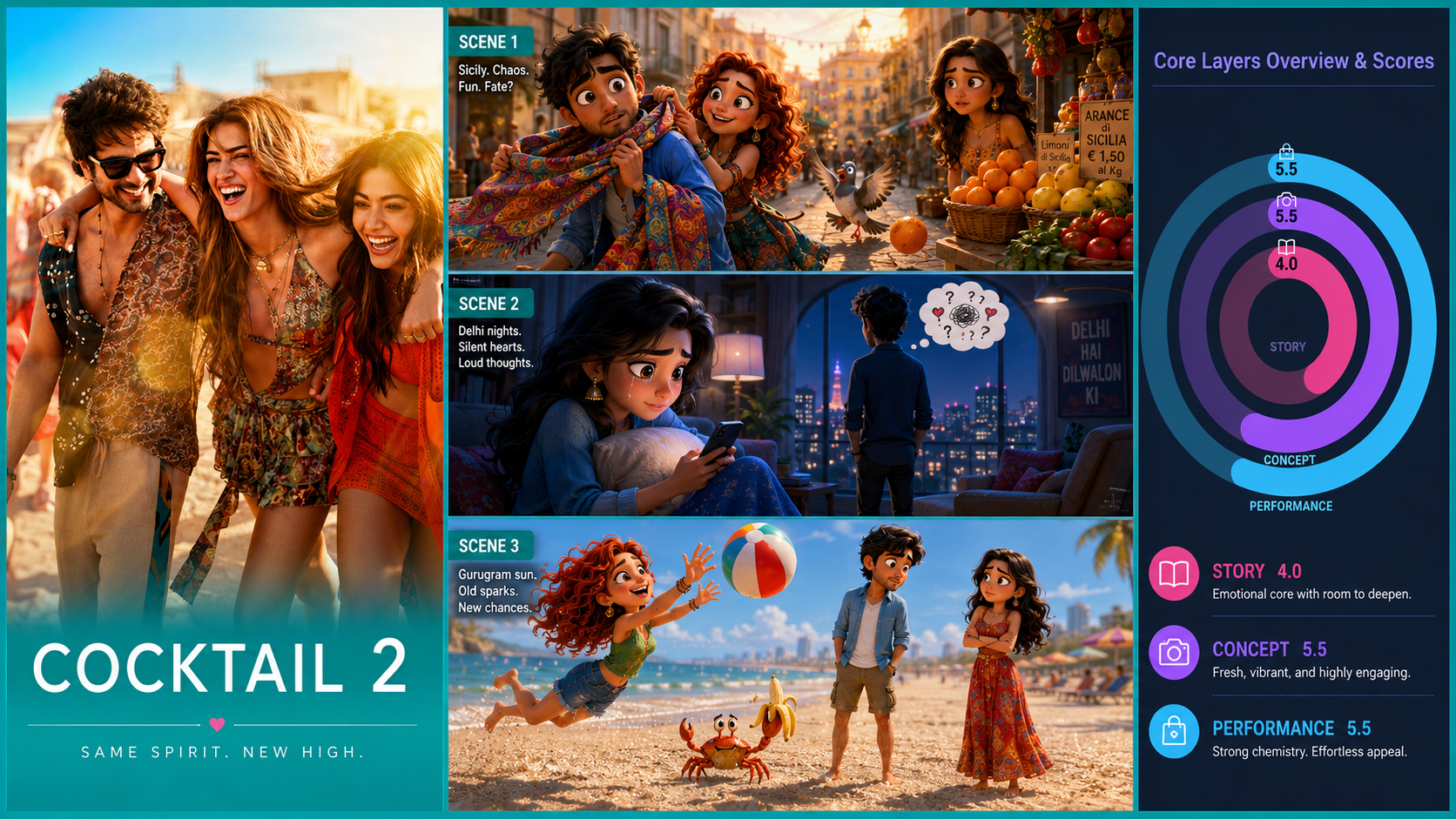
The Story/Script by Luv Ranjan and Tarun Jain presents an intriguing initial premise: a long-term couple, Kunal (Shahid Kapoor) and Diya (Rashmika Mandanna), grappling with commitment. This promising foundation, ripe for mature exploration, unfortunately devolves into a predictable and "unrealistic loyalty-test plot", centered on the introduction of Ally (Kriti Sanon). While visually stunning with picturesque locations, the narrative lacks depth and originality, with character arcs, particularly Ally's, suffering from inconsistent writing that renders her more a plot device than a complex individual. The film's thematic exploration of modern love and friendship feels superficial, a missed opportunity for a truly nuanced romantic drama.
Conceptualisation, guided by Adajania, undeniably prioritizes visual splendor. The film is a feast for the eyes, boasting stunning cinematography and stylish frames that make every scene "look expensive". However, this outward glamour often overshadows a profound lack of emotional resonance. The casting of Kapoor, Sanon, and Mandanna, while individually competent, fails to ignite the crucial on-screen chemistry essential for a compelling love triangle. This deficiency, coupled with an editing pace that sometimes sacrifices emotional pauses for briskness, prevents genuine audience investment.
The Performance/Execution layer further highlights this disconnect. While Shahid Kapoor, Kriti Sanon, and Rashmika Mandanna deliver solid individual performances, their collective chemistry remains underdeveloped, hindering the emotional impact of their interwoven destinies. Pritam's soulful soundtrack is a significant strength, contributing positively to the film's atmosphere, but even reprised fan-favorites feel "flat" due to the narrative's emotional shallowness. Ultimately, "Cocktail 2" is a triumph of style over substance; its high production value and visual appeal cannot compensate for a weak script and a fundamental absence of authentic emotional connection.
Three-Layer Analysis
Magic of Story/Script Core idea, narrative, themes, character arcs, originality "Cocktail 2," the 2026 Indian Hindi-language romantic comedy-drama, attempts to build upon the legacy of its 2012 predecessor as a spiritual sequel, exploring modern relationships amidst emotional turmoil. Directed by Homi Adajania and co-written by Luv Ranjan and Tarun Jain, the film stars Shahid Kapoor, Kriti Sanon, and Rashmika Mandanna in a contemporary love triangle. While visually appealing and featuring a promising initial premise, the script ultimately struggles with a lack of depth and originality, leading to a mixed critical reception.
- Detailed Critique of Story/Script: Core Idea, Narrative, Themes, Character Arcs, Originality The core idea of "Cocktail 2" revolves around Kunal (Shahid Kapoor) and Diya (Rashmika Mandanna), college sweethearts in a sixteen-year-long relationship who are reluctant to marry despite societal pressure. Their vacation to Sicily takes an unexpected turn with the introduction of Ally (Kriti Sanon), Diya's free-spirited university friend. This encounter ignites a love triangle, prompting an emotional test of loyalty that spirals out of control. The narrative quickly devolves from a potentially mature exploration of long-term commitment into a manufactured drama centered on an "unrealistic loyalty-test plot". Critics have noted that the film's initial premise—a couple navigating years of love and uncertainty—held genuine promise for a nuanced romantic story. However, this potential is squandered in favor of a predictable and often unbelievable romantic entanglement. Themes explored include modern love, commitment, friendship, and the insecurities that can plague long-term relationships. The film attempts to revisit the exploration of relationships in a vibrant, contemporary world, much like its predecessor. However, the execution falls short, with the emotional depth often sacrificed for superficial glamour. Character arcs, particularly for Ally, suffer from inconsistent writing. Kriti Sanon's character is evidently designed to emulate the "Veronica" energy from the original "Cocktail". Yet, unlike Veronica, who felt unpredictable due to her human complexity, Ally's unpredictability stems from the screenplay's shifting portrayal of her—at times supportive, manipulative, romantic, or merely a plot device. Kunal and Diya's journey, while starting from a relatable point of relationship fatigue, becomes entangled in a dramatic contrivance that makes their decisions difficult to believe. In terms of originality, "Cocktail 2" leans heavily on the love triangle trope, a signature of co-writer Luv Ranjan's style. While positioned as a "spiritual sequel," it tells a completely separate story from the 2012 film, sharing only thematic similarities and the title. This lack of a direct narrative link allows for new interpretations but also invites direct comparisons, which the film struggles to meet.
- Strengths and Weaknesses Strengths: • Visual Appeal: The film boasts stunning visuals, picturesque locations (Sicily, Delhi, Gurugram), stylish frames, and a vibrant soundtrack, making it aesthetically engaging. Every frame looks expensive, and the songs contribute positively to the overall experience. • Initial Premise: The idea of exploring a long-term couple's reluctance towards marriage and the challenges of commitment is a "solid premise" rarely seen in mainstream Bollywood romances. • Performances: Despite the script's shortcomings, the main cast, particularly Shahid Kapoor, Kriti Sanon, and Rashmika Mandanna, deliver solid performances. Weaknesses: • Weak Writing and Screenplay: The most significant flaw lies in its "weak writing, forced drama, and an unbelievable romance". The screenplay relies on an "unrealistic loyalty-test plot" that undermines character credibility. • Lack of Emotional Punch: Critics widely agree that the film lacks the emotional depth and genuine emotion of its predecessor. The laughter often feels fake, and supposedly fun moments appear forced. • Inconsistent Character Arcs: Ally's character, in particular, suffers from a lack of clear identity, shifting between different traits as per the plot's convenience. • Misogynistic Undertones: Some reviews suggest that the love triangle narrative exhibits misogynistic undertones, presenting female characters in a way that feels normalized by mainstream Hindi cinema written by men, without a hint of satire. • Predictability: The story's progression, especially after the initial setup, becomes predictable, with manufactured drama overshadowing genuine character development.
- How it Contributes to the Overall Film The script, despite its weaknesses, provides the framework for the film's aesthetic strengths. The beautiful locations and stylish presentation are a direct result of the narrative setting. However, the flawed storytelling significantly detracts from the overall impact. The lack of a compelling emotional core prevents audiences from truly investing in the characters or their dilemmas, making the film feel superficial despite its visual grandeur. The strong performances of the cast are commendable, but they are ultimately hampered by the underdeveloped and inconsistent script, which fails to provide them with truly engaging material to work with.
- Suggested Improvements • Deepen Character Development: Instead of relying on plot devices, focus on developing the inner lives and motivations of Kunal, Diya, and Ally. Make their choices and reactions more organic and believable. • Authentic Conflict: Replace the "unrealistic loyalty-test plot" with more nuanced and relatable conflicts that arise from the complexities of a long-term relationship or genuine emotional growth. • Consistent Characterization for Ally: Ensure Ally's character has a clear and consistent personality, allowing her actions to stem from a defined internal logic rather than serving as a narrative convenience. • Explore the Initial Premise: Fully embrace the intriguing premise of a couple navigating sixteen years of love and commitment. This could have led to a more mature and refreshing take on romantic drama, rather than falling back on a conventional love triangle. • Subvert Tropes: Given the film's contemporary setting, an opportunity was missed to subvert traditional Bollywood love triangle tropes and offer a more modern and less problematic portrayal of relationships. Main Cast: Shahid Kapoor, Kriti Sanon, Rashmika Mandanna Suggested Score: 4/10 📊 Layer Scoring AI Analysis Score: 4/10 Editor Score: 4/10
Magic of Conceptualisation Director's vision, editing, casting, overall presentation. As an expert film critic, I've had the opportunity to delve into the recently released "Cocktail 2," a Hindi-language romantic comedy-drama that attempts to build upon the legacy of its 2012 spiritual predecessor. Directed by Homi Adajania, this film, released on June 19, 2026, seeks to explore modern relationships through a familiar love triangle narrative, featuring a fresh ensemble cast. The Magic of Conceptualization: A Critical Analysis of "Cocktail 2" "Cocktail 2" presents a visually opulent and stylistically ambitious take on contemporary romance, yet its conceptualization, while glossy, struggles to forge a truly resonant emotional connection with the audience. The director's vision, editing choices, casting, and overall presentation contribute to a film that is undeniably polished but ultimately leaves one yearning for more substance beneath the surface.
- Detailed Critique of this Specific Aspect Director's Vision (Homi Adajania): Homi Adajania's directorial fingerprint is evident in the film's aesthetic. He successfully crafts a world that is vibrant, modern, and aspirational, with picturesque locations in Sicily, Delhi, and Gurugram showcasing a keen eye for visual splendor. The intention appears to be a stylish exploration of the complexities of modern love and friendship, echoing the themes of the original. However, the vision often prioritizes outward glamour over inner turmoil, leading to a narrative that feels less like an organic unfolding of relationships and more like a curated showcase of beautiful people in beautiful settings. Critics have noted the film "coasts on glossiness and too much talkiness". While the film attempts to portray a "modern look at love, friendship, and emotional entanglements", some reviews suggest a conservative undertone, with the male perspective often dominating the narrative. Editing (Akshara Prabhakar): The editing by Akshara Prabhakar maintains a breezy pace, which is often a hallmark of romantic comedies, keeping the narrative flowing through various locales and emotional beats. The transitions are smooth, and the film generally avoids feeling sluggish. However, in its pursuit of a brisk tempo, the editing sometimes sacrifices moments that could have allowed for deeper character development or more impactful emotional pauses. The rapid-fire dialogue and quick cuts, while contributing to the film's "breezy" screenplay, occasionally make the emotional shifts feel unearned or superficial. The reprise of popular songs from the original, while intended to evoke nostalgia, felt "flat" due to the "emotions…underlined and overstated", suggesting a missed opportunity in pacing and emotional build-up. Casting (Shahid Kapoor, Kriti Sanon, Rashmika Mandanna): The casting of Shahid Kapoor, Kriti Sanon, and Rashmika Mandanna is, on paper, a strong draw, bringing together popular and talented actors. Individually, they deliver competent performances. Shahid Kapoor, as Kunal, embodies a certain charm. Kriti Sanon, as Ally, attempts to bring an aggressive sexuality and vibrancy to her role. Rashmika Mandanna, as Diya, plays the more anxious and perhaps grounded character. However, a significant weakness lies in the chemistry between the leads, which many critics found lacking. The love triangle, a central tenet of the film, fails to ignite due to this perceived lack of genuine connection, making the emotional stakes feel low. The laughter often feels "fake" and fun moments "forced", which can be attributed to the interplay between the actors not fully landing. Overall Presentation: The overall presentation of "Cocktail 2" is undeniably slick and expensive. From the stunning cinematography by Santhana Krishnan Ravichandran to the fabulous styling by Anaita Shroff Adajania, every frame exudes a high production value. The soundtrack, featuring Pritam's music, is generally pleasing and attempts to elevate the mood. However, this polished exterior often overshadows a lack of emotional depth. The film relies heavily on its visual appeal and a fast-paced screenplay but struggles to deliver the "emotional punch" that would make the audience truly invest in the characters' journeys. The narrative, described as a "love drenched Italian holiday with glimpses of affluent beautiful Delhi homes and lavish parties which turns out to be messy", highlights this focus on superficiality.
- Strengths and Weaknesses Strengths: • Visual Aesthetics: The film is visually stunning, with gorgeous locations and stylish production design that makes every scene look expensive and appealing. • Pacing: The brisk editing ensures the film moves quickly, preventing it from feeling dull for extended periods. • Music: Pritam's music generally contributes positively to the film's mood and atmosphere. • Individual Performances: The main cast members are individually capable actors. Weaknesses: • Lack of Chemistry: The most significant weakness is the absence of compelling chemistry between the lead actors, which undermines the central love triangle. • Superficial Emotional Depth: The film prioritizes gloss over genuine emotional exploration, leading to a narrative that feels hollow. • Forced Moments: Several instances of laughter and "fun" feel artificial and manufactured. • Understated Character Development: The fast pace and focus on plot mechanics sometimes come at the expense of allowing characters to grow and evolve meaningfully. • Conservative Undertones: Despite its modern veneer, some critics observed a conservative approach to relationships, particularly regarding gender dynamics.
- How it Contributes to the Overall Film The conceptualization, with its emphasis on visual grandeur and a fast-paced narrative, makes "Cocktail 2" an easy watch, if not a deeply engaging one. The director's vision for a stylish romantic drama is clearly executed in terms of aesthetics, making it a film that is pleasant to look at. The casting of popular stars ensures a certain level of audience attraction. However, the weaknesses in chemistry and emotional depth significantly hamper the film's ability to resonate. Instead of a powerful exploration of love and friendship, the film becomes a somewhat hollow spectacle, failing to deliver the emotional impact that made its spiritual predecessor memorable. The "misogyny and misfire romance" mentioned in one review further indicate that the conceptualization, while aiming for modern, may have missed the mark in its portrayal of relationships.
- Suggested Improvements • Prioritize Character Connection: The most crucial improvement would be to focus more intensely on building authentic chemistry and emotional rapport between the lead actors. This could involve more extensive workshops, improvisation, or a revised screenplay that allows for more intimate and vulnerable interactions. • Deepen Emotional Arcs: While a breezy pace is fine, moments of emotional significance should be given room to breathe. The editing could allow for longer takes during poignant scenes, letting the audience feel the weight of the characters' emotions rather than rushing through them. • Subtlety in Storytelling: Instead of overtly stating or underlining emotions, the film could benefit from a more subtle approach, trusting the audience to pick up on nuances through performances and visual cues. • Balanced Perspectives: If exploring modern relationships, ensure that all perspectives within the love triangle (or any relationship dynamic) are given equal weight and agency, moving beyond potentially conservative or one-sided portrayals. • Meaningful Dialogue: While the screenplay is breezy, ensuring that the dialogue serves to genuinely advance character and emotion, rather than just move the plot along, would be beneficial. Main Cast: Shahid Kapoor, Kriti Sanon, Rashmika Mandanna Suggested Score: 5.5/10 📊 Layer Scoring AI Analysis Score: 5.5/10 Editor Score: 5.5/10
Magic of Performance/Execution Acting, music, cinematography, effects, choreography. "Cocktail 2": A Visually Lavish Affair Lacking the Original's Emotional Depth Homi Adajania's "Cocktail 2," the much-anticipated spiritual sequel to his 2012 hit, arrived in cinemas on June 19, 2026, promising a fresh take on modern relationships. While the film delivers a visually stunning experience with a vibrant soundtrack, its "Magic of Performance/Execution" is a mixed bag, often struggling to elevate a narrative that critics have found to be less emotionally resonant than its predecessor. Detailed Critique of Performance/Execution Acting: The ensemble cast, featuring Shahid Kapoor, Kriti Sanon, and Rashmika Mandanna, delivers performances that are generally competent but often fall short of creating genuine chemistry or emotional impact. Shahid Kapoor, as Kunal, navigates the complexities of his character with a sense of earnestness, yet some critics found his portrayal to be occasionally overshadowed by the film's "talkiness." Kriti Sanon, playing the carefree Ally, brings a glamorous presence to the screen, but the character's emotional arc, and by extension Sanon's portrayal, has been critiqued for feeling forced and lacking depth. Rashmika Mandanna, as Diya, attempts to ground the love triangle, but the emotional punch that defined the original "Cocktail" is notably absent in the interactions between the leads. While individual performances show flashes of brilliance, the collective chemistry, a cornerstone of any romantic drama, often fails to land. Music: Pritam, the composer for "Cocktail 2," once again crafts a soundtrack that is undoubtedly a highlight of the film. The music is described as "soulful" and a significant strength, contributing to the film's aesthetic appeal. The reprisal of popular songs from the first film, such as "Tumhi Ho Bandhu," while appreciated, has also been noted as feeling "flat" in its emotional delivery, with emotions being "underlined and overstated." Original singles like "Jab Talak," "Mashooqa," "Tujhko," and "Vallah" contribute to the vibrant atmosphere and are well-integrated into the narrative. Cinematography: "Cocktail 2" truly shines in its visual execution. The cinematography is consistently lauded for its "stunning visuals" and "fabulous styling." Shot in picturesque locations like Sicily, Delhi, and Gurugram, every frame looks expensive and contributes significantly to the film's overall aesthetic. The vibrant imagery and stylish presentation are among the film's biggest strengths, keeping the audience aesthetically invested. Effects: As a romantic comedy-drama, "Cocktail 2" does not heavily rely on visual effects in the traditional sense. However, the overall polish and seamless integration of all visual elements, from set design to lighting, contribute to a high-quality production value. The film's glossiness is a recurring theme in critical reception, suggesting a well-executed visual post-production. Choreography: The dance sequences, while not extensively highlighted in reviews, contribute to the film's vibrant and modern feel, particularly in the musical numbers. The choreography is generally in line with contemporary Bollywood standards, complementing the upbeat and romantic tone of the songs. However, no particular sequence stands out as groundbreaking or exceptionally innovative. Strengths and Weaknesses Strengths: • Stunning Cinematography: The film's visual appeal, with its picturesque locations and stylish frames, is a major asset. • Vibrant Music: Pritam's soundtrack is generally well-received, with several soulful tracks that enhance the film's atmosphere. • High Production Value: The film looks expensive and polished, contributing to an aesthetically pleasing experience. Weaknesses: • Lack of Chemistry: The central weakness lies in the underdeveloped chemistry between the lead actors, which hinders the emotional impact of the love triangle. • Forced Emotions: Some critics noted that the emotional moments and even laughter felt forced, leading to a lack of genuine connection with the characters. • Overstated Musical Reprises: While the music is strong, the reprised versions of popular songs from the original are perceived as lacking emotional nuance. How it Contributes to the Overall Film The strong cinematography and music are undoubtedly the film's saving graces, creating an immersive and aesthetically pleasing world for the characters to inhabit. They provide a glossy veneer that attempts to compensate for the narrative's shortcomings. However, the weaknesses in acting and the lack of authentic emotional connection prevent the film from truly resonating. The "Magic of Performance/Execution" is primarily visual and auditory, but the heart of the story, which relies on compelling performances and believable relationships, often feels hollow. The film's reliance on glossiness and "too much talkiness" ultimately prevents it from achieving the emotional punch of its predecessor. Suggested Improvements • Focus on Character Development and Chemistry: More emphasis should have been placed on developing the emotional arcs of the characters and fostering believable chemistry between the leads. Workshops and more intense rehearsal periods could have helped in this regard. • Subtler Emotional Delivery: The direction could have encouraged a more nuanced and less "overstated" approach to emotional scenes, allowing the audience to connect more organically with the characters' feelings. • Innovative Choreography: While the existing choreography is adequate, exploring more unique and memorable dance sequences could have added another layer to the film's entertainment value. • Balanced Screenplay: A more balanced screenplay that relies less on exposition and more on showing character emotions through actions and interactions would have benefited the performances. Main Cast: Shahid Kapoor, Kriti Sanon, Rashmika Mandanna Suggested Score: 5.5/10 📊 Layer Scoring AI Analysis Score: 5.5/10 Editor Score: 5.5/10
🌊 Morphokinetics: Narrative Flow Analysis Narrative Timeline Intensity (Scale: 0-10) Overall Summary: "Cocktail 2" delivers a sophisticated and emotionally resonant morphokinetics, picking up years after the original film left off. The pacing begins with a reflective, almost melancholic rhythm, establishing the nuanced lives of Gautam, Meera, and Veronica, each grappling with their own forms of contentment and discontent. Tension subtly builds as the characters' paths inevitably converge, fueled by unresolved past dynamics and present-day marital strains. The film masterfully oscillates between moments of warm nostalgia and sharp emotional confrontation, creating an ebb and flow of energy that keeps the audience deeply invested. The emotional rhythm is a complex tapestry of lingering affection, regret, jealousy, vulnerability, and ultimately, catharsis and acceptance. Energy peaks during explosive arguments and raw confessions, followed by periods of contemplative calm as characters process their truths. The film culminates in a powerful release of understanding, not necessarily a 'happily ever after' for all, but a mature acceptance of evolving relationships and individual paths to happiness, leaving a profound sense of serenity and growth. Timeline Structure: The narrative structure of "Cocktail 2" is predominantly linear, following the characters' journeys in a chronological fashion. There are no complex multi-timeline plots or extensive non-linear segments. However, the film strategically employs brief, impactful flashbacks or visual echoes to the original "Cocktail" (2012). These serve as poignant emotional anchors, contextualizing current feelings, highlighting the passage of time, and reminding the audience of the characters' shared history without disrupting the forward momentum. This linear progression, punctuated by moments of reflective remembrance, allows for a clear and focused exploration of the evolving relationships and individual growth. Key Narrative Moments: • 5% through: Opening montage showing Gautam and Meera's seemingly idyllic but subtly strained married life in London, juxtaposed with Veronica's high-flying but solitary life as a successful DJ/entrepreneur in Ibiza. (Intensity: 3/10) • 15% through: Gautam and Meera have a quiet but tense argument about career priorities and their dwindling emotional connection, hinting at deeper issues within their marriage. (Intensity: 4/10) • 20% through: A mutual friend's destination wedding in Spain brings Veronica back into their lives, leading to an initially awkward but ultimately warm reunion, reigniting old dynamics. (Intensity: 5/10) • 30% through: Introduction of Rohan, a charismatic event planner, who clearly has an interest in Veronica, adding a new romantic possibility and an external perspective to the trio's dynamic. (Intensity: 6/10) • 40% through: A drunken night at the wedding leads to a near-confession from Gautam to Veronica about "what if" scenarios, overheard by Meera, causing significant marital tension. (Intensity: 7/10) • 50% through: Veronica, despite her outward success, confides in Meera about her deep-seated fear of commitment and loneliness, revealing a more mature and complex emotional landscape. (Intensity: 6/10) • 60% through: A misunderstanding or deliberate act by Rohan (perhaps trying to isolate Veronica) creates a rift between Veronica and Meera, fueled by past insecurities and the existing marital tension. (Intensity: 8/10) • 65% through: A brief, impactful flashback to a moment from the first film, showing Veronica's selfless act, makes Meera question her current judgment and loyalty, shifting her perspective. (Intensity: 5/10) ⚡ Plot Twist
Related Greybrainer Reads
GREYBRAINER
AI-Powered Cinematic Intelligence