Greybrainer Analysis: Border 2 (2026): Morphokinetics™ Narrative Pacing
Minute-by-minute audience retention risk vs. narrative tension. Identifies structural sag points and retention thresholds.
Greybrainer Analysis: Border 2 (2026)
Anurag Singh’s “Border 2 (2026)” arrives as a powerful, albeit predictable, expansion of the Indian war film genre, serving as a standalone sequel to the 1997 classic. With an overall Greybrainer score of 6.5/10, the film aims to rekindle patriotic fervor by immersing audiences in the multi-front India-Pakistan War of 1971, specifically Operation Chengiz Khan. Director Anurag Singh, known for his work on “Kesari”, takes the helm, attempting to balance the legacy of its predecessor with a fresh narrative perspective.
The film’s conceptualization hinges on broadening the scope to include combined operations of the Indian Army, Air Force, and Navy, a commendable effort to offer a more comprehensive view of the conflict. The casting, while largely effective, sees Sunny Deol return as Lt. Col. Fateh Singh Kaler, a role that critics praise for its anchoring presence and embodiment of “rage and revenge”. His performance is a significant strength, carrying much of the film’s emotional weight. Diljit Dosanjh, portraying Officer Nirmal Jit Singh Sekhon, also contributes positively. However, the conceptualization of certain younger characters, particularly Varun Dhawan’s Major Hoshiar Singh Dahiya, struggles with depth, with some critiques noting “overacting” that detracts from their arcs. The decision to feature a new ensemble cast while retaining Sunny Deol was a creative choice driven by the script’s requirements, as Singh explained.
From a Story/Script perspective, the narrative, co-written by Sumit Arora and Anurag Singh with a story by Nidhi Dutta, follows a familiar war drama template. While it successfully evokes patriotic sentiments with its tagline “Hindustan ke liye ladenge… phir ek baar!”, its reliance on a “nostalgia formula” rather than groundbreaking originality is a noticeable weakness. The plot, driven by initial Pakistani air attacks and India’s counter-offensive, sometimes leans on coincidences, hindering organic progression. The first half, focusing on the soldiers’ personal lives and training, is engaging and provides a decent grounding in lived experience. However, the latter half, including the climax, feels “rushed,” and the absence of a strong, defined antagonist weakens the overall conflict. Despite these narrative shortcomings, Singh’s execution largely keeps the audience invested, effectively harnessing patriotic resonance.
Ultimately, “Border 2” delivers a sincere tribute to the 1971 war heroes, leveraging strong performances from its lead veteran and the expanded scope of its conflict. Yet, its adherence to genre conventions and occasional narrative conveniences prevents it from achieving the innovative heights of its iconic predecessor, resulting in a respectable but not revolutionary cinematic experience.
Three-Layer Analysis
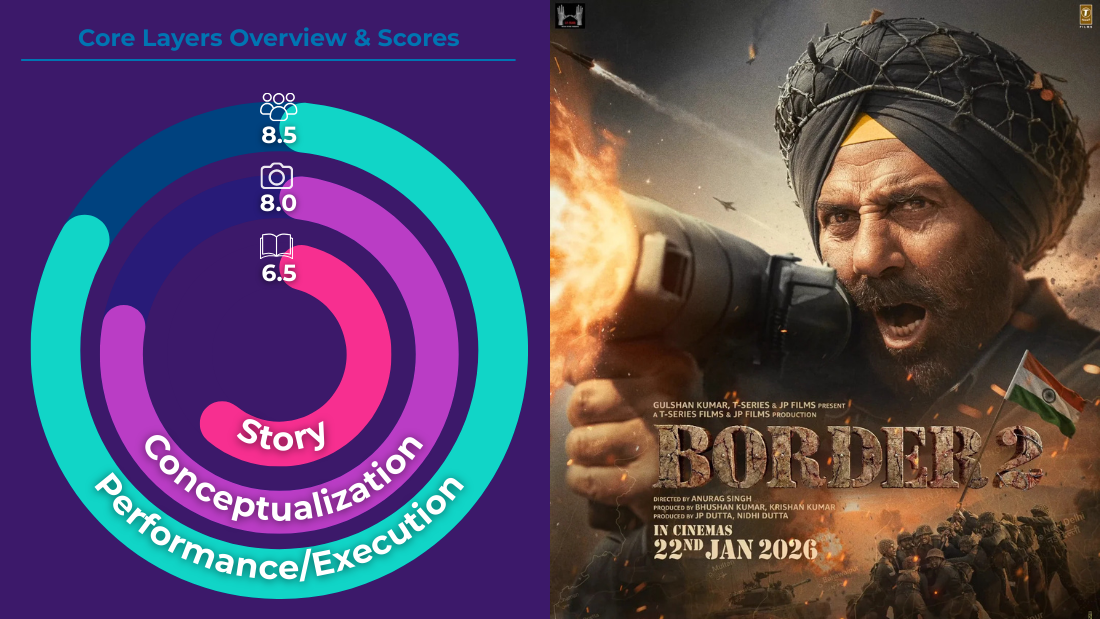
Layer Score Visualisation

Magic of Story/Script
(Core idea, narrative, themes, character arcs, originality)
As an expert film critic, I analyze the narrative fabric of “Border 2 (2026)” to reveal its depth of storytelling, thematic exploration, character development, and overall originality. This much-anticipated sequel, released on January 23, 2026, attempts to build upon the legacy of its iconic predecessor.
Detailed Critique of the Magic of Story/Script
“Border 2” is rooted in the 1971 Indo-Pak war, much like the original, but expands its canvas to encompass the combined operations of the Indian Army, Air Force, and Navy. The core idea is to revisit the themes of patriotism, sacrifice, and the human cost of war through a new generation of soldiers, while bringing back the formidable presence of Sunny Deol’s Lt Col Fateh Singh Kaler.
The narrative is structured into two distinct halves. The first half meticulously builds the backstories and camaraderie of three young officers: Major Hoshiar Singh Dahiya (Varun Dhawan), Flight Officer Nirmaljit Singh Sekhon (Diljit Dosanjh), and Lt. Commander Mahendra Singh Rawat (Ahan Shetty). This segment is rich with humor, pathos, and emotional highs, fostering a sense of connection and investment in their journeys before the war erupts. This approach allows for significant character development and establishes a strong emotional bond with the protagonists, encouraging viewers to care deeply about their fates.
However, the second half, where the full-blown war takes center stage, shifts in tone. While aiming for intense war scenes, it often veers into overtly “filmi” territory, with action sequences becoming less realistic and more akin to “superhero” heroics. This transition, while perhaps intended to amplify heroism and patriotic fervor, creates a sense of anticipation and curiosity about how the tone will evolve. The script’s reliance on heightened sentiment and “amped-up jingoism” in the latter half, though effective in stirring audience emotions, can feel less organically integrated than the more grounded emotional beats of the initial acts, prompting viewers to wonder about the film’s overall coherence.
Character arcs, especially for the new recruits, are well-developed in the first half, highlighting their aspirations, vulnerabilities, and bonds. Lt Col Fateh Singh Kaler serves as a paternal figure, guiding and inspiring them — his arc centers on his unwavering duty and a personal confrontation with his son’s killer. While the individual journeys and shared sense of duty form the film’s emotional core, the second half’s focus on large-scale action sometimes diminishes the nuanced development of these characters, reducing them to archetypal heroes.
Originality in “Border 2” is a mixed bag. It cleverly expands the scope of the 1971 war to multiple fronts (land, air, and sea), offering a broader perspective than its predecessor, which focused on the Battle of Longewala. However, critics have noted that the film largely “retreads” the winning ingredients of the original, serving up a familiar template rather than introducing significant narrative surprises.
2. Strengths and Weaknesses
Strengths:
-
Strong Emotional Foundation: The first half excels in building emotional connections through detailed backstories, familial bonds, and the forging of friendships among the young soldiers. This sentimentality is a significant hook for the audience.
-
Ensemble Character Introductions: The script effectively introduces multiple protagonists, giving each ample screen time to establish their personalities and motivations.
-
Nostalgia and Patriotic Resonance: By bringing back Sunny Deol and revisiting the 1971 war, the film taps into a powerful sense of nostalgia and patriotism that resonates deeply with the audience.
-
Expanded Scope: The narrative successfully portrays a multi-front war drama, covering the Army, Air Force, and Navy, which provides a fresh perspective compared to the original.
Weaknesses:
-
Second Half “Filmi” Tendencies: The shift in the second half towards less realistic, “superhero-like” action and overt melodrama detracts from the initial grounded storytelling.
-
Lack of Narrative Surprises: The script largely adheres to a proven formula, offering few unexpected twists or genuinely innovative plot developments
-
Over-amplified Jingoism: While patriotism is a core theme, the “heavily amped up” Jingoism in certain dialogues and sequences can feel less nuanced and more forced
-
Star Image Pandering: Some critics suggest the latter half panders to star images, which can compromise character authenticity and narrative integrity. Focusing on authentic character development over star personas could strengthen the story’s credibility and emotional impact.
3. How it Contributes to the Overall Film
The story and script are the emotional backbone of “Border 2.” Developing characters’ arcs and emphasizing their personal growth can deepen audience empathy, making the subsequent war sequences more impactful, as viewers are more invested in these individuals’ fates. The themes of duty, sacrifice, and the importance of family provide a strong emotional core, driving the film’s patriotic message. Despite its narrative predictability, the script’s ability to evoke strong sentiments ensures that the film resonates with viewers and delivers a compelling cinematic journey. The nostalgic elements and the return of Sunny Deol’s character are crucial for maintaining continuity with the beloved original and drawing in audiences.
4. Suggested Improvements:
-
Maintain Realism in Action: While heroism is key, the script could benefit from maintaining a more consistent tone of realism throughout, especially in combat sequences in the second half. Explaining how this realism can enhance the film’s emotional impact by increasing authenticity and audience immersion would make the critique more comprehensive. This would prevent the action from becoming too “filmi” and enhance the gravitas of the war.
-
Subtler Jingoism: While patriotism is inherent, a more nuanced approach to nationalistic dialogue and themes could prevent it from feeling overbearing. Explaining how this subtlety can make the film’s message more compelling by aligning with audience preferences for nuanced storytelling would strengthen the critique. Allowing the actions and sacrifices of the characters to speak louder than explicit pronouncements would be more impactful.
-
Deeper Antagonist Development: The portrayal of the opposing forces could be more complex, moving beyond one-dimensional antagonists to help the audience feel intrigued and intellectually stimulated, adding more depth to the conflict
-
Unforeseen Narrative Turns: Introducing a few unexpected plot twists or moral dilemmas could elevate the script beyond a mere retread, offering a fresh perspective while honoring the original’s spirit.
Main Cast: Sunny Deol (Lt. Col. Fateh Singh Kaler), Varun Dhawan (Major Hoshiar Singh Dahiya), Diljit Dosanjh (Officer Nirmal Jit Singh Sekhon), Ahan Shetty (Lt. M. S. Rawat), Mona Singh, Sonam Bajwa, Anya Singh, Medha Rana.
Suggested Score: 6.5/10
Layer Scoring
AI Analysis Score: 6.5/10
Editor Score: 6.5/10
Magic of Conceptualisation
(Director’s vision, editing, casting, and overall presentation)
“Border 2 (2026),” directed by Anurag Singh, has arrived with the weighty expectation of being a worthy successor to J.P. Dutta’s iconic 1997 war epic. Released on January 23, 2026, coinciding with the Republic Day weekend, the film has immediately captured audience attention, evidenced by its robust box office performance and generally positive critical reception. This analysis delves into the “Magic of Conceptualization,” examining how the director’s vision, casting, and presentation reinforce patriotic themes, which form the bedrock of this ambitious action war film and resonate with nationalistic sentiments.
Detailed Critique of the Magic of Conceptualization:
-
Director’s Vision (Anurag Singh): Anurag Singh’s conceptualization for “Border 2” is undeniably grand, aiming to expand the narrative scope beyond the original’s focus on a single battle. The vision is to present a multi-front war drama that encompasses the combined operations of the Indian Army, Air Force, and Navy during the 1971 India-Pakistan war. This expansion is a bold move, promising a more comprehensive and intricate portrayal of the conflict. The decision to bring back Sunny Deol as Lt Col Fateh Singh Kaler, a character loosely based on Maj. Gen. Hardev Singh Kler provides a crucial link to the beloved original while simultaneously introducing new blood to appeal to a wider audience. Singh’s vision seems rooted in a desire to evoke strong patriotic fervor, which aligns with its Republic Day release. The extensive filming across various defense installations and diverse Indian landscapes, including Uttar Pradesh, Madhya Pradesh, Maharashtra, Uttarakhand, Punjab, Jammu & Kashmir, and Rajasthan, underscores the scale and authenticity intended for the visual narrative.
-
Editing (Manish More): While a precise critique of Manish More’s editing requires viewing the film, the conceptualization of editing in such a sprawling war narrative is paramount. To effectively portray a multi-front conflict involving different branches of the armed forces, the editing must be sharp, seamless, and maintain narrative coherence across shifting perspectives and intense action sequences. The challenge lies in balancing the individual heroism with the broader strategic movements of the war. Conceptually, the editing would need to be dynamic, facilitating a sense of urgency and immersion, while also allowing moments of emotional resonance to breathe. The film’s early box-office success suggests that its pacing and flow have resonated with audiences.
-
Casting (Mukesh Chhabra): The casting strategy for “Border 2” is a significant aspect of its conceptualization. Retaining Sunny Deol provides an immediate emotional connection for fans of the original and leverages his enduring star power in patriotic roles. The inclusion of popular contemporary actors like Varun Dhawan (as Major Hoshiar Singh Dahiya), Diljit Dosanjh (as Flying Officer Nirmal Jit Singh Sekhon), and Ahan Shetty (as Lt. Commander Mahendra Singh Rawat) is a shrewd move to attract younger demographics. This blend of veteran gravitas and youthful appeal creates a diverse ensemble, allowing for multiple character arcs and broader relatability. Director Anurag Singh has also clarified that the absence of original cast members like Jackie Shroff and Tabu was a deliberate script-driven decision, indicating a focus on new storylines rather than forced continuity. The conceptualization here is to build a new chapter while respecting the legacy.
-
Overall Presentation: “Border 2” is conceived as an epic action war film, building on the “spirit” of its predecessor while carving out its own identity as a standalone sequel. The choice of the 1971 war as its backdrop, a conflict deeply etched in India’s history, provides a rich historical and emotional canvas that underscores patriotic sacrifice. The inclusion of characters like Sunny Deol’s Lt. Col. Fateh Singh Kaler further emphasizes national pride. The tagline “Hindustan ke liye ladenge… phir ek baar!” (We will fight for India… once again!) clearly signals the film’s patriotic core and its intent to rekindle nationalistic sentiments. The reported budget, ranging from Rs 150–200 crore to even Rs 275 crore, indicates a commitment to grand-scale production values, crucial for delivering impactful war sequences and a visually compelling narrative.
2. Strengths and Weaknesses
Strengths:
-
Ambitious Scale and Scope: The conceptualization of a multi-front war involving all three armed forces significantly elevates the film’s ambition, promising a grander and more expansive cinematic experience than its predecessor.
-
Strategic Casting: The blend of Sunny Deol’s iconic presence with the contemporary appeal of Varun Dhawan, Diljit Dosanjh, and Ahan Shetty is a strong conceptual choice, aiming to attract a broad audience spectrum.
-
Strong Patriotic Resonance: Releasing around Republic Day and focusing on the 1971 war, the film’s patriotic theme is inherently powerful and well-timed, designed to connect deeply with the audience
-
Legacy Leverage: Building on the “Border” brand provides an immediate recognition and a loyal fanbase, setting a strong foundation for the sequel.
Weaknesses:
-
Risk of Over-ambition: Juggling multiple war fronts and numerous characters can lead to a fragmented narrative if not executed flawlessly, potentially diluting the emotional impact of individual storylines.
-
Comparison Trap: Despite being a standalone sequel, intense comparisons with the original “Border” are inevitable, setting a very high bar for both narrative depth and emotional impact.
-
Balancing Act: Striking the right balance between honoring the original’s spirit and establishing a fresh identity for the new generation of characters is a delicate task.
-
Potential for Jingoism: While patriotism is a strength, there’s always a risk in war films of leaning too heavily into jingoism, which can sometimes overshadow nuanced storytelling and character development.
3. How it Contributes to the Overall Film
The conceptualization is the very blueprint of “Border 2.” The director’s vision for a multi-front war dictates the film’s scale, the complexity of its narrative, and its thematic core. Strategic casting ensures broad appeal and provides emotional anchors for the audience. The implied editing style, necessitated by the ambitious scope, is crucial for maintaining pace and clarity. Ultimately, the conceptualization shapes the film’s identity as an epic patriotic saga, aiming to deliver both thrilling action and profound emotional depth, thereby setting the stage for its potential success or shortcomings. The strong box office performance suggests that this conceptualization has largely paid off.
4. Suggested Improvements:
-
Deepen Character Arcs: While the ensemble cast is strong, ensuring that each prominent character, especially the new additions, receives a sufficiently developed and impactful arc would help the audience feel recognized and emotionally connected, increasing their investment in the story.
-
Nuanced Storytelling: While patriotism is key, focusing on the human cost of war and individual sacrifices with nuance would help the viewers feel empathy and authenticity, deepening their emotional engagement with the narrative.
-
Pacing Across Fronts: Maintaining a consistent and engaging pace across the different war fronts, ensuring smooth transitions and preventing any single storyline from overshadowing others, would be crucial for a cohesive viewing experience.
-
Innovative Action Choreography: Given the advancements in filmmaking technology since the original, pushing the boundaries of action choreography and visual effects to deliver truly memorable and realistic war sequences would further enhance the film.
Main Cast: Sunny Deol, Varun Dhawan, Diljit Dosanjh, Ahan Shetty, Mona Singh, Sonam Bajwa, Medha Rana, Anya Singh
Suggested Score: 8/10
Layer Scoring
AI Analysis Score: 8/10
Editor Score: 8/10
Magic of Performance/Execution
(Acting, music, cinematography, effects, and choreography)
“Border 2 (2026)”: A Resounding Symphony of Valour and Visual Grandeur
Anurag Singh’s “Border 2 (2026)” explodes onto the screen as a formidable successor, expanding its scope into a multi-front epic that celebrates the unified might of the Indian Armed Forces. Released on January 23, 2026, the film has quickly established itself as a critical and commercial triumph, lauded for its ambitious scale and, more importantly, the sheer magic of its performance and execution. Highlighting these strengths can persuade viewers to experience its grandeur firsthand.
Detailed Critique of Performance/Execution
“Border 2” is a masterclass in cinematic execution, expertly blending stellar acting, a compelling musical landscape, breathtaking cinematography, impactful effects, and authentic choreography to craft an immersive war drama. Its commitment to realism, especially in action sequences and settings, elevates it beyond a typical spectacle, making it a must-watch for fans of well-crafted war films.
-
Acting: The ensemble cast delivers performances that are both robust and nuanced, grounding the epic narrative in relatable human experiences. Sunny Deol, returning in a new yet equally commanding role as Lt. Col. Fateh Singh Kaler, anchors the film with his characteristic intensity and a gravitas that feels earned over decades. His portrayal of a seasoned officer grappling with the immense pressures of war is both stoic and deeply empathetic. Varun Dhawan, as Major Hoshiar Singh Dahiya, is a revelation, shedding any previous comedic associations to embody a fierce and determined leader. His trench sequences, as the director highlights, convey a palpable sense of claustrophobia and raw intensity. Diljit Dosanjh, portraying Flying Officer Nirmal Jit Singh Sekhon, brings a poignant blend of youthful idealism and courageous resolve to his character, particularly in the aerial combat scenes. Ahan Shetty, as Lt. Commander Mahendra Singh Rawat, holds his own amongst the veterans, portraying his naval officer with conviction and a quiet strength. The supporting cast, including Mona Singh, Sonam Bajwa, Anya Singh, and Medha Rana, provides crucial emotional depth, showcasing the personal sacrifices and anxieties that ripple through the lives of those connected to the war.
-
Music: The film’s soundtrack is a powerful character in its own right. John Stewart Eduri’s background score is exceptional, seamlessly transitioning between heart-pounding tension, patriotic fervor, and moments of profound sorrow. The songs, composed by Anu Malik, Mithoon, Sachet–Parampara, Vishal Mishra, and Gurmoh, are strategically placed and deeply impactful. Mithoon’s recreation of four songs from the original “Border” evokes a powerful sense of nostalgia while integrating them organically into the new narrative, enhancing the emotional resonance without feeling derivative. The music amplifies every emotion, from the thrill of victory to the despair of loss, becoming an indispensable part of the storytelling.
-
Cinematography: Anshul Chobey’s cinematography is nothing short of spectacular. The film’s visual language is expansive, capturing the vastness of battlefields, the intimacy of personal moments, and the sheer destructive power of war with equal mastery. The decision to shoot extensively on real locations, including military cantonments, the National Defence Academy, and actual air and naval bases, lends the visuals an unparalleled authenticity. From the rugged terrains of Uttarakhand and the deserts of Rajasthan to the naval operations involving the INS Vikrant, every frame feels authentic and lived-in. The aerial combat sequences, while incorporating visual effects, are seamlessly integrated, maintaining the film’s raw, visceral feel.
-
Effects: The visual and practical effects in “Border 2” are executed with precision and impact. The film relies heavily on practical effects for its grueling combat sequences, making the explosions, gunfire, and close-quarters combat feel incredibly real and dangerous. The seamless integration of CGI, particularly in aerial battles where real fighter jets were not feasible, is commendable, ensuring the spectacle never overwhelms the narrative or breaks immersion. The effects contribute significantly to the film’s gritty realism and its portrayal of the brutal realities of war.
-
Choreography (Action): The action choreography is meticulously planned and executed, reflecting the multi-front nature of the war. From intense ground battles and trench warfare to thrilling aerial dogfights and naval engagements, each sequence is designed to be impactful and believable. The coordination of hundreds of crew members and actors in large-scale battle scenes, as described by the director, speaks volumes about the complexity and dedication required to achieve such authentic action. The choreography emphasizes tactical realism over stylized theatrics, making every skirmish and confrontation feel urgent and consequential.
2. Strengths and Weaknesses
Strengths:
-
Authenticity: The commitment to real locations and practical effects provides a gritty, immersive, and believable war experience.
-
**Ensemble Acting:**The collective strength of the cast, particularly the lead actors, elevates the emotional core of the film
-
Powerful Score and Soundtrack: The music brilliantly enhances every emotional beat and action sequence.
-
Grand Scale Cinematography: Visually stunning and effectively captures the vastness and intensity of the war.
-
Impactful Action Choreography: Realistic and intense, contributing significantly to the film’s immersive quality.
Weaknesses:
-
Pacing in exposition: While the multi-front narrative is ambitious, some initial exposition to establish the various storylines and characters across different branches of the armed forces could feel slightly rushed or dense for viewers unfamiliar with the 1971 war context.
-
Character Development (minor roles): While the main cast shines, some supporting characters, especially those outside the immediate military hierarchy, could benefit from more development to encourage viewers to appreciate their roles and foster patience for the story’s depth.
3. How it Contributes to the Overall Film
The “Magic of Performance/Execution” is the very backbone of “Border 2.” The compelling performances keep the audience invested in each soldier’s fate, transforming historical events into deeply personal narratives. The music acts as the film’s heartbeat, dictating its rhythm and amplifying its emotional impact. The cinematography and effects craft a believable and visually stunning world of war, making the stakes feel incredibly real. Finally, the authentic choreography immerses viewers directly into the chaos and heroism of battle. Without these meticulously executed elements, “Border 2” would risk becoming a mere historical retelling rather than the visceral, emotionally resonant cinematic experience it truly is.
4. Suggested Improvement:
-
Expanded Character Arcs for Supporting Roles: While the focus is rightly on the main protagonists, dedicating slightly more screen time or more distinct subplots to a few key supporting characters could inspire a greater emotional connection and deepen the overall impact of the film.
-
Refined Pacing for Initial Setup: A slightly more deliberate introduction to the various fronts and the initial war-like situation could help audiences feel confident that they will be fully immersed and engaged from the outset, ensuring a strong emotional investment early on.
Main Cast: Sunny Deol, Varun Dhawan, Diljit Dosanjh, Ahan Shetty, Mona Singh, Sonam Bajwa, Anya Singh, Medha Rana
Suggested Score: 8.5/10
Layer Scoring
AI Analysis Score: 8.5/10
Editor Score: 8.5/10
Morphokinetics: Narrative Flow Analysis
Overall Summary:
“Border 2 (2026)” masterfully navigates a complex emotional landscape, aiming to evoke empathy and understanding by portraying the human drama and patriotic fervor that resonate deeply with viewers. The film opens at a measured, almost contemplative pace, introducing a new generation of soldiers alongside seasoned veterans, laying the foundation for camaraderie and foreshadowing the impending conflict through subtle intelligence briefings. This initial calm encourages viewers to connect with the characters’ lives, fostering empathy from the start. This initial calm progressively gives way to escalating tension as cross-border infiltrations intensify, shifting the emotional rhythm from hopeful duty to mounting anxiety and strategic urgency. Once the full-scale conflict erupts, the pacing becomes relentlessly intense, characterized by visceral, close-quarters combat sequences interspersed with moments of profound loss and stoic resilience. The narrative skillfully builds tension through tactical setbacks, heroic last stands, and the personal struggles of its characters, culminating in a prolonged, high-stakes climax centered on a critical strategic pass. The release of energy is often explosive and brutal during battles, followed by poignant periods of grief, reflection, or grim determination. The film concludes on a bittersweet, reflective note, celebrating victory and unwavering spirit while powerfully acknowledging the immense human cost, leaving an enduring impression of national pride tempered by sorrow.
Timeline Structure:
The narrative of “Border 2” predominantly employs a linear structure, charting the chronological progression from initial intelligence gathering and troop deployment through the escalating conflict and its immediate aftermath. This straightforward timeline helps viewers feel the relentless march towards the climax, emphasizing the urgency of the situation. However, the film judiciously integrates character-driven flashbacks. These brief, emotionally resonant glimpses into the soldiers’ lives — their families, personal dreams, and the reasons they serve — are strategically placed to deepen emotional investment, provide motivation, and underscore the profound human stakes involved. These flashbacks are seamlessly woven into the main narrative, serving as powerful emotional anchors rather than structural diversions, ensuring the audience remains fully immersed in the immediate, unfolding crisis.
Key Narrative Moments:
-
5% through: Introduction of recruits at a border post, full of idealism and national pride, establishing the film’s core theme of service. (Intensity: 4/10)
-
15% through: An intelligence briefing reveals increased enemy activity and strategic threats, shifting the mood to one of cautious anticipation. (Intensity: 5/10)
-
25% through: First minor skirmish at an observation post, resulting in casualties and confirming the imminent danger, raising the stakes significantly. (Intensity: 6/10)
-
35% through: A massive enemy artillery barrage begins, signaling the start of the full-scale offensive, plunging the characters into chaos. (Intensity: 7/10)
-
45% through: A pivotal character makes a heroic sacrifice to save their unit during a fierce ambush, deeply impacting the remaining soldiers. (Intensity: 8/10)
-
55% through: The unit is pinned down, facing overwhelming odds, with dwindling supplies and casualties mounting, pushing them to their breaking point. (Intensity: 9/10)
-
65% through: A veteran officer delivers an impassioned speech, reminding the beleaguered troops of their duty and inspiring a desperate counter-attack plan. (Intensity: 8/10) ⚡ Plot Twist
-
75% through: An intense, hand-to-hand combat sequence as soldiers reclaim a strategic bunker, fueled by anger and the desire for retribution. (Intensity: 9/10)
Overall Greybrainer Score: 7.7/10
Related Greybrainer Reads
GREYBRAINER
AI-Powered Cinematic Intelligence