Greybrainer Analysis: Badland Rising: Morphokinetics™ Narrative Pacing
Minute-by-minute audience retention risk vs. narrative tension. Identifies structural sag points and retention thresholds.
Greybrainer Analysis: Badland Rising
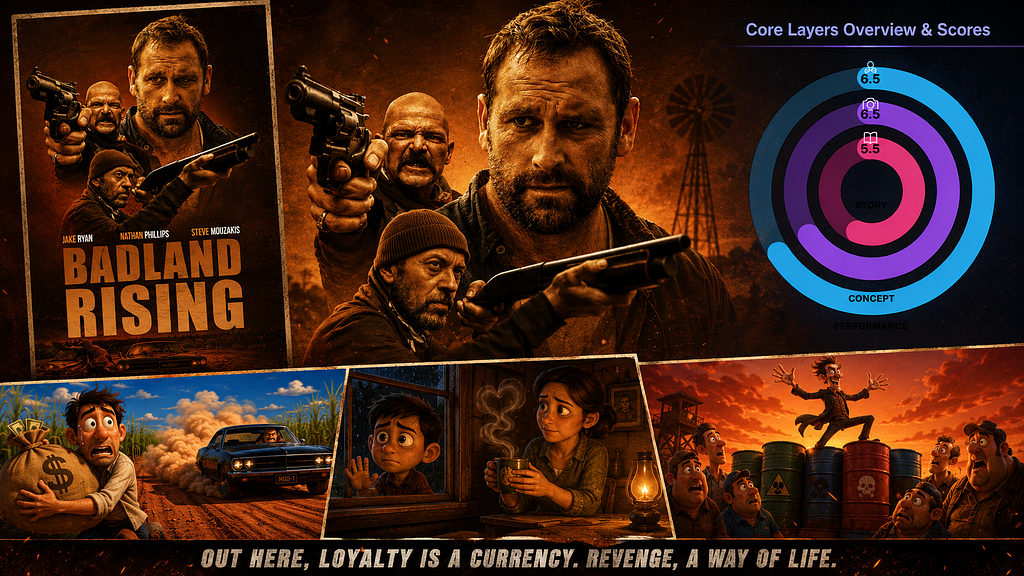
Blair Moore’s “Badland Rising” emerges as a compelling, albeit familiar, Australian action-thriller, scoring a Greybrainer overall of 6.2/10. The film, released on June 12, 2026, distinguishes itself through a visceral commitment to practical action and a clear conceptual vision, even as its narrative leans heavily on established genre tropes. At its core, “Badland Rising” presents a classic “wrong place, wrong time” scenario, with former SAS sniper Dave Shepard (Jake Ryan) inadvertently entangled with a dangerous criminal underworld while trying to protect his family. This straightforward premise, though lacking significant originality, provides a strong emotional anchor for the relentless pursuit that defines the film.
The conceptualisation, spearheaded by director Blair Moore, is arguably the film’s greatest strength. Moore’s vision for a stripped-down, intense chase thriller, coupled with strategic casting that leverages Jake Ryan’s genuine martial arts background, results in authentic and brutal fight choreography. Editor Steph Liquorish’s decision to allow more in-camera fight sequences further enhances this realism, creating a palpable sense of tension. While the Story layer, co-written by Moore and Dru Brown, is noted for its predictability and limited character development beyond Dave’s core motivation, the Conceptualisation layer’s focus on raw intensity and the unique Queensland hinterland setting injects a fresh, gritty aesthetic into a well-worn narrative.
Performance and execution, particularly in the action sequences, truly drive “Badland Rising.” Jake Ryan delivers a physically commanding performance, performing his own stunts with conviction. However, critics noted a “wooden” quality in his dramatic delivery, highlighting the script’s challenge in balancing relentless action with emotional depth. Nathan Phillips, as the unhinged antagonist Morgan, stands out with a charismatic and layered portrayal that elevates the film’s villainy. Ultimately, the film’s strong action choreography and commitment to practical effects are its defining features, allowing it to deliver a visceral cinematic experience despite narrative conventionality and some inconsistent dramatic performances. “Badland Rising” demonstrates how a focused conceptualisation and exceptional physical execution can elevate a familiar story into an engaging, hard-hitting thriller.
Three-Layer Analysis
Layer Score Visualisation
Magic of Story/Script
Core Idea, Narrative, Themes, Character Arcs, Originality
“Badland Rising,” directed by Blair Moore and co-written with Dru Brown, is an Australian action-thriller that plunges an ordinary man into an extraordinary fight for survival. Released on digital platforms on June 12, 2026, the film centers on themes of family, desperation, and the lengths one will go to protect loved ones.
Detailed Critique of the Magic of Story/Script
The core idea of “Badland Rising” is a classic “wrong place, wrong time” scenario, where an unassuming protagonist inadvertently becomes embroiled in a dangerous criminal underworld. Dave Shepard (Jake Ryan), a former SAS sniper now working in construction to save his family farm, is simply trying to get home to his wife and son. However, his journey is irrevocably altered when he gets caught in the chaos of a botched mob robbery and unknowingly drives off with a bag of stolen cash. This premise immediately establishes high stakes and a clear objective for the protagonist: survive and protect his family.
The narrative is designed as a relentless pursuit, a ticking-clock thriller where Dave is hunted by a variety of antagonists including the ruthless robbers Morgan (Nathan Phillips) and Mitch (Steve Mouzakis), a deadly Russian assassin, and even two determined detectives. This multi-pronged pursuit creates constant tension and ensures a dynamic, if somewhat predictable, sequence of events. The script leans heavily on action set pieces and chase sequences, driving the plot forward through physical confrontations and escalating danger.
The central theme is the fierce protectiveness of family and the primal instinct for survival. Dave’s motivation is consistently tied to his desire to return to and safeguard his wife and son, making his violent actions understandable, if not entirely justifiable. The film explores how an “ordinary bloke” can tap into extraordinary capabilities when pushed to the brink, particularly when his family’s safety is at risk.
Character arcs, particularly for Dave, are somewhat constrained by the genre’s demands for constant action. While we understand his motivation, his internal struggle and transformation are secondary to the external conflict. He begins as a reluctant man of violence, trying to leave his past as an SAS sniper behind, but is forced to embrace those skills once more. The script attempts to ground his actions in his humanity and his role as a father, but the relentless pace often overshadows deeper character exploration. The antagonists, particularly Morgan, are portrayed as unhinged and driven by greed, with Nathan Phillips’ performance being noted as a standout.
In terms of originality, “Badland Rising” largely adheres to established action-thriller tropes. Reviewers have noted its similarities to other popular action films, borrowing familiar elements rather than forging a distinct identity. The “man on the run” and “protecting family” narratives are well-worn, and the script doesn’t introduce significant twists or innovative storytelling devices to elevate it beyond its genre conventions.
Strengths and Weaknesses
Strengths:
- Clear and Compelling Core Motivation: Dave’s unwavering desire to get home to his family provides a strong emotional anchor for the audience. This simple, relatable goal makes his desperate actions understandable.
- Pacing and Tension: The script maintains a high level of tension through constant pursuit and escalating threats. The “ticking-clock” element keeps the audience engaged in Dave’s race against time.
- Effective Action Setup: The premise allows for a variety of action sequences, from car chases to hand-to-hand combat, which are well-integrated into the narrative flow.
Weaknesses:
- Lack of Originality: The script heavily relies on established action-thriller tropes, leading to a predictable plot progression. This can make it feel like a rehash of other, more impactful films.
- Limited Character Development: While Dave’s motivation is clear, his character arc is relatively flat. The script doesn’t delve deeply into the psychological toll of his past or present struggles beyond the immediate need for survival.
- Dialogue and Emotional Depth: Some critiques suggest that the dialogue and emotional delivery, particularly from the lead, can be wooden, hindering deeper audience connection.
- Plot Convenience: The initial entanglement of Dave with the stolen money can feel somewhat contrived.
How it Contributes to the Overall Film
The script is the backbone of “Badland Rising,” dictating its relentless pace and action-oriented nature. It establishes the high stakes and the clear goal, which are crucial for an effective thriller. The straightforward narrative ensures that the film is easy to follow, allowing the audience to focus on the escalating conflict and physical confrontations. The script’s emphasis on family as a driving force provides a moral compass for Dave’s actions, even as they become increasingly violent.
Suggested Improvements
- Inject More Originality: The script could benefit from a unique twist on the “man on the run” formula, perhaps by exploring a more morally ambiguous protagonist.
- Deepen Character Arcs: Moments for character reflection and emotional resonance could be woven in to enhance audience empathy.
- Elevate Dialogue: Sharper, more impactful dialogue could breathe more life into the characters, moving beyond functional exposition.
- Subvert Expectations: Introduce unexpected turns in the plot to keep the audience guessing.
- Explore Themes More Richly: The script could delve into the consequences of violence or the nature of justice.
Main Cast: Jake Ryan (Dave Shepard), Nathan Phillips (Morgan), Steve Mouzakis (Mitch), Robert Rabiah (Vlad Ivanov), Jeremy Lindsay Taylor (Detective Hargraves), Aaron Glenane (Detective Marshall), Hannah Levien (Jen)
Suggested Score: 5.5/10
📊 Layer Scoring
AI Analysis Score: 5.5/10
Editor Score: 5.5/10
Magic of Conceptualisation
Detailed Critique of the Magic of Conceptualisation
The conceptualisation of “Badland Rising” centers on a lean, high-pressure chase thriller with a focus on raw intensity and practical action. Director Blair Moore envisions a desperate survival story fueled by violence and family stakes. This concept, while straightforward, promises a relentless and visceral cinematic experience.
Director’s Vision: Blair Moore’s vision clearly leans into a stripped-down, no-nonsense action aesthetic. The film eschews overly complex plotting for a propulsive narrative driven by constant threat. Leveraging Jake Ryan’s background in martial arts, the intent appears to be to create an action film where the stakes are personal and the action feels tangible. The setting in the Queensland hinterland adds a distinctive Australian flavor.
Editing: Steph Liquorish’s editing plays a crucial role by allowing more of the fight sequences to be seen in-camera, rather than relying on rapid, disorienting cuts. This approach enhances the authenticity of the combat.
Casting: Jake Ryan brings a genuine physicality to the role, making the action believable. Nathan Phillips as Morgan provides the necessary antagonistic force, with his performance being a standout element of the film’s concept.
Overall Presentation: The presentation aims for a gritty, intense, and relentless tone. The cinematography by Timothy Carr helps establish the harsh, sun-drenched landscape, amplifying the sense of isolation.
Strengths and Weaknesses
Strengths:
- Authentic Fight Choreography: Utilizes the lead’s real-world fighting background for impactful sequences.
- Clear Vision for Action: A focused and intense experience for action fans.
- Unique Setting: The Queensland hinterland provides a fresh backdrop for a chase thriller.
Weaknesses:
- Derivative Story Elements: Borrowing familiar elements from other movies hinders a unique identity.
- Potential for “Wooden Acting”: Some performances detract from emotional depth.
- Budgetary Constraints: Occasionally, “cheap effects” pull viewers out of the experience.
How it Contributes to the Overall Film
The “Magic of Conceptualization” is the backbone of “Badland Rising.” The clear directorial vision for a visceral action film dictates the pacing, the style, and the intensity. Without this focused conceptualization, the film would likely lose its ability to deliver on its promise of a brutal fight for survival.
Suggested Improvements
- Refine Character Development: Investing more in the emotional arcs of the antagonists could add depth.
- Innovate on Familiar Tropes: Find unique ways to execute familiar action sequences.
- Pacing Variety: Strategic moments of respite could enhance the impact of action sequences.
- Visual Storytelling: Lean heavily on cinematography and character reactions to convey emotion if dialogue proves challenging.
- Optimize Effects: Ensure a careful balance between practical and visual effects to maintain the gritty aesthetic.
Main Cast: Jake Ryan (Dave Shepard), Nathan Phillips (Morgan), Steve Mouzakis (Mitch), Robert Rabiah (Nikolai), Jeremy Lindsay Taylor (Detective Hargraves), Aaron Glenane (Detective Marshall)
Suggested Score: 6.5/10
📊 Layer Scoring
AI Analysis Score: 6.5/10
Editor Score: 6.5/10
Magic of Performance/Execution
“Badland Rising”: A Punchy Thriller Elevated by Its Gritty, Practical Action
Blair Moore’s “Badland Rising” distinguishes itself through its commitment to visceral, old-school action and commendable fight choreography. The film aims for an homage to 70s and 80s road movies, featuring a simple premise of a man trying to get home while being pursued.
Detailed Critique of Performance/Execution
Acting: Jake Ryan delivers a physically capable portrayal, excelling in demanding action sequences, though some critics note a “wooden” quality in his dramatic delivery. Nathan Phillips, playing “unhinged Morgan,” steals the show with a tenacious and charming performance that imbues his villainous character with a layered personality.
Music: The score, composed by Ronnie Minder, underpins the action and tension, helping to maintain the film’s pace.
Cinematography: Timothy Carr’s cinematography captures the Queensland hinterland effectively, making the setting both beautiful and unsettling, which suits the film’s tone perfectly.
Effects: Director Blair Moore emphasizes the use of practical effects over CGI, grounding the action in a tangible reality.
Choreography: This is unequivocally the strongest aspect of “Badland Rising.” The fight choreography is lauded for its authenticity and brutality, with more in-camera fighting and motivated cuts that allow the audience to truly witness the combat.
Strengths and Weaknesses
Strengths:
- Exceptional Fight Choreography: The brutal, authentic sequences are a major highlight.
- Strong Antagonist Performance: Nathan Phillips delivers a captivating and memorable performance.
- Practical Stunt Work: Enhances the film’s gritty realism and old-school charm.
Weaknesses:
- Inconsistent Acting: The lead’s dramatic performance occasionally lacks emotional depth.
- Predictable Plot: The story sometimes falls into familiar action tropes.
- “Cheap Effects”: Some aspects appear less polished due to budget constraints.
Contribution to the Overall Film
The magic of performance and execution is the driving force behind the film. The authentic and hard-hitting choreography creates a sense of immediate danger. Nathan Phillips’ vibrant portrayal of Morgan provides a necessary counterpoint to the stoic hero, adding crucial tension and character dynamic.
Suggested Improvements
- Nuance in Lead Performance: Encourage greater emotional range and vulnerability in scenes outside of combat.
- Refined Dialogue: A more nuanced script could elevate the dramatic stakes.
- Strategic Use of Practical Effects: Ensure consistent standards in key practical set pieces to avoid “cheap” visuals.
Main Cast: Jake Ryan (Dave), Nathan Phillips (Morgan), Steve Mouzakis (Mitch), Robert Rabiah (Vlad Ivanov), Jeremy Lindsay Taylor, Aaron Glenane
Suggested Score: 6.5/10
📊 Layer Scoring
AI Analysis Score: 6.5/10
Editor Score: 6.5/10
Morphokinetics: Narrative Flow Analysis
Overall Summary:
“Badland Rising” unfolds with a relentless, gritty pacing that mirrors its desolate post-apocalyptic setting. The film establishes a bleak emotional rhythm from the outset, immersing viewers in a world defined by desperation and violence. Tension is a near-constant companion, often building through suspenseful tracking shots and the ever-present threat of Max Abaddon’s marauders. The narrative cleverly intersperses moments of relative calm, often for exposition or character bonding, which serve as brief reprieves before plunging back into high-stakes action. Emotional energy primarily oscillates between grim determination, simmering rage, and fleeting glimpses of camaraderie or hope. The build-up to confrontations is typically swift and brutal, with releases of tension coming in explosive, often bloody, bursts of violence. While the overall emotional journey leans heavily into despair and the harsh realities of survival, the underlying current of The Drifter’s quest for justice and revenge provides a propulsive force, leading to a cathartic, albeit bittersweet, climax.
Timeline Structure:
The narrative structure of “Badland Rising” is predominantly linear, following The Drifter’s journey of revenge and survival through the wasteland. The story progresses chronologically from the inciting incident — the abduction of his wife — to the final confrontation with Max Abaddon. While the film does not employ complex non-linear timelines or extensive flashbacks, there are brief, impactful moments where past events are alluded to or quickly shown (e.g., the initial attack on The Drifter’s family) to establish character motivation and the bleak history of the world. These are not full flashbacks but rather quick cuts or expository dialogue that reinforce the present-day urgency. The focus remains squarely on the unfolding events and the immediate challenges faced by the protagonists.
Key Narrative Moments:
- 5% through: The brutal attack on The Drifter’s home, his wife’s abduction, and his near-death experience, immediately establishing the bleak world and inciting his revenge quest. (Intensity: 8/10)
- 15% through: The Drifter, severely wounded, begins his solitary journey through the desolate landscape, showcasing his grim resolve. (Intensity: 6/10)
- 25% through: First encounter with Max Abaddon’s raiders, a tense skirmish that highlights their brutality and The Drifter’s fighting prowess. (Intensity: 7/10)
- 35% through: The Drifter encounters Commander Stone and her group of resistance fighters, forming an uneasy alliance and introducing a glimmer of collective hope. (Intensity: 5/10)
- 45% through: A seemingly friendly outpost turns out to be a trap, leading to a violent ambush and the betrayal of a minor character, intensifying distrust. (Intensity: 8/10) ⚡ Plot Twist
- 55% through: The Drifter and Stone’s group devise a plan to infiltrate Abaddon’s stronghold, a moment of strategic plotting amidst the chaos. (Intensity: 6/10)
- 65% through: The initial assault on Abaddon’s compound, a chaotic and violent sequence with heavy casualties on both sides. (Intensity: 9/10)
- 75% through: A key member of Stone’s group is killed, deepening the emotional stakes and reinforcing the high cost of their fight. (Intensity: 7/10)
Overall Greybrainer Score: 6.2/10
Related Greybrainer Reads
GREYBRAINER
AI-Powered Cinematic Intelligence