From Action Heroes to Administrative Strategists: The Era of Institutional Betrayal
From Action Heroes to Administrative Strategists: The Era of Institutional Betrayal: Morphokinetics™ Narrative Pacing
Minute-by-minute audience retention risk vs. narrative tension. Identifies structural sag points and retention thresholds.
From Action Heroes to Administrative Strategists: The Era of Institutional Betrayal
For years, the streaming landscape was dominated by the kinetic energy of the pure action hero, the lone wolf who could punch, shoot, or explode their way out of any systemic injustice. But as we navigate the cultural currents of 2026, a profound shift has taken place in the audience’s psychological palate. We are no longer merely looking for escapist explosions; we have developed a deep, almost voyeuristic fascination with “Institutional Betrayal.” Today’s most compelling narratives do not feature villains with grand plans for world domination. Instead, the monsters are the systems we built to protect us. The modern drama explores how revered mentors fail their most dedicated students, how bureaucratic machinations quietly delete individuals from the narrative, and how history is aggressively litigated not in actual courts, but in the volatile courtroom of public opinion. We have traded the physical battlefield for the ideological one.
Here is a deep dive into the viewing trends of the week, broken down by what is popular, what is being heavily critiqued, and the overarching social complexes defining our era.
1. Most Popular: “The DM vs. The Mentor”
When we look at what is currently dominating social metrics and viewing hours, it becomes abundantly clear that audiences are craving stories that mirror their own professional and ideological anxieties.
Aspirants Season 3: The Identity Crisis of Success
Trending at #1 on Prime Video, the return of TVF’s magnum opus has taken the internet by storm, but not for the reasons it did in its inaugural season. Aspirants is no longer just a relatable struggle about passing the gruelling UPSC exams. It has evolved into a dark, mature exploration of the “Identity Crisis of Success.” The central conflict has shifted from the textbooks to the soul, manifesting in an intense ideological battle between the now-successful DM Abhilash and his former guiding light, Sandeep Bhaiya. The show is trending because it dares to ask a cynical, terrifying question: Does “The System” eventually corrupt even the most well-intentioned mentors? Audiences are deeply invested in this narrative because it reflects their own workplace realities, the realisation that the people who taught you how to survive the game are often the ones perpetuating its most toxic rules.
One Piece Season 2: The Escapist Counter-Balance
Interestingly, the perfect foil to this heavy, bureaucratic drama comes from Netflix’s live-action adaptation of One Piece Season 2. As Monkey D. Luffy makes his highly anticipated entry into the Grand Line, the show remains the top “Global Binge” for the urban Gen-Z demographic.
Why? Because it offers “High-Stakes Competence.” In a media landscape saturated with corrupt systems, failing institutions, and grey morality, Luffy’s crew represents a pure, unadulterated found-family dynamic where goals are clear, and loyalties are absolute. It serves as the ultimate escapist palate cleanser, a necessary counter-balance to the heavy, local bureaucratic dramas that remind us too much of the real world.
2. Most Critiqued: “Revisionist Courtrooms & Algorithmic Souls”
While audiences are rewarding nuanced systemic critiques, they are simultaneously becoming hyper-aware and highly critical of content that feels artificially engineered or intellectually dishonest.
The Taj Story: The Eighth Wonder of Gaslighting
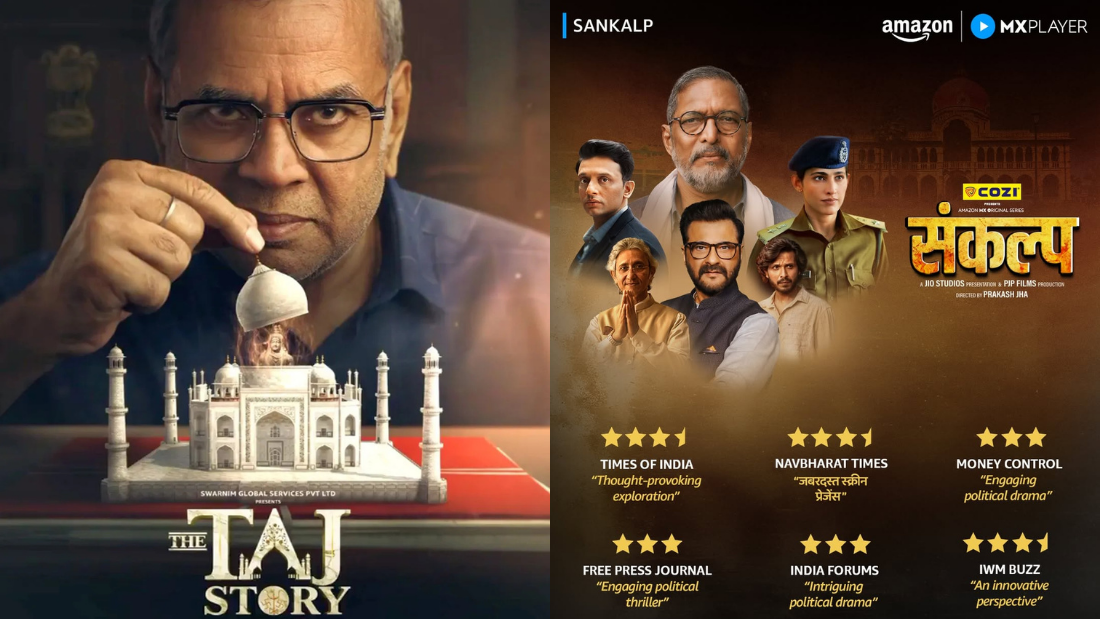
Paresh Rawal’s new courtroom drama on Lionsgate Play, The Taj Story, has become the most intensely debated and critiqued title of the week. While Rawal’s central performance is universally praised for its gravitas, the film itself is being blasted by critics who have dubbed it the “Eighth Wonder of Gaslighting.” > “Cinema is meant to be an instrument of inquiry, not a blunt tool for historical revisionism.”
The core of the backlash lies in the film’s writing, which actively weaponises “Viral Social Media Logic” and presents it as legitimate legal and historical evidence. It has sparked a fierce, necessary debate regarding the responsibility of filmmakers. Are we now living in an era where complex historical truths are flattened into Twitter-friendly rhetoric to win arguments on screen? Audiences are pushing back against narratives that prioritise algorithmic outrage over genuine intellectual inquiry.
Made in Korea: The Death of Originality
On the other end of the critique spectrum is Made in Korea, a Tamil-Korean crossover on Netflix that is currently being panned as a “Seoul-less Drama.” On paper, merging two of the world’s most passionate entertainment consumer bases seems like a foolproof strategy. In practice, the audience has rejected it as a perfunctory, synthetic product. Critics argue that the show feels less like a genuine cross-cultural artistic endeavour and more like a Frankenstein’s monster designed in a boardroom by Netflix’s predictive algorithms. It has triggered a larger discourse on the “Death of Originality” in the streaming era, proving that while algorithms can predict what tropes audiences like, they cannot artificially synthesise a soul.
3. Social Topic: “The Chanakya Complex”
If there is one thread tying the zeitgeist of 2026 together, it is our collective obsession with the puppet-master archetype.
Sankalp and the Manipulative Mentor
Nana Patekar’s highly anticipated OTT debut in Amazon MX Player’s Sankalp- playing a ruthless, brilliant political strategist has triggered a massive social conversation around the concept of the “Manipulative Mentor.” Between the political manoeuvrings in Sankalp, the bureaucratic chess of Aspirants S3, and the educational warfare in Hello Bachhon, 2026 is entirely captivated by what cultural commentators are calling “The Chanakya Complex.”
This cultural obsession highlights a stark shift in the social discourse:
• The Loss of Faith in Meritocracy: Have we lost faith in the concept of self-made success?
• The Need for a Puppet-Master: There is a growing, cynical belief among modern audiences that hard work is no longer enough; you can only win if you have a brilliant, morally flexible strategist pulling the strings behind the scenes.
The Ultimate Takeaway
We are witnessing a definitive evolution in storytelling. We have moved from idolising “Action Heroes” who break the rules with their fists to revering “Administrative Strategists” who rewrite the rules with their minds. The audience no longer wants to see the system physically destroyed; they want to see it outsmarted, manipulated, and ultimately, exposed for exactly what it is.
[[LENS_NARRATIVE:
🎬 Today’s Morning Brief: March 16, 2026
- Trending Now
Aspirants Season 3 (Prime Video): TVF’s top-tier drama returns. The DM vs. The Mentor. A brutal look at how power changes the very people who once fought it.
One Piece Season 2 (Netflix): Luffy sets sail for the Grand Line. The ultimate “High-Adrenaline” global binge for your Monday evening wind-down.
Subedaar (Prime Video): Anil Kapoor’s “Hyper-Local Noir” remains a staple for those seeking grounded, “Old-School” heroic thrills against local mafias.
- Critical View
The Taj Story (Lionsgate Play): Paresh Rawal’s courtroom drama is sparking a “Post-Truth” civil war. Is it brave revisionism or just an “Eighth Wonder of Gaslighting”?
Made in Korea (Netflix): Critics blast it as “Seoul-less.” A fierce debate erupts over whether Indian cinema is trading its soul for global streaming metrics.
- The Social Spark
The “Manipulative Mentor”: From ‘Sankalp’ to ‘Aspirants’, why is 2026 obsessed with the “Chanakya” archetype? Are we finally losing faith in self-made merit?
The “March 19” Vacuum: With ‘Toxic’ (Yash) officially postponed to June due to Middle-East tensions, ‘Dhurandhar 2’ (Ranveer Singh) now owns the biggest IMAX window of the year. The “Leviathan Clash” has become a solo coronation. ]]
Related Greybrainer Reads
GREYBRAINER
AI-Powered Cinematic Intelligence